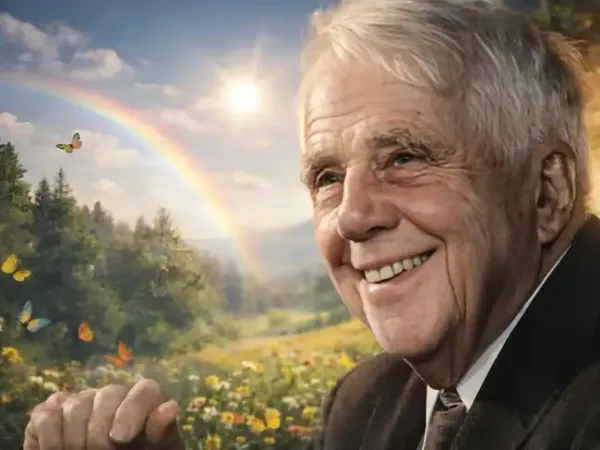
Robert Frost stands as one of the most celebrated figures in American literature, renowned for blending sharp wisdom with deeply thoughtful poetry. His work frequently drew inspiration from everyday countryside life, using ordinary landscapes to explore universal themes and human experiences. This distinctive style allowed his poetry to feel both accessible and intellectually powerful. Throughout his career, Frost received extraordinary acclaim for his literary achievements, winning several Pulitzer Prizes and securing a lasting place in poetic history. His verses, praised for their simplicity, emotional richness, and timeless relevance, remain widely read, analysed, and appreciated by audiences around the globe.
One of the famous writings of Robert Frost is the opening and closing lines of his poem, ‘Fire and Ice,’ first published in Harper's Magazine in 1920 and later in his Pulitzer Prize-winning collection, New Hampshire. It goes like this, ‘Some say the world will end in fire, some say in ice. I hold with those who favor fire. But if it had to perish twice, ice is also great and would suffice.’
Robert Frost explores how intense human emotions and secret desires can become deeply destructive forces. He suggests that powerful impulses such as greed, anger, or obsession often have the capacity to consume individuals and societies from within. In the real world, this can be seen in conflicts driven by ambition, personal relationships damaged by uncontrolled emotions, or environmental harm caused by the relentless pursuit of power. Frost’s insight serves as a warning that when passion is left without restraint, it can lead to irreversible consequences. His words reflect how internal forces can often pose greater threats than external dangers.
Robert Frost also presents emotional coldness and detachment as equally capable of causing harm. While intense passions may destroy dramatically, apathy, hatred, or lack of compassion can erode humanity more slowly yet just as effectively. In modern life, this can appear through broken relationships, social division, or societies that ignore suffering. Emotional distance may not seem immediately destructive, but over time it weakens connection and understanding. Frost’s perspective highlights that both overwhelming intensity and complete emotional withdrawal can be dangerous. His message remains relevant by reminding people that balance, empathy, and self-awareness are essential for preserving both personal and collective well-being.
Robert Frost was born on March 26, 1874, in San Francisco, California. His childhood was shaped by hardship after the death of his father, which led his mother to move the family across the country to Lawrence, Massachusetts. This transition proved significant, as it was during these formative years that Frost’s passion for language, books, and creative expression began to flourish. Though he enrolled for short periods at both Dartmouth and Harvard, he ultimately left without completing higher education.
In 1895, Robert Frost married Elinor White, his lifelong partner, whose influence would become deeply woven into his personal life and literary voice. Before gaining recognition, he balanced various professions, from teaching to farming, while persistently nurturing his poetic ambitions. A major shift in his journey occurred in 1912 when he relocated to England with his wife and children. This move introduced him to influential literary circles, including figures like Ezra Pound.
During his time abroad, Robert Frost released his first major poetry collections, A Boy’s Will and North of Boston, both of which laid the groundwork for his literary breakthrough. After returning to America in 1915, his reputation expanded rapidly. Some of Frost’s major works include The Road Not Taken, Stopping by Woods on a Snowy Evening, Mending Wall, Birches, Home Burial, Nothing Gold Can Stay, Acquainted with the Night, Desert Places and Fire and Ice.
Robert Frost also achieved the rare honour of performing at President John F. Kennedy’s inauguration. His masterful portrayal of rural New England life, combined with profound reflections on human nature, secured his place as a lasting icon in world literature. Frost died on January 29, 1963, at the age of 88 in Boston, Massachusetts, due to complications following prostate surgery. He was later buried in the Old Bennington Cemetery in Bennington, Vermont.
One of the famous writings of Robert Frost is the opening and closing lines of his poem, ‘Fire and Ice,’ first published in Harper's Magazine in 1920 and later in his Pulitzer Prize-winning collection, New Hampshire. It goes like this, ‘Some say the world will end in fire, some say in ice. I hold with those who favor fire. But if it had to perish twice, ice is also great and would suffice.’
Quote of the day by Robert Frost: Destruction through passion
Robert Frost explores how intense human emotions and secret desires can become deeply destructive forces. He suggests that powerful impulses such as greed, anger, or obsession often have the capacity to consume individuals and societies from within. In the real world, this can be seen in conflicts driven by ambition, personal relationships damaged by uncontrolled emotions, or environmental harm caused by the relentless pursuit of power. Frost’s insight serves as a warning that when passion is left without restraint, it can lead to irreversible consequences. His words reflect how internal forces can often pose greater threats than external dangers.
Robert Frost quote of the day: Quiet danger of indifference
Robert Frost also presents emotional coldness and detachment as equally capable of causing harm. While intense passions may destroy dramatically, apathy, hatred, or lack of compassion can erode humanity more slowly yet just as effectively. In modern life, this can appear through broken relationships, social division, or societies that ignore suffering. Emotional distance may not seem immediately destructive, but over time it weakens connection and understanding. Frost’s perspective highlights that both overwhelming intensity and complete emotional withdrawal can be dangerous. His message remains relevant by reminding people that balance, empathy, and self-awareness are essential for preserving both personal and collective well-being.
More about Robert Frost
Robert Frost was born on March 26, 1874, in San Francisco, California. His childhood was shaped by hardship after the death of his father, which led his mother to move the family across the country to Lawrence, Massachusetts. This transition proved significant, as it was during these formative years that Frost’s passion for language, books, and creative expression began to flourish. Though he enrolled for short periods at both Dartmouth and Harvard, he ultimately left without completing higher education.
In 1895, Robert Frost married Elinor White, his lifelong partner, whose influence would become deeply woven into his personal life and literary voice. Before gaining recognition, he balanced various professions, from teaching to farming, while persistently nurturing his poetic ambitions. A major shift in his journey occurred in 1912 when he relocated to England with his wife and children. This move introduced him to influential literary circles, including figures like Ezra Pound.
During his time abroad, Robert Frost released his first major poetry collections, A Boy’s Will and North of Boston, both of which laid the groundwork for his literary breakthrough. After returning to America in 1915, his reputation expanded rapidly. Some of Frost’s major works include The Road Not Taken, Stopping by Woods on a Snowy Evening, Mending Wall, Birches, Home Burial, Nothing Gold Can Stay, Acquainted with the Night, Desert Places and Fire and Ice.
Robert Frost also achieved the rare honour of performing at President John F. Kennedy’s inauguration. His masterful portrayal of rural New England life, combined with profound reflections on human nature, secured his place as a lasting icon in world literature. Frost died on January 29, 1963, at the age of 88 in Boston, Massachusetts, due to complications following prostate surgery. He was later buried in the Old Bennington Cemetery in Bennington, Vermont.