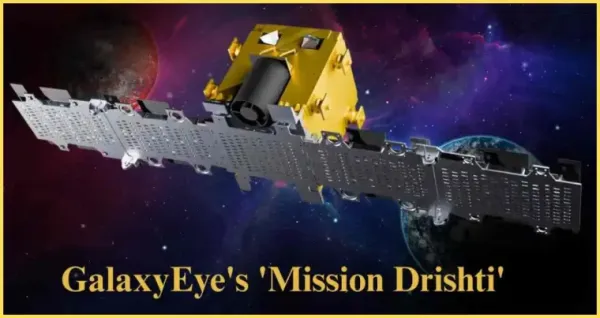
Another important achievement is going to be added to India’s space sector. Bengaluru-based private space startup Galaxy Eye Space is set to launch its new satellite mission “Drishti” on May 3, 2026.
New Delhi: India is once again going to take a big step in the field of space technology. Bengaluru-based private space startup Galaxy Eye Space is going to launch its state-of-the-art satellite mission ‘Drishti’ on 3 May 2026. This mission reflects India’s growing space technology capability globally and is considered a significant achievement in the private space industry.
This satellite will be sent into space through the Falcon 9 rocket of America’s space technology company SpaceX. It is one of the most advanced and massive satellite projects ever developed by the private sector in India.
Specialty of ‘Drishti’ satellite
The ‘Drishti’ mission has been designed as a new generation Earth observation technology. Its weight is approximately 190 kg, making it among the largest satellites in the Indian private space sector. The biggest feature of this satellite is that it is based on “OptoSAR” technology. This technology combines two separate systems—optical imaging and radar (SAR) technology—together.
Optical technology gives clear and colorful photos, but becomes limited in cloud and darkness. Radar technology can work in any weather and even at night, but its images are relatively less clear. ‘Drishti’ combines these two technologies to create a system that can provide high quality imaging in all weather conditions and at all times.
All-weather monitoring capability
Through this technology, clouds, rain or darkness will no longer become a hindrance in monitoring the Earth. This satellite can track ground movements under any circumstances. It has a resolution of up to 1.8 meters, which means it can capture even the smallest changes. Be it the condition of crops in a field, construction going on in the city or activities in the border areas – this satellite will be able to keep an eye on everything.
Strategic importance for India
This mission is considered important for India at many levels. Its usefulness is not only technical but also strategic and economic.
- Agriculture Sector: Monitoring of crops, assessment of damage due to drought or flood.
- Disaster Management: Real-time data in situations like floods, landslides and cyclones
- Urban development: monitoring construction and land use in rapidly growing cities.
- National Security: Better monitoring of activities in border areas
- Environmental monitoring: study of changes in forests, rivers and natural resources
This technology can further strengthen India’s decision-making capacity in all these areas.
India’s growing strength in private space sector
India’s private space sector has grown rapidly in the last few years. Through this mission, it is a clear indication that India is not limited to only government agencies, but private companies are also becoming able to compete at the global level. This move further strengthens India in the list of countries that are developing advanced Earth Observation technology.
Now the demand for satellite based data is increasing rapidly across the world. Its role has become important in areas like agriculture, defence, infrastructure and climate monitoring. In such a situation, missions like ‘Drishti’ can establish India as a strong player in the global space economy.
-
Kosovo to hold snap elections in June

-
Bail denied to accused in PFI anti-national activities case

-
Live-in relationship: 34-year-old woman dies by suicide in Bengaluru

-
Dubai honours bus driver who helped blind man safely cross road

-
Gwen Farrell dead: M*A*S*H icon dies as family issue emotional tribute to 'guiding light'