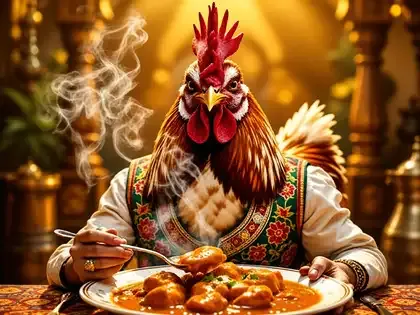
Shane Jones, New Zealand's minister for oceans and fisheries, is in troubled waters, having bitten off more than he can chew after his remark that the recently signed FTA between his country and India could bring migrants and a 'tsunami of butter chicken'.
His utterly butterly tsunami reference has created a toofan in the local desi kadai, and invited a barrage of ballyhoo, with an Indian-origin member of NZ parliament denouncing it as 'outright racism,' and a spokesperson for the community, describing it as 'incredibly worrying'.
Considering that New Zealand has a population of 5.35 mn people and an ovine population of over 23 mn - the preponderance of the woolly creature in relation to humans making sheep-shearing contests a major divertissement, which might invite conjecture as to what or whom is being fleeced, the quadruped or the cash-paying spectator viewing the spectacle - the country's entrenched bucolicism could well do with a dash of spice, in the form of butter chicken, or anything else to liven things up a bit.
However, literary purists might take issue with the minister's term 'tsunami' - from the Japanese word for 'harbour wave' - in the context of a supposed incursion of butter chicken. They may suggest that 'oil spill' would have been more appropriate, considering the explicitly oleaginous nature of the dish in question, while also being in consonance with the minister's maritime portfolio.
Wokeists might evoke the spectre of 'foodism'. Whereby the supposed preference for a particular dietary item is pejoratively employed to stereotype nationalities, like the anglophone epithet of 'frogs' used to belittle the French, whose haute cuisine includes the nether limbs of the amphibian. Or the other dated British term 'krauts' to denote the Teutonic nation's allegiance to the pickled cabbage preparation called sauerkraut.
Moreover, the carnivorous implication of the term used by the minister could well offend the sensibilities of shudh shakaharis, who might protest that a more palatable trope would have been a tsunami of pav bhaji, or possibly one of veg manchurian.
Political incorrectness aside, Jones could find himself entangled in legal proceedings being heard before Delhi High Court since 2024. The litigants are owners of two well-known restaurant chains in the Indian capital - Moti Mahal and Daryaganj. The wishbone of contention is the origin of butter chicken, and who invented it.
The 2,752-page lawsuit has been filed by Moti Mahal against Daryaganj. The current owner of Moti Mahal has claimed that it was his grandfather, Kundan Lal Gujral, who in pre-Partition Peshawar created the iconic dish by smothering leftover chicken in a creamy tomato-based sauce. In 1947, Gujral came to Delhi and set up the first Moti Mahal, which over decades has boasted serving distinguished patrons, such as Jawaharlal Nehru and Jackie Kennedy.
To help handle the growing business, which necessitated opening of branches, Gujral brought in his cousin, Kundan Lal Jaggi, as a partner, sowing the seeds of future comestible conflict. In 2019, Jaggi's successors opened their own restaurant, Daryaganj, in Delhi, and advertised it as being the legacy of the inventor of butter chicken, Kundan Lal Jaggi, grandfather of the current owner, who claims that his forebears devised the recipe in much the same way as claimed by descendants of the other Kundan Lal.
The 'Kundan Lal v Kundan Lal' clash involves a ₹2 cr claim by way of damages for infringement of culinary copyright by Moti Mahal against Daryaganj.
The ongoing case might cause either party - or both parties - to demand that the Kiwi minister, who has added fuel to the butter chicken fire, be made to clarify, in writing, if need be, which variant of the dish he has prophesied a tsunami of: Moti Mahal or Daryaganj.
Having curried disfavour with the Indian community for his obiter dictum regarding what has now become a matter of much more than chicken feed, the Kiwi mantri might find himself in a legal pickle, having unwittingly made himself a murga.
His utterly butterly tsunami reference has created a toofan in the local desi kadai, and invited a barrage of ballyhoo, with an Indian-origin member of NZ parliament denouncing it as 'outright racism,' and a spokesperson for the community, describing it as 'incredibly worrying'.
Considering that New Zealand has a population of 5.35 mn people and an ovine population of over 23 mn - the preponderance of the woolly creature in relation to humans making sheep-shearing contests a major divertissement, which might invite conjecture as to what or whom is being fleeced, the quadruped or the cash-paying spectator viewing the spectacle - the country's entrenched bucolicism could well do with a dash of spice, in the form of butter chicken, or anything else to liven things up a bit.
However, literary purists might take issue with the minister's term 'tsunami' - from the Japanese word for 'harbour wave' - in the context of a supposed incursion of butter chicken. They may suggest that 'oil spill' would have been more appropriate, considering the explicitly oleaginous nature of the dish in question, while also being in consonance with the minister's maritime portfolio.
Wokeists might evoke the spectre of 'foodism'. Whereby the supposed preference for a particular dietary item is pejoratively employed to stereotype nationalities, like the anglophone epithet of 'frogs' used to belittle the French, whose haute cuisine includes the nether limbs of the amphibian. Or the other dated British term 'krauts' to denote the Teutonic nation's allegiance to the pickled cabbage preparation called sauerkraut.
Moreover, the carnivorous implication of the term used by the minister could well offend the sensibilities of shudh shakaharis, who might protest that a more palatable trope would have been a tsunami of pav bhaji, or possibly one of veg manchurian.
Political incorrectness aside, Jones could find himself entangled in legal proceedings being heard before Delhi High Court since 2024. The litigants are owners of two well-known restaurant chains in the Indian capital - Moti Mahal and Daryaganj. The wishbone of contention is the origin of butter chicken, and who invented it.
The 2,752-page lawsuit has been filed by Moti Mahal against Daryaganj. The current owner of Moti Mahal has claimed that it was his grandfather, Kundan Lal Gujral, who in pre-Partition Peshawar created the iconic dish by smothering leftover chicken in a creamy tomato-based sauce. In 1947, Gujral came to Delhi and set up the first Moti Mahal, which over decades has boasted serving distinguished patrons, such as Jawaharlal Nehru and Jackie Kennedy.
To help handle the growing business, which necessitated opening of branches, Gujral brought in his cousin, Kundan Lal Jaggi, as a partner, sowing the seeds of future comestible conflict. In 2019, Jaggi's successors opened their own restaurant, Daryaganj, in Delhi, and advertised it as being the legacy of the inventor of butter chicken, Kundan Lal Jaggi, grandfather of the current owner, who claims that his forebears devised the recipe in much the same way as claimed by descendants of the other Kundan Lal.
The 'Kundan Lal v Kundan Lal' clash involves a ₹2 cr claim by way of damages for infringement of culinary copyright by Moti Mahal against Daryaganj.
The ongoing case might cause either party - or both parties - to demand that the Kiwi minister, who has added fuel to the butter chicken fire, be made to clarify, in writing, if need be, which variant of the dish he has prophesied a tsunami of: Moti Mahal or Daryaganj.
Having curried disfavour with the Indian community for his obiter dictum regarding what has now become a matter of much more than chicken feed, the Kiwi mantri might find himself in a legal pickle, having unwittingly made himself a murga.
(Disclaimer: The opinions expressed in this column are that of the writer. The facts and opinions expressed here do not reflect the views of www.economictimes.com.)




Jug Suraiya
A prominent Indian journalist, author and columnist.