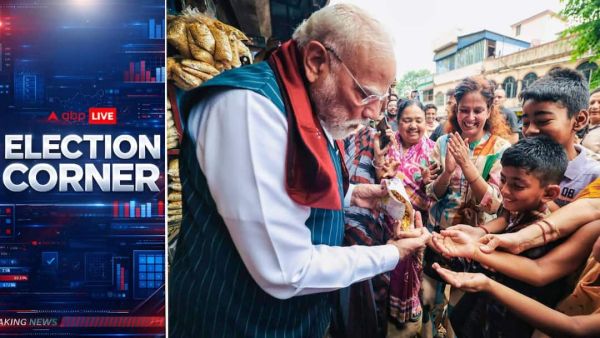
Elections 2026: The 2026 Assembly verdicts have delivered a political reset that feels less like a routine election cycle and more like a structural shift. The Bharatiya Janata Party has finally cracked West Bengal, long seen as the last major eastern fortress of Opposition politics, while in Tamil Nadu, Joseph Vijay has emerged as a disruptive force strong enough to challenge a political duopoly that has defined the state for decades.
Bengal Breakthrough Feels Like More Than A Win, It’s A Strategic Milestone
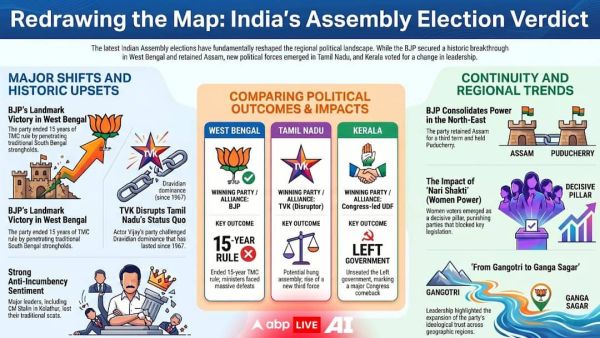
The BJP’s victory over Trinamool Congress and Mamata Banerjee is not just electoral, it is symbolic. Bengal was the final major eastern frontier after Odisha. With this result, the party’s footprint now stretches seamlessly across north, west, and east India, tightening its grip on national politics.
The scale of the win signals a deep voter shift rather than a marginal swing. The BJP didn’t just rely on traditional strongholds like North Bengal but broke into urban and semi-urban belts of South Bengal, including Kolkata. That breadth suggests a coalition of voters cutting across class and geography.
Prime Minister Narendra Modi framed it as a turning point, calling it “historic” and stating, “a new chapter has begun in Bengal’s future. It has become ‘bhay-mukt’ (free of fear).” He added, “Last year on November 14, when the Bihar results came, from the same venue of the BJP headquarters, I told all of you that Gangaji flows forward towards Ganga Sagar from Bihar. Today, from Gangotri to Ganga Sagar, only the lotus blooms.”
His messaging also hinted at narrative control going forward: “There should be a change in the political habits of the state. Today when the BJP has won, not badla (retribution) but badlav (change) needs to be talked about. Not bhay (fear), bhavishya (the future) should be spoken of… Let us end this endless circle of violence.”
Tamil Nadu’s Verdict Signals Voter Fatigue With Old Power Cycles
If Bengal was about expansion, Tamil Nadu was about disruption. The rise of Vijay’s TVK has broken the predictable alternation between the Dravida Munnetra Kazhagam and AIADMK, a pattern intact since 1967.
The verdict reflects a deeper fatigue with entrenched political ecosystems. The scale of the anti-incumbency wave was visible in Chennai itself, where Chief Minister M K Stalin lost his own seat. While Udhayanidhi Stalin held ground, the broader message was unmistakable: legacy alone is no longer enough.
Vijay’s near-majority performance is historically significant. Indian politics rarely allows new entrants to scale this quickly, making this moment comparable to political disruptions seen in Andhra Pradesh in the 1980s or Assam in the mid-80s. The likelihood of a coalition or minority government also introduces a phase of negotiation politics in a state that has largely avoided it.
Kerala Relief, Assam Stability, Puducherry Continuity
Elsewhere, the mood for change played out differently. Kerala swung back to the Congress-led UDF, ending the Left’s run under Pinarayi Vijayan. For Congress, this win is less about dominance and more about survival and relevance in a rapidly shifting political landscape.
Assam, however, stood apart. The BJP not only retained power but expanded its mandate, reinforcing the Northeast as a zone of stability for the party.
In Puducherry, the NDA’s return indicates that regional alliances backed by national leadership continue to hold ground where governance continuity is valued.
Modi also underlined a gender dimension to the results: “Nari Shakti is another pillar of Viksit Bharat. But the Congress tried to stop it… These parties did not let the Nari Shakti Adhiniyam pass in Parliament. I had cautioned such parties they will have to face the ire of women. Today, the Congress party, TMC and DMK have been punished by the women of this country.”
The Big Picture: A Fragmented Opposition, A Consolidating BJP
Put together, these results underline two parallel trends. One, the BJP is no longer just expanding, it is consolidating across geographies that once seemed politically incompatible. Two, voters are increasingly willing to disrupt entrenched systems, whether that means voting out long-standing incumbents or backing entirely new players.
As BJP president Nitin Nabin put it, “From Gangotri to Ganga Sagar, the BJP-led NDA government is being formed. This isn’t just a geographical expansion; it’s an expansion of trust and our ideology.”
For the Opposition, the message is sharper than ever. This wasn’t just a loss of seats. It was a loss of narrative control in key battlegrounds.
-
Registration Opens for CTET September 2026: Key Changes and Important Dates
-
Man Utd consider Federico Valverde transfer bid with Real Madrid chiefs furious

-
Anticipation Grows for CBSE Class 12 Result 2026 Release

-
18 places you must never park your car according to Highway Code

-
Football: Spain coach backs Nico Williams to recover in time for 2026 World Cup