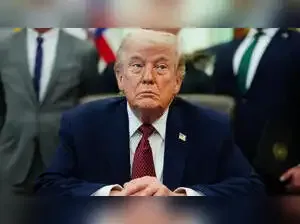
US President Donald Trump on Wednesday warned Iran that if it agrees to the terms being negotiated, Operation Epic Fury, the US military's name for its offensive campaign against Tehran, will be "at an end," and the naval blockade on Iranian ports will allow the Strait of Hormuz to remain open to all, including Iran. If Tehran refuses, Trump said, bombing would resume "at a much higher level and intensity than it was before."
Also Read: Resilient, not shock-free: India charts path through war jitters
"Assuming Iran agrees to give what has been agreed to, which is, perhaps, a big assumption, the already legendary Epic Fury will be at an end, and the highly effective Blockade will allow the Hormuz Strait to be OPEN TO ALL, including Iran. If they don't agree, the bombing starts, and it will be, sadly, at a much higher level and intensity than it was before," Trump wrote on Truth Social.
The statement came a day after Secretary of State Marco Rubio confirmed at a White House press conference that Operation Epic Fury had concluded, with Rubio saying the US had "achieved the objectives of that operation" and was not seeking further escalation.
Trump also announced a pause on "Project Freedom" , the US naval operation to guide stranded commercial vessels through the Strait of Hormuz, citing significant progress in peace negotiations, at the request of Pakistan and other countries. The naval blockade on Iranian ports, however, is to remain fully in effect.
The Strait of Hormuz, through which roughly one-fifth of the world's energy supplies normally pass, has been effectively sealed by Iran since the US and Israel launched their military campaign against the country on February 28.
Iran's latest 14-point proposal envisions ending the war and resolving the shipping standoff first, while leaving talks on Iran's nuclear programme for a later stage, an approach at odds with Washington's repeated demand that Iran accept stringent restrictions on its nuclear programme before the conflict can end.
Also Read: RBI MPC: India's central bank sounds alarm with five risks as Iran war threatens domestic stability
Trump on Sunday rejected that proposal, calling it "not acceptable," and said Iran had yet to pay "a big enough price."
Oil prices retreated on the latest developments but remained well above $100 a barrel, while average gasoline prices in the US climbed slightly to $4.48 a gallon.
Talks between the two sides have been mediated by Pakistan. Iranian Foreign Minister Abbas Araghchi said that "events in Hormuz make clear that there's no military solution to a political crisis" and called on the US to be "wary of being dragged back into quagmire by ill-wishers."
Also Read: Resilient, not shock-free: India charts path through war jitters
"Assuming Iran agrees to give what has been agreed to, which is, perhaps, a big assumption, the already legendary Epic Fury will be at an end, and the highly effective Blockade will allow the Hormuz Strait to be OPEN TO ALL, including Iran. If they don't agree, the bombing starts, and it will be, sadly, at a much higher level and intensity than it was before," Trump wrote on Truth Social.
The statement came a day after Secretary of State Marco Rubio confirmed at a White House press conference that Operation Epic Fury had concluded, with Rubio saying the US had "achieved the objectives of that operation" and was not seeking further escalation.
Trump also announced a pause on "Project Freedom" , the US naval operation to guide stranded commercial vessels through the Strait of Hormuz, citing significant progress in peace negotiations, at the request of Pakistan and other countries. The naval blockade on Iranian ports, however, is to remain fully in effect.
The Strait of Hormuz, through which roughly one-fifth of the world's energy supplies normally pass, has been effectively sealed by Iran since the US and Israel launched their military campaign against the country on February 28.
Iran's latest 14-point proposal envisions ending the war and resolving the shipping standoff first, while leaving talks on Iran's nuclear programme for a later stage, an approach at odds with Washington's repeated demand that Iran accept stringent restrictions on its nuclear programme before the conflict can end.
Also Read: RBI MPC: India's central bank sounds alarm with five risks as Iran war threatens domestic stability
Trump on Sunday rejected that proposal, calling it "not acceptable," and said Iran had yet to pay "a big enough price."
Oil prices retreated on the latest developments but remained well above $100 a barrel, while average gasoline prices in the US climbed slightly to $4.48 a gallon.
Talks between the two sides have been mediated by Pakistan. Iranian Foreign Minister Abbas Araghchi said that "events in Hormuz make clear that there's no military solution to a political crisis" and called on the US to be "wary of being dragged back into quagmire by ill-wishers."