
In a significant development for India’s startup and insolvency ecosystem, the Supreme Court of India has upheld the inclusion of US-based lenders represented by Glas Trust in the Committee of Creditors (CoC) of Think and Learn Private Limited, the parent company of Byju’s.
The ruling dismisses a plea filed by Byju’s founder Byju Raveendranwho had challenged the participation of these lenders. With this decision, the apex court has effectively drawn a line under a prolonged legal tussle over who gets a seat at the table in one of India’s most closely watched insolvency cases.
Credits: Economic Times Legal
A Dispute Rooted in Insolvency Proceedings
The controversy originates from the corporate insolvency resolution process initiated against Think and Learn under the Insolvency and Bankruptcy Code (IBC). As part of this process, the Committee of Creditors plays a central role in determining the company’s future—whether through restructuring, sale, or liquidation.
At the heart of the dispute was the status of a group of US lenders, represented by Glas Trust, and whether they should be part of the CoC. Their inclusion carries significant weight, as voting power within the committee directly influences key decisions regarding the company’s fate.
IRP’s Decision Sparks Legal Battle
The issue escalated when the interim resolution professional (IRP) removed Glas Trust and the associated US lenders from the CoC. This move triggered immediate legal challenges, with the lenders approaching the National Company Law Tribunal (NCLT).
The lenders argued that their exclusion was unjustified and undermined their rights as financial creditors. Given the high stakes involved, the case quickly became a test of how creditor rights are interpreted under India’s evolving insolvency framework.
NCLT and NCLAT Reinstate Lenders
Earlier this year, the NCLT ruled in favor of the US lenders, overturning the IRP’s decision and reinstating them into the CoC. This marked the first major legal victory for Glas Trust and its constituents.
The ruling was subsequently upheld by the National Company Law Appellate Tribunal (NCLAT), which reinforced the idea that the CoC is a statutory body under the IBC. Importantly, the appellate tribunal also clarified that the CoC has the authority to initiate legal proceedings in its own name—further strengthening its institutional standing.
Supreme Court Ends Prolonged Litigation
With the matter reaching the Supreme Court, expectations were high for a definitive resolution. The apex court, however, chose not to disturb the findings of the lower tribunals.
Observing that the issue had already undergone extensive litigation, the court found no compelling reason to interfere with the NCLAT’s order. By dismissing Byju Raveendran’s plea, it effectively affirmed the inclusion of Glas Trust and the US lenders in the CoC.
This decision brings much-needed clarity and finality to the dispute over the committee’s composition.
What This Means for Byju’s and the IBC Framework
The ruling has immediate implications for the ongoing insolvency process of Think and Learn. With the US lenders now firmly part of the CoC, the balance of power within the committee could shift, potentially influencing key decisions on resolution strategies.
More broadly, the judgment reinforces the robustness of the IBC framework by upholding creditor rights and institutional processes. It sends a clear signal that decisions made by adjudicating authorities like the NCLT and NCLAT will not be easily overturned without strong grounds.
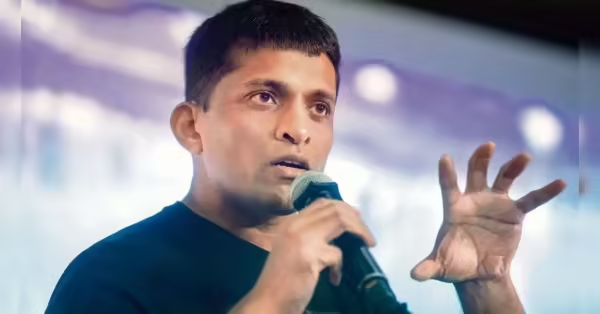
Credits: Economic Times Legal
A Governance Test Ahead
While the legal battle over CoC composition may have reached its conclusion, the larger challenge lies ahead. The insolvency process itself will test governance standards, creditor coordination, and the viability of revival plans for Byju’s.
With multiple stakeholders now firmly in place, the focus shifts from courtroom battles to boardroom negotiations—where the real outcome of this high-stakes insolvency case will ultimately be decided.
For India’s startup ecosystem, the case serves as a reminder: rapid growth must be matched with financial discipline and governance, or the consequences can be swift—and very public.
-
Shukra Gochar 2026: Impact on Zodiac Signs

-
Daily Horoscope - May 07, 2026 (For All Zodiac Signs Today)

-
Today's Daily Horoscope For All 12 Zodiac Signs – May 7, 2026

-
Surat SBI robbery cracked; two UP men held, Bihar mastermind identified

-
Health Crisis Aboard Luxury Expedition Ship Sparks Political Tensions in Spain