
One of the best advancements in automotive technology over the last half-century, especially in the summertime, is the widespread implementation of air conditioning across nearly every model available today. When a vehicle’s air conditioner is working as it should it keeps the car’s interior, and its occupants, relatively comfortable at nearly any external temperature, except for the most extreme cases.
However, when your car’s air conditioner starts to feel weak, summer driving can turn from arriving at your destination as fresh as you were when the trip started, to looking like a sweat-stained mess. There are a number of reasons why your car’s air conditioner isn’t blowing cold air like it normally should. A few are easy DIY projects, and others will require a trip to a professional auto repair shop.
One common reason behind a reduction in the cold air coming from your car’s air conditioner vents is a dirty cabin air filter. This is the first thing you should check since it’s easy to do, usually doesn’t require any tools, and it’s relatively inexpensive to replace if required or you can simply put it back if it’s not dirty.
How to check your car’s cabin air filter
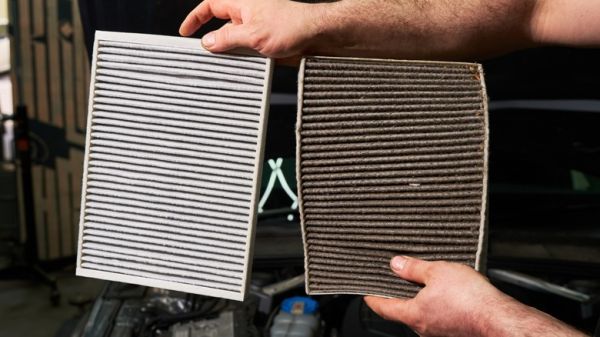
Keep in mind that cabin air filters and engine air filters are different. It’s also important to keep your engine air filter changed, or cleaned in some cases, to keep your car’s engine running efficiently. But only the cabin filter will affect your A/C.
The process of checking your car’s cabin air filter involves removing the filter from its location in the climate control system’s airflow path. It’s situated in the air stream to filter out any dust or other airborne particles that would otherwise be circulated into the air inside the vehicle whenever the climate control system is operating.
The exact location of your car’s cabin air filter depends on its make, model, and year. The easiest way to find it is by consulting your vehicle’s owner manual. The cabin air filter housing is usually easily accessible and held closed with plastic clips or other simple closure. It could be on the outside of the car near the bottom of the windshield or inside the car either behind the glove box or under the dash. Once the housing is located and opened the filter element will slide out revealing an accordion-like paper structure with a square or rectangle shape around an inch tall or less.
Inspect both sides of the filter for trapped dirt and debris and look in the housing for signs of dirt. It’s a good idea to vacuum the dirt from the housing before replacing the filter. In a pinch, to test if it makes a difference, vacuum the filter or blow it clean with compressed air to see if airflow from the vents improves.
Other reasons your car’s air conditioner may feel weak

If your air conditioner is blowing a normal amount of air through the vents but it’s not cold enough to keep you comfortable, the system is likely low on refrigerant. You can recharge your car’s air conditioner at home with a simple kit, but often the underlying cause for low refrigerant is a leaking hose or other component. Unless you have the specialized tools, skills, and/or certifications, you’ll need a professional to do this repair.
If the cabin air filter is clean but there is little to no air coming from the vents, it could indicate an issue with the system’s fan. If you turn on the blower and nothing happens you may have a blown fuse, bad relay, malfunctioning blower motor resistor, or failed fan motor. If you hear rattling, especially rattling that increases and decreases when switching to different fan speeds, the blower assembly may have become loose from the fan motor.
To find the right fuse or relay for your fan, check your owner’s manual. If either is bad, replace it with the same type and rating. The blower motor resistor controls fan speed by delivering varying voltages to the fan. With the fan control switch on high it should deliver around 12-volts when tested with a multimeter (a handy tool to have when working on your car). If not, it should be replaced. Replacing the fan motor assembly is a little more complicated, but depending on its location within your car it is often a straightforward DIY project.