Reserve Bank of India
Mumbai: Large banks have sent feelers to the regulator to rethink the blanket rule on their uncovered foreign currency exposure. As rupee came under attack, the Reserve Bank of India (RBI) had imposed a $100 million uniform limit on all banks' net open position (NOP), which is the difference between a bank's foreign currency assets and liabilities at the end of each business day.
In recent interactions with RBI, officials of big state-owned and private sector banks have suggested a dynamic regulation on the unhedged forex exposure, by linking an institution's NOP to its size and flows, two bankers told ET.
"It makes little sense to fix one NOP for all. It's a temporary measure to handle turbulence," said an industry official. "But if RBI chooses to review the rule, it could be once volatility subsides. It would mean suggesting a formula for NOP."
Also Read: Gold loans power Small Finance Banks' growth as microfinance asset quality weakens
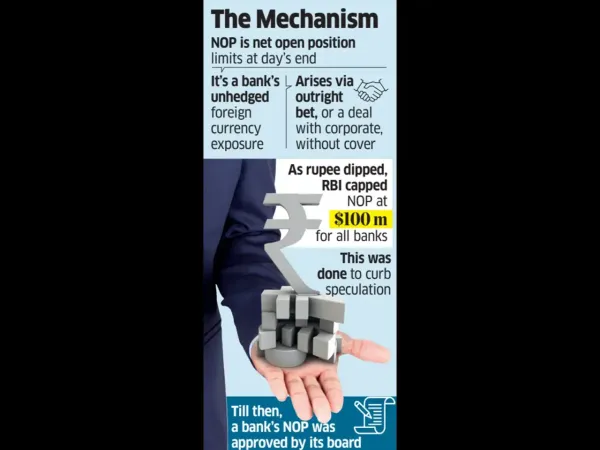 A decade ago, NOP was tied to a bank's capital. Subsequently, bank boards were allowed to approve it.
Capping NOP limit, along with restricting dollar/rupee trades in the offshore market and banning cancellation and rebooking of derivative contracts, were hurriedly taken measures to curb speculation against the rupee. Amid criticism that these could be construed as retrograde steps, most restrictions were relaxed, though the $100 million NOP limit continues.
Significantly, the NOP limit relates to onshore trades, and was done to kill arbitrage trades between the Indian market and the offshore - or non-deliverable forward (NDF) - markets of Singapore, London and Hong Kong.
Also Read: RBI imposes penalties on YES Bank, Hinduja Housing Finance
The NOP limit arises primarily in two ways - when a bank takes an outright bet; and when it cuts a deal with a corporate and refrains from doing a back-to-back trade to cover the position. Say, when an exporter sells dollars forward, the bank usually does a reverse trade with another bank to cover.
Positions Unwound
This hedge can be either in the onshore or NDF market. But, with the $100 million limit, banks couldn't consider offshore hedging trades to calculate NOP. A bank which bought $10 million forward in India and sold $10 million forward on NDF, could not treat them as offsetting trades for NOP.
So, the $10 million onshore trade added to NOP. Only if the bank had hedged (that is, sold dollar forward) onshore, there would have been no addition to NOP.
As offshore trades were disregarded for NOP, banks had to unwind offshore positions in April, and book mark-to-market losses on NDF positions as on March 31. Around April 20, lobby group Indian Banks' Association sought its members' views before requesting RBI for a "one-time dispensation of amortisation of losses" following the NOP limit.
"IBA acted at the behest of a large PSU bank, and a few bank chiefs and their secretariats were cc'ed in the email. But RBI is yet to react, probably because small banks were unaffected and large banks had the power to absorb the losses," said another person.
In recent interactions with RBI, officials of big state-owned and private sector banks have suggested a dynamic regulation on the unhedged forex exposure, by linking an institution's NOP to its size and flows, two bankers told ET.
"It makes little sense to fix one NOP for all. It's a temporary measure to handle turbulence," said an industry official. "But if RBI chooses to review the rule, it could be once volatility subsides. It would mean suggesting a formula for NOP."
Also Read: Gold loans power Small Finance Banks' growth as microfinance asset quality weakens
Capping NOP limit, along with restricting dollar/rupee trades in the offshore market and banning cancellation and rebooking of derivative contracts, were hurriedly taken measures to curb speculation against the rupee. Amid criticism that these could be construed as retrograde steps, most restrictions were relaxed, though the $100 million NOP limit continues.
Significantly, the NOP limit relates to onshore trades, and was done to kill arbitrage trades between the Indian market and the offshore - or non-deliverable forward (NDF) - markets of Singapore, London and Hong Kong.
Also Read: RBI imposes penalties on YES Bank, Hinduja Housing Finance
The NOP limit arises primarily in two ways - when a bank takes an outright bet; and when it cuts a deal with a corporate and refrains from doing a back-to-back trade to cover the position. Say, when an exporter sells dollars forward, the bank usually does a reverse trade with another bank to cover.
Positions Unwound
This hedge can be either in the onshore or NDF market. But, with the $100 million limit, banks couldn't consider offshore hedging trades to calculate NOP. A bank which bought $10 million forward in India and sold $10 million forward on NDF, could not treat them as offsetting trades for NOP.
So, the $10 million onshore trade added to NOP. Only if the bank had hedged (that is, sold dollar forward) onshore, there would have been no addition to NOP.
As offshore trades were disregarded for NOP, banks had to unwind offshore positions in April, and book mark-to-market losses on NDF positions as on March 31. Around April 20, lobby group Indian Banks' Association sought its members' views before requesting RBI for a "one-time dispensation of amortisation of losses" following the NOP limit.
"IBA acted at the behest of a large PSU bank, and a few bank chiefs and their secretariats were cc'ed in the email. But RBI is yet to react, probably because small banks were unaffected and large banks had the power to absorb the losses," said another person.