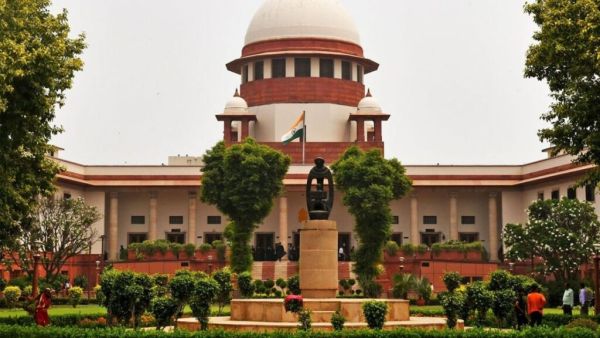
- The Supreme Court clarified that for registration of a case under the Scheduled Castes and Scheduled Tribes (Prevention of Atrocities) Act, the alleged insult or abuse must take place in a place in ‘public view’.
- The use of racial slurs inside a private residence where no outsiders are present cannot be considered as an offense under the atrocity.
- The case concerned a property dispute between two brothers, where it was alleged that caste- words had been used while breaking the lock of the house; But at the time of the incident, only the family members were present, so the court gave this verdict
Supreme Court News: The Supreme Court has ruled that if a person uses racial slurs within the four walls of a private residence and in the absence of any outsiders, it will not be considered an offense under the Scheduled Castes and Scheduled Tribes Anti-Atrocities Act, 1989 i.e. Atrocities. Justice N. V. Anjaria and Justice P. K. Mishra’s bench clarified that the alleged insult or abuse must take place in a public setting for the offense to be registered under Sections 3(1) (r) and 3(1) (s) of the SC/ST Act.
The Supreme Court said in the judgment that the incident of caste insult must appear to have taken place in a public place. Even if it is a private place, there should be a situation in which what is happening there can be seen by the public eye. Being a mere residential house, it is not a place in ‘public view’.
‘My lord, she will never be a mother’, AIIMS pleads against 15-year-old girl’s abortion; Supreme Court said
What is the matter?
According to the FIR filed by the complainant, there was a dispute over two properties as per the complaint. The accused tried to break the lock of his house, during which the complainant and his wife were allegedly insulted using caste- words. In this case, the complainant and the two accused are full brothers belonging to the Scheduled Caste category. It was also clarified that the wife of the accused does not belong to the Scheduled Caste-Tribe category. After investigation, the lower court in this case booked the accused under several IPC sections including SC ST Act. The Delhi High Court then refused to take cognizance saying that a mini-trial at this level could not be expected.
The condition of the offense is not fulfilled
It was argued in the Supreme Court on behalf of the accused that the FIR did not necessarily mention that the alleged incident took place in a place in public view. Therefore, the essential condition of the offense under the Atrocities Act is not fulfilled. While examining the FIR, the court noted that the incident took place in the vicinity of the complainant’s house. However, the court observed that there was no mention anywhere that there was public presence at that place or that ordinary people could see the incident.
Charge of criminal intimidation dismissed
The Supreme Court quashed the judgment of the lower court and the Delhi High Court and quashed the FIR and the entire charge sheet. Apart from this, the charge of criminal intimidation has also been cancelled. Courtan clarified that the investigation into the entire case did not find any solid basis for filing a case under the SC/ST Act. The two witnesses mentioned in the FIR were both friends of the complainant.
-
Do you know the richest Kapoor? Not Ranbir or Kareena

-
IPL 2026: Jasprit Bumrah becomes the new captain of Mumbai Indians, gets opportunity for the first time in 13 years

-
Asuka’s WWE Exit Shock! Real Reason Behind Sudden Departure Revealed

-
Russia Attacks Kyiv: 5 Dead, Dozens Injured | Zelenskyy Latest Update | World #Shorts
-
Amazon Summer Deal: Induction worth ₹ 8000 for just ₹ 3700, up to 52% discount on these 5! | Amazon Summer Deal Induction Cooktop Sale 52 Percent Off Bajaj Prestige Cadlec Longway