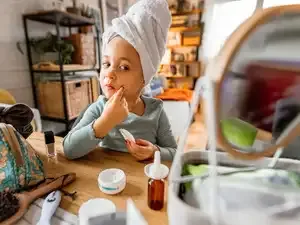
The ‘get ready with me’ social media trend, which involves posting a video of yourself getting ready while sharing personal anecdotes, has become a genre of its own today. What was once a private ritual now plays out daily on our screens. And the audience isn’t just adults any more. It is children watching, copying, and then starring in these makeup routines. ‘Kidfluencers’ like Kassie are a good example of this change – her makeup tutorials are drawing young audiences to the cosmetic industry early on, often before age 13.
“I never really introduced makeup to her; she picked it up from a kid influencer on YouTube… I do notice that she sometimes becomes conscious about how she looks,” says Jyoti Dhanuka, mother of a fouryear-old. For now, she limits its use to occasions, drawing a line between play and habit.
But that line is beginning to shift. What started as dress-up and experimentation is slowly becoming more frequent, more visible, and harder to separate from everyday behaviour. Which raises a question that sits at the heart of this emerging category: is this play, or the beginning of early social conditioning by the beauty industry?
Globally, the kids’ cosmetics market is projected to grow by nearly $969 million between2025 and 2030, according to a report by Technavio, with APAC accounting for over 32% of that growth. In India, however, the category is still in its infancy, even as global markets have seen the rise of dedicated kids’ beauty brands like Klee Naturals, Miss Nella, and Evereden.
“I think the kids’ cosmetics category is still very niche in India. There’s still a clear gap for younger kids, especially between (ages) four and seven,” says Shradha Agarwal, Global CEO of marketing agency Grapes Worldwide, who is a mother to two girls aged seven and twelve and often finds herself sourcing products from the US and UK due to the limited options available locally. She points out that while global retailers like Sephora have begun segmenting for teens, the space between baby care and adult beauty remains largely unaddressed.
That gap is precisely what new-age brands are stepping into. For founders like Kanika Singh, the category isn’t new – it was simply overlooked. “This isn’t a category brands have created. We’re responding to existing curiosity more responsibly,” she says. Her brand, Mishmash Naturals, sells Ayurvedic and personal care products to children under 13. It has grown 10x in a year, with a monthly run rate of ₹50 lakh, signalling rising parental demand for safer, age appropriate alternatives.
While interest may be natural, growth is largely driven by marketing, with discovery happening mostly through social media and videos rather than stores.
Agarwal observes that kids discover brands on YouTube, while parents encounter them on Instagram. Marketing budgets remain modest, often capped at 50–60% of product value, but the reliance on influencers is high. Parent creators, in particular, have emerged as key trust-builders.
For brands like Tuco Kids, the shift is already visible in usage patterns. “Parents are reaching for our products in the morning and evening, not just for occasions – the habit is forming,” says Chanakya Gupta, co-founder of Tuco Kids. The company has seen 5x revenue growth, scaled to over 1.5 lakh monthly customers, and launched a campaign with Farah Khan, indicating that what began as occasional use is steadily becoming routine.
This is where the ethical tension sharpens. According to Ronita Mitra, founder of Brand Eagle, “The concern is not age alone, but the nature of usage. If it becomes habitual or tied to self-image, it becomes problematic.” She adds that brands must avoid messaging that hints at ‘looking better’ and instead anchor communication in fun and experimentation.
While brands emphasise play and creativity, experts warn that the real concern lies in how children interpret these experiences.
“Concern begins when beauty products become routine and are linked to validation,” explains Riddhi Doshi Patel, a child psychologist. “You look prettier with makeup” may seem like a harmless compliment, but they can quietly shape a child’s understanding of self-worth.
She notes that the shift happens when makeup moves from play to reassurance, when children feel they need it to look good. Over time, this can lead to comparison, self-doubt, and a dependence on external validation. In extreme cases, children may begin to see their bodies as ‘projects’ to improve rather than something to accept.
In the business of beauty, early adoption often builds long-term loyalty. But that strategy comes with responsibility. As Mitra points out, the real risk isn’t just safety, it is psychological conditioning. If beauty becomes linked to acceptance early in the life cycle, the impact can go beyond childhood. The kids’ cosmetics category may still be small and fragmented, but the cultural shift is much bigger. Children are already engaging with beauty brands – the real question is how early, how often, and under whose influence.
In that sense, ‘too early’ may not be about age alone, but about when beauty shifts from occasional play to routine, and from expression to expectation.
“I never really introduced makeup to her; she picked it up from a kid influencer on YouTube… I do notice that she sometimes becomes conscious about how she looks,” says Jyoti Dhanuka, mother of a fouryear-old. For now, she limits its use to occasions, drawing a line between play and habit.
But that line is beginning to shift. What started as dress-up and experimentation is slowly becoming more frequent, more visible, and harder to separate from everyday behaviour. Which raises a question that sits at the heart of this emerging category: is this play, or the beginning of early social conditioning by the beauty industry?
Catching up
Globally, the kids’ cosmetics market is projected to grow by nearly $969 million between2025 and 2030, according to a report by Technavio, with APAC accounting for over 32% of that growth. In India, however, the category is still in its infancy, even as global markets have seen the rise of dedicated kids’ beauty brands like Klee Naturals, Miss Nella, and Evereden.
“I think the kids’ cosmetics category is still very niche in India. There’s still a clear gap for younger kids, especially between (ages) four and seven,” says Shradha Agarwal, Global CEO of marketing agency Grapes Worldwide, who is a mother to two girls aged seven and twelve and often finds herself sourcing products from the US and UK due to the limited options available locally. She points out that while global retailers like Sephora have begun segmenting for teens, the space between baby care and adult beauty remains largely unaddressed.
That gap is precisely what new-age brands are stepping into. For founders like Kanika Singh, the category isn’t new – it was simply overlooked. “This isn’t a category brands have created. We’re responding to existing curiosity more responsibly,” she says. Her brand, Mishmash Naturals, sells Ayurvedic and personal care products to children under 13. It has grown 10x in a year, with a monthly run rate of ₹50 lakh, signalling rising parental demand for safer, age appropriate alternatives.
The push
While interest may be natural, growth is largely driven by marketing, with discovery happening mostly through social media and videos rather than stores.
Agarwal observes that kids discover brands on YouTube, while parents encounter them on Instagram. Marketing budgets remain modest, often capped at 50–60% of product value, but the reliance on influencers is high. Parent creators, in particular, have emerged as key trust-builders.
For brands like Tuco Kids, the shift is already visible in usage patterns. “Parents are reaching for our products in the morning and evening, not just for occasions – the habit is forming,” says Chanakya Gupta, co-founder of Tuco Kids. The company has seen 5x revenue growth, scaled to over 1.5 lakh monthly customers, and launched a campaign with Farah Khan, indicating that what began as occasional use is steadily becoming routine.
This is where the ethical tension sharpens. According to Ronita Mitra, founder of Brand Eagle, “The concern is not age alone, but the nature of usage. If it becomes habitual or tied to self-image, it becomes problematic.” She adds that brands must avoid messaging that hints at ‘looking better’ and instead anchor communication in fun and experimentation.
Play vs pressure
While brands emphasise play and creativity, experts warn that the real concern lies in how children interpret these experiences.
“Concern begins when beauty products become routine and are linked to validation,” explains Riddhi Doshi Patel, a child psychologist. “You look prettier with makeup” may seem like a harmless compliment, but they can quietly shape a child’s understanding of self-worth.
She notes that the shift happens when makeup moves from play to reassurance, when children feel they need it to look good. Over time, this can lead to comparison, self-doubt, and a dependence on external validation. In extreme cases, children may begin to see their bodies as ‘projects’ to improve rather than something to accept.
What next?
In the business of beauty, early adoption often builds long-term loyalty. But that strategy comes with responsibility. As Mitra points out, the real risk isn’t just safety, it is psychological conditioning. If beauty becomes linked to acceptance early in the life cycle, the impact can go beyond childhood. The kids’ cosmetics category may still be small and fragmented, but the cultural shift is much bigger. Children are already engaging with beauty brands – the real question is how early, how often, and under whose influence.
In that sense, ‘too early’ may not be about age alone, but about when beauty shifts from occasional play to routine, and from expression to expectation.