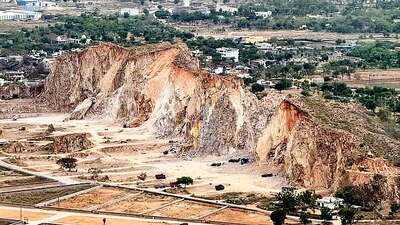
The Supreme Court on Friday refused to grant any immediate relief to mining lease holders in the Aravalli region, saying it has been receiving “quite disturbing” feedback about mining activities in the ecologically sensitive mountain range.
A bench headed by Chief Justice of India Surya Kant and justice Joymalya Bagchi said the court would not permit any activity until it was fully satisfied about the environmental implications.
“We will not hear this matter in a piecemeal manner. We will not permit any activity unless we are fully satisfied,” the bench observed.
The apex court was hearing a suo motu matter titled In Re: Definition of Aravalli hills and ranges and ancillary issue.
During the hearing, the CJI noted that the court had been receiving alarming feedback regarding activities in the Aravalli hills and ranges.
“Lot of things are happening there. We are getting feedback and it is quite disturbing,” the CJI remarked.
Silent destruction of Aravallis: The outrage over secret mining leasesThe bench told lawyers appearing in the matter that if any mining lease was cancelled, affected parties could challenge such decisions separately.
However, the court made it clear: “We will not pass any order in favour of the mining lease holders now. This is a sensitive matter.”
The case centres around the definition and ecological protection of the Aravalli hills and ranges, one of the world’s oldest mountain systems spread across Delhi, Haryana, Rajasthan and Gujarat.
In February, the Supreme Court had directed the Union environment ministry and other stakeholders to suggest names of domain experts for a panel tasked with finalising the definition of the Aravalli ranges.
Earlier, on 20 November 2025, the apex court accepted a uniform definition proposed by a ministry-appointed committee and banned fresh mining leases in Aravalli regions until expert reports were submitted.
The committee recommended:
An “Aravalli Hill” would mean any landform in designated Aravalli districts rising at least 100 metres above local relief
An “Aravalli Range” would mean a cluster of two or more such hills located within 500 metres of each other
However, on 29 December, the Supreme Court kept its 20 November directions in abeyance after widespread objections from environmentalists and experts.
The court expressed concern that the new definition could potentially exclude large portions of the Aravalli ecosystem from environmental protection.
It observed that “critical ambiguities” remained unresolved, including whether the 100-metre elevation rule and 500-metre distance criteria could weaken safeguards for the fragile region.
The bench had then said there was a “dire need to further probe” the issue to prevent regulatory gaps that might damage the ecological integrity of the Aravallis.
The court also reiterated that no mining activity can be permitted in the Aravalli hills and ranges — as defined in the Forest Survey of India’s 25 August 2010 report — without prior approval from the Supreme Court.
Environmental groups have repeatedly raised concerns over illegal mining, deforestation and ecological degradation in the Aravalli region, which plays a crucial role in maintaining biodiversity and preventing desertification in northwestern India.
With PTI inputs
The Aravallis — Defining an eco-system with a tape measure-
NEET UG To Be Held In Computer-Based Test Mode From 2027: Dharmendra Pradhan

-
Custodial deaths represent 'profound failure of constitutional machinery', says Jharkhand HC
-
Custodial deaths represent 'profound failure of constitutional machinery', says Jharkhand HC
-
SC questions why panel for appointing Election Commissioners should include Cabinet minister
-
This book argues that leaders weaponise world trade to wage wars and win votes