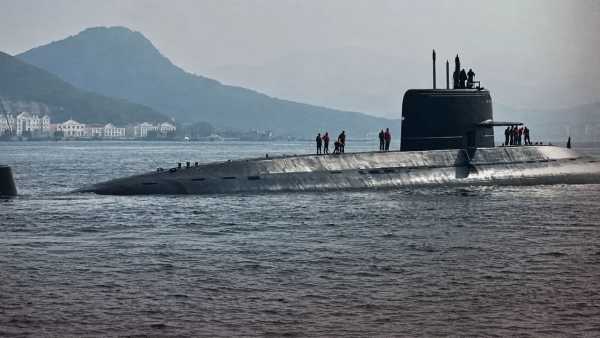
New Delhi: Pakistan commissioned its first new submarine in decades on 30 April 2026. The venue was Sanya, China. It was attended by President Asif Ali Zardari and Chief of Naval Staff Admiral Naveed Ashraf, marking the first operational milestone in what Islamabad is pitching as a generational leap in naval capability. Built under Chinese collaboration and based on the export derivative of the Yuan-class design, the platform is framed as the foundation of a revitalised sea-denial posture in the Arabian Sea. The framing is not without basis. But it has also triggered measured scepticism among analysts, and the questions it leaves unanswered may matter more than the ceremony it generated.
The propulsion question sits at the heart of the matter. Germany declined to supply its MTU diesel engines for the programme under EU export controls. China substituted its domestically produced CHD620. Thailand’s navy, facing the same substitution on its parallel S26T contract, demanded that China certify the engine’s reliability, and required bench testing of more than 6,000 hours before it would issue a verdict. The Royal Thai Navy ultimately concluded the CHD620 “demonstrates a quality comparable to the original engine, in accordance with the performance limits specified in the agreement.” That is a contracted performance assessment, not independent long-term validation under operational conditions.
And the underlying concern it was designed to address has not disappeared: no publicly confirmed operational navy, excluding possible experimental or prototype use, is known to have adopted the CHD620 for active submarine service. Pakistan has released no technical documentation showing the substitute meets the specifications originally set out. This is not a footnote. It is the programme’s foundational engineering question.
The delivery schedule is also under pressure, though claims that 2028 has already “passed into irrelevance” are premature — that date is still two years away. What is accurate is that the trajectory is difficult. The original bilateral plan envisaged Pakistan receiving all eight submarines between 2022 and 2028. Of the four China-built boats, PNS Hangor alone has been commissioned, with sisters PNS Shushuk, PNS Mangro, and PNS Ghazi having been launched through 2025 and sitting in the final stages of handover.
The four vessels to be assembled at Karachi Shipyard and Engineering Works present a starker picture: the steel cutting ceremony for the fifth boat took place in December 2021, and the keel for the sixth was only laid in February 2025. Full fleet induction is now expected between 2028 and 2030 at the earliest. Pakistan has issued no formal revision to its stated timelines, no acknowledgement of the slippage, and no explanation for what caused it.
Questions about capability sit alongside questions about schedule. The Hangor is an export-optimised derivative of the Type 039A/B Yuan class, and export configurations of Chinese naval platforms have consistently omitted the most sensitive technologies reserved for PLA Navy use — particularly in sensors, combat management systems, and acoustic quieting. No published specification confirms the export Hangor performs at Yuan-class levels, and a more sober reading of the programme treats it primarily as a recapitalisation effort to replace ageing boats and signal resolve, rather than a decisive capability shift. Pakistani officials have not contested this assessment with evidence.
The operational environment adds further complications. India currently operates twelve P-8I maritime patrol aircraft — the first export customer for the platform — with crews ranging across the Arabian Sea on sustained anti-submarine patrol cycles. India has approved a further six aircraft, which would expand the fleet to eighteen and significantly increase persistent coverage over the Arabian Sea and wider Indian Ocean Region. This sits alongside sonar-equipped surface combatants and an expanding submarine fleet. Analysts note the CHD620 may be acoustically inferior to the MTU 396 it replaced, and concerns over the engine’s noise signature were specifically raised during the Thai programme — an important variable in waters where India’s detection infrastructure is increasingly dense. No Pakistani official has offered a public assessment of platform survivability under these conditions.
Financial sustainability compounds strategic uncertainty. The programme carries an estimated price tag of $4–5 billion, making it the largest arms export contract in Chinese military history — committed by a country operating under IMF fiscal adjustment conditions, with decade-long maintenance and sustainment costs still to come. The economic logic has not been subjected to serious public scrutiny.
Then there is dependency. Every major Hangor system — propulsion, electronics, weapons, spare parts — traces back to China. Pakistan’s submarine force cannot sustain itself without Beijing’s continued material and technical support.
Taken separately, any one of these concerns would justify careful questioning. Together, they form a serious challenge to the triumphalist framing Pakistan has chosen. The submarines are real, and the commissioning of PNS Hangor represents a genuine milestone. But commitment is not the same as capability, and capability is not the same as readiness.
-
Increase in illegal wildlife trade in the Himalayas endangers the fragile region

-
Reform issue blunt warning over Labour's 'red herring' new migrant deal with Europe

-
Private bus operators in Karnataka to hike fares by 20-30 pc after fuel price rise

-
CBI arrests main accused in 2026 NEET-UG paper leak case

-
VHP opposes Karnataka move allowing hijab in educational institutions, seeks withdrawal of order