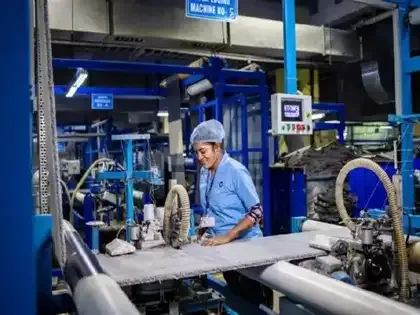
Capital goods boom, apparel bust: India's manufacturing growth is concentrated where it creates the fewest jobs
Latest IIP data for FY26 offers a sobering picture. General IIP grew by 4.1% in FY26, only marginally higher than 4.0% in FY25. This remains well below the pace required to sustain the country's growth ambitions. More importantly, it reflects a long-term pattern: between FY15 and FY26, general IIP has grown at an average annual rate of around 3.5%, while manufacturing has expanded at a similar pace of 3.3% a year.
Despite a sustained infra push, strong fiscal support, PLIs and one of the world's fastest-growing domestic consumer markets, manufacturing growth remains stuck in second gear.
Also read: 'Underground revolution underway in India': Anand Mahindra explains how thousands of MSMEs are quietly becoming world-class manufacturers
A closer look reveals a divergence. Outperforming sectors - automobiles, basic metals, other transport equipment, infrastructure and construction goods, electrical equipment, and capital goods - are capital-intensive and predominantly driven by domestic demand. Their growth is real and valuable. Infra and capital goods also generate strong forward and backward linkages that compound over time. But they're not the primary engines for large-scale employment generation.
Lagging sectors tell a different story. In 2025-26, wearing apparel contracted by 5.3%, leather by 4.1%, while textiles - despite India's vast cotton base - grew by just 1.2%. Other manufacturing collapsed by 14.9%, and food products grew by less than 1%. These sectors are labour-intensive, export-oriented and historically central to industrialisation in developing economies. They are precisely where India should be scaling up. Instead, they are stagnating or contracting.
Nor is this a one-off year. Between FY15 and FY26, food products grew at an average annual rate of just 2.1%, leather contracted by 1.9%, wearing apparel grew by only 0.8%, and textiles by a negligible 0.2%.
Monthly IIP data for 2025-26 reinforces this divergence between capital-intensive and labour-intensive sectors. The year began weakly, with General IIP growth dipping to 1.5% in June. A festive-season surge pushed growth to 7.2% in November and 8.0% in December, before it settled at 4.1% in March.
Infra and construction goods remained strong, registering double-digit growth from July onward and peaking at 14.6% in January. Capital goods, though volatile, strengthened in the second half of the year, reaching 14.6% in March. Consumer durables also rebounded during the festive quarter.
In contrast, labour-intensive sectors continued to deteriorate. Wearing apparel fell from 8.7% in April to -5.3% in August, -13.8% in October, and further to -17.1% in February and -14.6% in March. Leather followed a similar trajectory, including a steep contraction of 16.1% in October. Textiles oscillated around zero growth for most of the year. Consumer non-durables - proxy for mass demand - remained negative or near-zero in 8 out of 12 mths.
This is not merely cyclical volatility. It reflects a structural pattern. Capital-intensive, domestic demand-driven sectors are growing, while labour-intensive, export-oriented sectors are stagnating or shrinking.
Divergence points to a deeper constraint. Manufacturing growth driven primarily by domestic consumption is inherently bounded. India's IIP trajectory over the past decade - persistently in the 3-5% range - reflects this limitation. Breaking out of it requires an external demand engine. That engine is exports.
Experience of other economies underscores the point. China's manufacturing sector grew at an average annual rate of around 10% during the immediate post-reform period between 1979 and 1996, and accelerated further to roughly 12% annually between 1995 and 2015. Unsurprisingly, China today accounts for nearly 29% of global manufacturing output and 21% of global manufactured exports. China's total exports reached approximately $3.7 tn in 2025 - more than 4x India's total exports of about $860 bn.
Also read: High-activity industrial clusters to dominate India warehousing growth
Vietnam and Bangladesh have sought to emulate China's export-driven manufacturing model. Vietnam's manufacturing sector grew at an average annual rate of around 10% between 2019 and 2025, with manufactured exports reaching $356.7 bn in 2024, accounting for 88% of total exports. Bangladesh's manufacturing sector grew by 11.5% in 2021 and 2022 before moderating to 6.6% in FY24 and 5.7% in FY25. Both countries built this growth on garments, textiles, footwear and light manufacturing - precisely the sectors where India's IIP performance has remained persistently weak.
So, India's manufacturing story today is deeply uneven. Sectors capable of absorbing labour and driving export growth are stagnating, while growth is concentrated in capital-intensive domestic sectors. An objective and in-depth inquiry is needed to identify factors preventing Indian firms from achieving global competitiveness and becoming more export-oriented.
A beginning can be made by working with individual states to design tailored export promotion strategies. Continuing with a one-size-fits-all national Exim policy increasingly appears outdated. That may well be a worthy challenge for NITI Aayog.
Kumar is chairman, and Prakash is associate, strategy & research,Pahle India Foundation.
Despite a sustained infra push, strong fiscal support, PLIs and one of the world's fastest-growing domestic consumer markets, manufacturing growth remains stuck in second gear.
Also read: 'Underground revolution underway in India': Anand Mahindra explains how thousands of MSMEs are quietly becoming world-class manufacturers
A closer look reveals a divergence. Outperforming sectors - automobiles, basic metals, other transport equipment, infrastructure and construction goods, electrical equipment, and capital goods - are capital-intensive and predominantly driven by domestic demand. Their growth is real and valuable. Infra and capital goods also generate strong forward and backward linkages that compound over time. But they're not the primary engines for large-scale employment generation.
Lagging sectors tell a different story. In 2025-26, wearing apparel contracted by 5.3%, leather by 4.1%, while textiles - despite India's vast cotton base - grew by just 1.2%. Other manufacturing collapsed by 14.9%, and food products grew by less than 1%. These sectors are labour-intensive, export-oriented and historically central to industrialisation in developing economies. They are precisely where India should be scaling up. Instead, they are stagnating or contracting.
Nor is this a one-off year. Between FY15 and FY26, food products grew at an average annual rate of just 2.1%, leather contracted by 1.9%, wearing apparel grew by only 0.8%, and textiles by a negligible 0.2%.
Monthly IIP data for 2025-26 reinforces this divergence between capital-intensive and labour-intensive sectors. The year began weakly, with General IIP growth dipping to 1.5% in June. A festive-season surge pushed growth to 7.2% in November and 8.0% in December, before it settled at 4.1% in March.
Infra and construction goods remained strong, registering double-digit growth from July onward and peaking at 14.6% in January. Capital goods, though volatile, strengthened in the second half of the year, reaching 14.6% in March. Consumer durables also rebounded during the festive quarter.
In contrast, labour-intensive sectors continued to deteriorate. Wearing apparel fell from 8.7% in April to -5.3% in August, -13.8% in October, and further to -17.1% in February and -14.6% in March. Leather followed a similar trajectory, including a steep contraction of 16.1% in October. Textiles oscillated around zero growth for most of the year. Consumer non-durables - proxy for mass demand - remained negative or near-zero in 8 out of 12 mths.
This is not merely cyclical volatility. It reflects a structural pattern. Capital-intensive, domestic demand-driven sectors are growing, while labour-intensive, export-oriented sectors are stagnating or shrinking.
Divergence points to a deeper constraint. Manufacturing growth driven primarily by domestic consumption is inherently bounded. India's IIP trajectory over the past decade - persistently in the 3-5% range - reflects this limitation. Breaking out of it requires an external demand engine. That engine is exports.
Experience of other economies underscores the point. China's manufacturing sector grew at an average annual rate of around 10% during the immediate post-reform period between 1979 and 1996, and accelerated further to roughly 12% annually between 1995 and 2015. Unsurprisingly, China today accounts for nearly 29% of global manufacturing output and 21% of global manufactured exports. China's total exports reached approximately $3.7 tn in 2025 - more than 4x India's total exports of about $860 bn.
Also read: High-activity industrial clusters to dominate India warehousing growth
Vietnam and Bangladesh have sought to emulate China's export-driven manufacturing model. Vietnam's manufacturing sector grew at an average annual rate of around 10% between 2019 and 2025, with manufactured exports reaching $356.7 bn in 2024, accounting for 88% of total exports. Bangladesh's manufacturing sector grew by 11.5% in 2021 and 2022 before moderating to 6.6% in FY24 and 5.7% in FY25. Both countries built this growth on garments, textiles, footwear and light manufacturing - precisely the sectors where India's IIP performance has remained persistently weak.
So, India's manufacturing story today is deeply uneven. Sectors capable of absorbing labour and driving export growth are stagnating, while growth is concentrated in capital-intensive domestic sectors. An objective and in-depth inquiry is needed to identify factors preventing Indian firms from achieving global competitiveness and becoming more export-oriented.
A beginning can be made by working with individual states to design tailored export promotion strategies. Continuing with a one-size-fits-all national Exim policy increasingly appears outdated. That may well be a worthy challenge for NITI Aayog.
Kumar is chairman, and Prakash is associate, strategy & research,Pahle India Foundation.
(Disclaimer: The opinions expressed in this column are that of the writer. The facts and opinions expressed here do not reflect the views of www.economictimes.com.)





Rajiv Kumar
Vice-chairman, NITI Aayog
Samriddhi Prakash
The author is associate, strategy & research, Pahle India Foundation