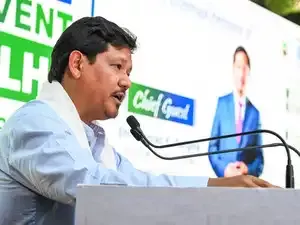
New Delhi, India and Bangladesh have initiated dialogue at the "local level" to reset ties, Meghalaya Chief Minister Conrad Sangma has said, while calling for reviving people-to-people engagement and trade between the two countries.
Interacting with a group of journalists here on Friday, Sangma said it was important to remind people of the historical cooperation between the two countries, including India's support to Bangladesh during difficult times.
He also called for more cultural exchanges and reopening of border haats that were shut in the aftermath of the 2024 political unrest in the neighbouring country.
"It is already happening. The process has started. Dialogues are taking place at the local level, people are talking and discussing," Sangma said in response to a question on talks between India and Bangladesh.
He was speaking on the sidelines of the curtain raiser event for the North East India Infrastructure Summit and Exhibition, which will be held in Shillong on June 11-12.
"I firmly believe the current phase with Bangladesh is temporary, but in the long run, we will have to work with Bangladesh. This is good for us and Bangladesh as well and I believe there is huge potential and opportunities," the chief minister said.
Sangma's remarks come at a time when India and Bangladesh are seeking to restore momentum in bilateral engagement after relations were strained following the ouster of former Bangladesh prime minister Sheikh Hasina and the subsequent transition in Dhaka, during which political-level interactions with New Delhi remained limited.
In April, Bangladesh Foreign Minister Khalilur Rahman, along with Humayun Kabir, Foreign Affairs Adviser to Bangladesh Prime Minister Tarique Rahman, visited New Delhi in his first official trip to India after assuming office.
BJP foreign affairs department in-charge Vijay Chauthaiwale had said last month that Rahman, also the chairman of Bangladesh's ruling BNP, had written a letter to BJP president Nitin Nabin.
"There is some top-level interest to initiate dialogue between the two parties, as far as political dialogue is concerned," Chauthaiwale had said while speaking at a conference organised by the Hudson Institute in Washington, D.C. on April 24.
Sangma said connectivity projects linking the region with Bangladesh could provide a major economic boost to the northeast.
He specifically referred to connectivity between Hili in West Bengal and Mahendraganj in Meghalaya through a proposed corridor in Bangladesh and said access to the Chittagong port could transform trade and logistics for the region.
"I think the normal economic activities that used to take place, whether it is just the basic border haats, or the movement of basic trade that used to take place earlier, should be reactivated," he said.
Concerns related to infiltration and illegal immigration must be addressed through strong safeguards and monitoring mechanisms, he added.
On the move towards border fencing in West Bengal following the BJP coming to power in the state, Sangma said national security remained the top priority and the issue should not be conflated with people-to-people ties.
"Border is for our protection, for our safety and national interests," he said, adding that cultural and social relations could continue despite physical barriers.
Asked about the continuing ethnic conflict in Manipur, Sangma acknowledged that the situation posed a major challenge.
Referring to recent incidents between the Kuki and Naga communities that have added to tensions, he said the situation had become "more complicated", but expressed hope that "better overall sense will prevail".
Rejecting suggestions that there had been inadequate political outreach from the Centre, Sangma said the Union government had been continuously monitoring the situation and consulting stakeholders, including political parties such as his National People's Party, which has a presence in Manipur.
"We only see it from the point of visits, but visits are not the only way to show concern," he said.
Sangma said he and his party had been "extensively consulted" by the Centre on developments in Manipur, including during discussions on President's Rule.
Interacting with a group of journalists here on Friday, Sangma said it was important to remind people of the historical cooperation between the two countries, including India's support to Bangladesh during difficult times.
He also called for more cultural exchanges and reopening of border haats that were shut in the aftermath of the 2024 political unrest in the neighbouring country.
"It is already happening. The process has started. Dialogues are taking place at the local level, people are talking and discussing," Sangma said in response to a question on talks between India and Bangladesh.
He was speaking on the sidelines of the curtain raiser event for the North East India Infrastructure Summit and Exhibition, which will be held in Shillong on June 11-12.
"I firmly believe the current phase with Bangladesh is temporary, but in the long run, we will have to work with Bangladesh. This is good for us and Bangladesh as well and I believe there is huge potential and opportunities," the chief minister said.
Sangma's remarks come at a time when India and Bangladesh are seeking to restore momentum in bilateral engagement after relations were strained following the ouster of former Bangladesh prime minister Sheikh Hasina and the subsequent transition in Dhaka, during which political-level interactions with New Delhi remained limited.
In April, Bangladesh Foreign Minister Khalilur Rahman, along with Humayun Kabir, Foreign Affairs Adviser to Bangladesh Prime Minister Tarique Rahman, visited New Delhi in his first official trip to India after assuming office.
BJP foreign affairs department in-charge Vijay Chauthaiwale had said last month that Rahman, also the chairman of Bangladesh's ruling BNP, had written a letter to BJP president Nitin Nabin.
"There is some top-level interest to initiate dialogue between the two parties, as far as political dialogue is concerned," Chauthaiwale had said while speaking at a conference organised by the Hudson Institute in Washington, D.C. on April 24.
Sangma said connectivity projects linking the region with Bangladesh could provide a major economic boost to the northeast.
He specifically referred to connectivity between Hili in West Bengal and Mahendraganj in Meghalaya through a proposed corridor in Bangladesh and said access to the Chittagong port could transform trade and logistics for the region.
"I think the normal economic activities that used to take place, whether it is just the basic border haats, or the movement of basic trade that used to take place earlier, should be reactivated," he said.
Concerns related to infiltration and illegal immigration must be addressed through strong safeguards and monitoring mechanisms, he added.
On the move towards border fencing in West Bengal following the BJP coming to power in the state, Sangma said national security remained the top priority and the issue should not be conflated with people-to-people ties.
"Border is for our protection, for our safety and national interests," he said, adding that cultural and social relations could continue despite physical barriers.
Asked about the continuing ethnic conflict in Manipur, Sangma acknowledged that the situation posed a major challenge.
Referring to recent incidents between the Kuki and Naga communities that have added to tensions, he said the situation had become "more complicated", but expressed hope that "better overall sense will prevail".
Rejecting suggestions that there had been inadequate political outreach from the Centre, Sangma said the Union government had been continuously monitoring the situation and consulting stakeholders, including political parties such as his National People's Party, which has a presence in Manipur.
"We only see it from the point of visits, but visits are not the only way to show concern," he said.
Sangma said he and his party had been "extensively consulted" by the Centre on developments in Manipur, including during discussions on President's Rule.