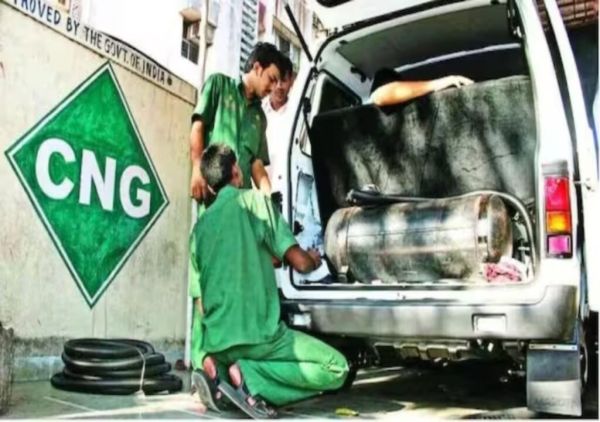
New Delhi: Compressed Natural Gas (CNG) prices in the Delhi-NCR region have been increased by Re 1 per kg, marking the second hike within a week amid rising global crude oil prices. The latest revision comes just two days after a Rs 2 per kg increase, taking the total hike to Rs 3 per kg in less than seven days.
With the revised rates, CNG in Delhi now costs Rs 80.09 per kg. Consumers in Noida, Greater Noida and Ghaziabad will now pay Rs 88.70 per kg. The frequent upward revisions have raised concerns among daily commuters and transport operators who rely heavily on CNG as a relatively economical and cleaner fuel alternative.
Consecutive hikes driven by global oil surge
The back-to-back increase in CNG prices reflects the pressure on domestic fuel pricing due to a sharp rise in international crude oil rates. Oil marketing companies have begun passing on a portion of the increased costs to consumers after holding prices steady for several weeks.
The earlier hike on May 15 also coincided with a significant increase in petrol and diesel prices across the country. Both fuels were raised by Rs 3 per litre — the first such increase in over four years — as global energy prices surged.
Petrol and diesel rates hit multi-year highs
Following the recent revision, petrol in Delhi is now priced at Rs 97.77 per litre, up from Rs 94.77, while diesel costs Rs 90.67 per litre compared to Rs 87.67 earlier. Fuel prices continue to vary across states due to differences in value-added tax (VAT).
Across major metros, petrol and diesel rates have reached their highest levels since May 2022. In Mumbai, petrol is currently priced at Rs 106.68 per litre and diesel at Rs 93.14. Kolkata has reported petrol prices at Rs 108.74 and diesel at Rs 95.13, while in Chennai, petrol costs Rs 103.67 and diesel Rs 95.25 per litre.
Strait of Hormuz disruption impacts supply
The surge in global crude oil prices has been largely attributed to geopolitical tensions in West Asia. Oil prices have risen by more than 50 per cent since late February following US-Israeli strikes on Iran and subsequent retaliatory actions by Tehran.
These developments have disrupted energy flows through the Strait of Hormuz, a critical route for global oil shipments. The supply uncertainty has led to volatility in international markets, directly impacting fuel pricing in import-dependent countries like India.
CNG prices rise in other cities
Apart from Delhi-NCR, CNG prices have also been increased in Mumbai, where the fuel now costs Rs 84 per kg. However, there has been no change so far in the prices of piped natural gas (PNG) supplied to households or domestic LPG cylinders.
Despite the recent hikes, industry sources indicate that the increase remains moderate compared to the sharp rise in global crude prices. Oil marketing companies are reportedly still absorbing substantial losses. Estimates suggest that retailers continue to incur losses of around Rs 11 per litre on petrol and Rs 39 per litre on diesel even after the revisions.
Political and economic context
Fuel prices had largely remained unchanged for weeks prior to the recent hikes, with the government attempting to shield consumers from the immediate impact of rising global costs. Opposition parties have alleged that price revisions were delayed due to Assembly elections in key states.
The latest hike comes shortly after the conclusion of elections, where the Bharatiya Janata Party (BJP) strengthened its position by winning three out of five states, including West Bengal.
Government urges fuel conservation
In response to rising fuel prices, the government has intensified its focus on conservation measures. Prime Minister Narendra Modi has urged citizens to minimise unnecessary travel, adopt work-from-home practices where feasible, and use fuel efficiently.
Several state governments have also issued advisories to reduce official travel and encourage virtual meetings to cut fuel consumption.
Inflation concerns and economic impact
Analysts warn that the cumulative increase in petrol, diesel and CNG prices could have a broader economic impact. Higher fuel costs are likely to contribute to inflationary pressures and may slow down demand growth in the coming months.
India’s retail inflation rose to 3.48 per cent in April 2026, up from 3.40 per cent in March. Meanwhile, wholesale inflation reached a 42-month high of 8.3 per cent, driven largely by rising fuel and energy costs.
Conclusion
The latest CNG price hike in Delhi-NCR underscores the growing impact of global energy market volatility on domestic fuel rates. While the increases so far have been relatively moderate, continued geopolitical tensions and rising crude prices may lead to further revisions.
For consumers, particularly those dependent on CNG for daily commuting, the rising costs highlight the need for cautious fuel usage and potential shifts towards more efficient or alternative energy options.
-
Nagaland State Lottery Result: May 18, 2026, 8 PM Live - Watch Streaming Of Winners List Of Dear Clover Sambad Night Monday Weekly Draw

-
NEET-UG 2026 Paper Leak Row: Parliamentary Panel Summons NTA Chief To Review Exam Reforms On May 21

-
Marty Supreme On OTT: Everything To Know About Timothée Chalamet's Sports Drama Film

-
Rasikh Salam Ends Cameron Green's Attack With Stunning Comeback

-
IPL 2026: Abishek Porel embodies fearless new generation of batters, says KL Rahul