
Listen to this article in summarized format
Loading...
××
Subscribe to

Unlock AI Briefing and Premium Content
New Year Offer 24 Hours Left
Subscribe NowAlready a member? Sign In
What's Included
- Exclusive Stories
- Daily ePaper Access
- Smart Market Tools
- Curated Investment Ideas
- Ad-lite Experience
Subscription

What does a normal monthly budget really look like in India today? For some, it runs into tens of thousands just to keep up with rent, food, travel, and daily survival in a city. For others, life quietly unfolds in smaller towns and villages where costs shrink to almost unbelievable levels. A recent online exchange between two professionals has triggered a fresh debate on lifestyle differences, financial reality, and how geography silently decides how much money we actually need every month.
Pune-based founder Vanesh Mali shared his monthly spending breakdown on X, offering a glimpse into urban living costs. His expenses reflected the typical structure of a city-based lifestyle, where fixed costs and daily necessities quickly add up.
According to his post, his monthly rent stands at Rs 14,000 rupees, followed by an electricity bill of Rs 800. Groceries cost him around Rs 8,000, while mobile and television recharges add another Rs 1,300 to his budget. He also spends about Rs 1,000 on outside food and Rs 4,000 on travel between Pune and his hometown. Miscellaneous expenses account for another Rs 10,000, bringing his total monthly spending to Rs 39,100. He mentioned that he prefers to spend only on necessities, highlighting a disciplined approach to personal finance.
The conversation took an unexpected turn when corporate professional Rutuja responded by sharing a completely different personal financial reality shaped by rural living.
Corporate woman's monthly expense
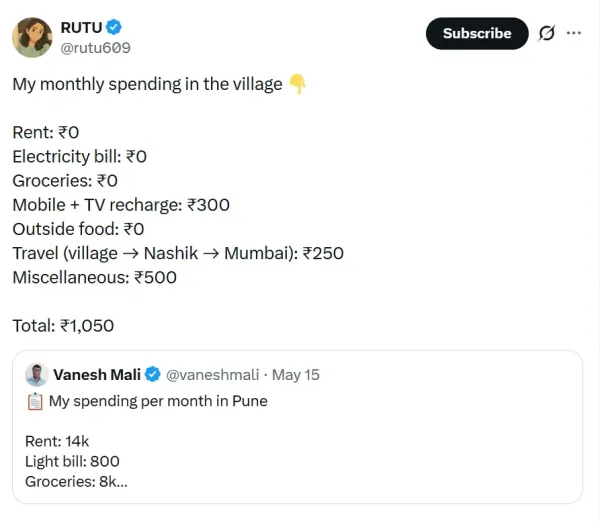
Her monthly expenses, as shared on X, revealed how dramatically costs can drop outside urban centres. Living in a village, she reported zero expenditure on rent, electricity (paid by her father), groceries, and outside food. Her only costs included Rs 300 for mobile and TV recharge, Rs 250 for travel between her village, Nashik, and Mumbai, and Rs 500 for miscellaneous expenses. This brought her total monthly spending to just Rs 1,050. She clarified that the grocery and electricity bill is managed by her father, and hence, it does not add to her personal monthly expense.
The contrast between the two lifestyles quickly caught attention online, not just because of the numbers, but because of what they represent. On one side is a structured urban life where basic survival comes with a high price tag. On the other is a rural setup where lower living costs create a completely different financial rhythm.
The exchange has sparked wider discussion about urban versus rural cost of living, especially among young professionals navigating career choices, relocation decisions, and financial planning. While city life often offers higher earning potential, it also comes with significantly higher expenses that can quickly consume income.
Questions also came in about shopping habits, with one user asking if she spends anything on clothes or personal items. Rutuja responded that she already has everything she needs. She added that most of her wardrobe was purchased during her earlier office days and that she does not feel the need to buy new clothes anymore, saying even a couple of T-shirts are enough for her current lifestyle.
Some users were struck by the simplicity of her monthly spending. One comment noted that even basic grooming costs more for them than her entire monthly budget, while also admitting that such a minimalist lifestyle sounds appealing in theory but may be difficult to actually follow in practice.
Pune-based founder Vanesh Mali shared his monthly spending breakdown on X, offering a glimpse into urban living costs. His expenses reflected the typical structure of a city-based lifestyle, where fixed costs and daily necessities quickly add up.
According to his post, his monthly rent stands at Rs 14,000 rupees, followed by an electricity bill of Rs 800. Groceries cost him around Rs 8,000, while mobile and television recharges add another Rs 1,300 to his budget. He also spends about Rs 1,000 on outside food and Rs 4,000 on travel between Pune and his hometown. Miscellaneous expenses account for another Rs 10,000, bringing his total monthly spending to Rs 39,100. He mentioned that he prefers to spend only on necessities, highlighting a disciplined approach to personal finance.
The conversation took an unexpected turn when corporate professional Rutuja responded by sharing a completely different personal financial reality shaped by rural living.
Screenshot of the post
Corporate woman's monthly expense
Her monthly expenses, as shared on X, revealed how dramatically costs can drop outside urban centres. Living in a village, she reported zero expenditure on rent, electricity (paid by her father), groceries, and outside food. Her only costs included Rs 300 for mobile and TV recharge, Rs 250 for travel between her village, Nashik, and Mumbai, and Rs 500 for miscellaneous expenses. This brought her total monthly spending to just Rs 1,050. She clarified that the grocery and electricity bill is managed by her father, and hence, it does not add to her personal monthly expense.The contrast between the two lifestyles quickly caught attention online, not just because of the numbers, but because of what they represent. On one side is a structured urban life where basic survival comes with a high price tag. On the other is a rural setup where lower living costs create a completely different financial rhythm.
The exchange has sparked wider discussion about urban versus rural cost of living, especially among young professionals navigating career choices, relocation decisions, and financial planning. While city life often offers higher earning potential, it also comes with significantly higher expenses that can quickly consume income.
Internet reacts
One user pointed out the zero spending on outside food, to which Rutuja explained that she simply does not eat out at all, making that category unnecessary in her budget. Another reaction highlighted how working from home can significantly reduce everyday costs, especially when compared to city-based routines that involve commuting, dining out, and constant spending.Questions also came in about shopping habits, with one user asking if she spends anything on clothes or personal items. Rutuja responded that she already has everything she needs. She added that most of her wardrobe was purchased during her earlier office days and that she does not feel the need to buy new clothes anymore, saying even a couple of T-shirts are enough for her current lifestyle.
Some users were struck by the simplicity of her monthly spending. One comment noted that even basic grooming costs more for them than her entire monthly budget, while also admitting that such a minimalist lifestyle sounds appealing in theory but may be difficult to actually follow in practice.