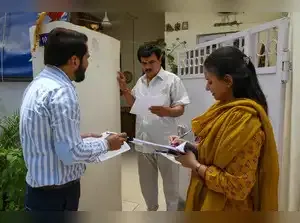
Field operations for the Houselisting and Housing Census (HLO) under Phase I of Census 2027 commenced in five states and union territories on Sunday Rajasthan, Meghalaya, Maharashtra, Jharkhand, and the Municipal Corporation of Delhi (MCD) area within the National Capital Territory of Delhi as the nationwide decennial exercise continues its phased rollout.
Meanwhile, house-to-house enumeration by field enumerators is currently under way in eleven other states and UTs: Andhra Pradesh, Arunachal Pradesh, Bihar, Chandigarh, Chhattisgarh, Dadra and Nagar Haveli and Daman and Diu, Haryana, Madhya Pradesh, Punjab, Telangana, and Uttarakhand.
Also Read: India begins its first digital census in 16 years and this time there's a big difference
Ladakh LG launches self-enumeration portal
Lieutenant Governor of Ladakh Vinai Kumar Saxena on Sunday launched the Self-Enumeration portal for Census 2027 in the union territory, marking the formal commencement of the census process in Ladakh.
Appealing to citizens to actively participate in the exercise, Saxena said the census "plays a vital role in shaping policies, planning resources and driving the development of our nation." He added that participation would ensure "Ladakh's unique identity, aspirations and needs are fully reflected in this national exercise."
Self-enumeration begins in four more regions
Alongside Ladakh, the SE facility was launched on Sunday in Gujarat, Jammu and Kashmir, and Puducherry. The window will remain open until May 31, 2026, after which physical houselisting field operations will be conducted from June 1 to June 30, 2026.
In Uttar Pradesh, self-enumeration is currently ongoing and will close on May 21, 2026, with field operations scheduled from May 22 to June 20, 2026.
The self-enumeration facility, a first in the history of Indian census operations, has seen over 1.44 crore households complete the process through the official portal at se.census.gov.in, across 25 states and UTs. Households that complete self-enumeration are required to note their Self-Enumeration ID (SE ID) and share it with the enumerator during the subsequent physical field visit. Those who have not opted for self-enumeration will be covered through the standard door-to-door process.
Earlier phase completed in five states
Houselisting and housing census operations conducted between April 16 and May 15, 2026, have been completed in Andaman and Nicobar Islands, Lakshadweep, Mizoram, Odisha, and Sikkim, along with the NDMC area and Delhi Cantonment Board area within the NCT of Delhi.
What the census is collecting and why it matters
Census 2027 is the 16th census since the exercise began and the 8th after independence. It is being conducted using digital tools for the first time, while retaining the traditional door-to-door enumeration model. The government has approved an outlay of Rs 11,718.24 crore for the exercise, which is being conducted in two phases houselisting between April and September 2026, followed by population enumeration in February 2027.
Also Read: Census 2027 to be India's first digital enumeration exercise
During field visits, enumerators are collecting data through a dedicated mobile application. The current phase gathers information on housing conditions, household details, amenities, and assets through a structured questionnaire of 33 notified questions. The data forms the basis for evidence-based planning and implementation of welfare and development programmes.
All data is collected under the Census Act, 1948, and is used exclusively for statistical purposes and development planning, the government said.
Meanwhile, house-to-house enumeration by field enumerators is currently under way in eleven other states and UTs: Andhra Pradesh, Arunachal Pradesh, Bihar, Chandigarh, Chhattisgarh, Dadra and Nagar Haveli and Daman and Diu, Haryana, Madhya Pradesh, Punjab, Telangana, and Uttarakhand.
Also Read: India begins its first digital census in 16 years and this time there's a big difference
Ladakh LG launches self-enumeration portal
Lieutenant Governor of Ladakh Vinai Kumar Saxena on Sunday launched the Self-Enumeration portal for Census 2027 in the union territory, marking the formal commencement of the census process in Ladakh.
Appealing to citizens to actively participate in the exercise, Saxena said the census "plays a vital role in shaping policies, planning resources and driving the development of our nation." He added that participation would ensure "Ladakh's unique identity, aspirations and needs are fully reflected in this national exercise."
Self-enumeration begins in four more regions
Alongside Ladakh, the SE facility was launched on Sunday in Gujarat, Jammu and Kashmir, and Puducherry. The window will remain open until May 31, 2026, after which physical houselisting field operations will be conducted from June 1 to June 30, 2026.
In Uttar Pradesh, self-enumeration is currently ongoing and will close on May 21, 2026, with field operations scheduled from May 22 to June 20, 2026.
The self-enumeration facility, a first in the history of Indian census operations, has seen over 1.44 crore households complete the process through the official portal at se.census.gov.in, across 25 states and UTs. Households that complete self-enumeration are required to note their Self-Enumeration ID (SE ID) and share it with the enumerator during the subsequent physical field visit. Those who have not opted for self-enumeration will be covered through the standard door-to-door process.
Earlier phase completed in five states
Houselisting and housing census operations conducted between April 16 and May 15, 2026, have been completed in Andaman and Nicobar Islands, Lakshadweep, Mizoram, Odisha, and Sikkim, along with the NDMC area and Delhi Cantonment Board area within the NCT of Delhi.
What the census is collecting and why it matters
Census 2027 is the 16th census since the exercise began and the 8th after independence. It is being conducted using digital tools for the first time, while retaining the traditional door-to-door enumeration model. The government has approved an outlay of Rs 11,718.24 crore for the exercise, which is being conducted in two phases houselisting between April and September 2026, followed by population enumeration in February 2027.
Also Read: Census 2027 to be India's first digital enumeration exercise
During field visits, enumerators are collecting data through a dedicated mobile application. The current phase gathers information on housing conditions, household details, amenities, and assets through a structured questionnaire of 33 notified questions. The data forms the basis for evidence-based planning and implementation of welfare and development programmes.
All data is collected under the Census Act, 1948, and is used exclusively for statistical purposes and development planning, the government said.