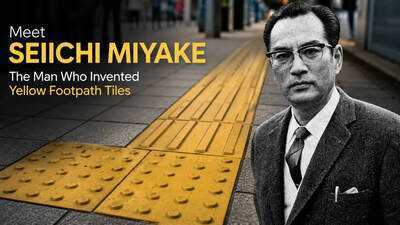
Every day, countless individuals traverse bright yellow tiles found on sidewalks, railway stations, and pedestrian crossings, often without a second thought. For many, these tiles are just a common feature of urban life. However, for those with visual impairments, these small raised bumps represent safety, autonomy, and assurance. The story behind these tiles is one of profound friendship and innovation. The visionary behind these yellow tactile paving tiles is Seiichi Miyake, a Japanese inventor whose simple yet impactful idea transformed cities globally.
The Inspiration Behind Tactile PavingIn the 1960s, Miyake observed the challenges faced by a close friend who was gradually losing his sight. Navigating busy streets and crossing roads became increasingly perilous for his friend. At a time when infrastructure for accessibility was nearly non-existent, visually impaired individuals were often left to fend for themselves. This observation deeply moved Miyake, prompting him to take action rather than merely express sympathy. He invested his own resources to develop a system that would enable visually impaired individuals to navigate their surroundings safely through tactile feedback.
In 1965, he introduced what we now recognize as tactile paving, the yellow textured tiles that have become a staple in cities worldwide. The design was ingeniously straightforward. The raised circular bumps were intended to alert visually impaired pedestrians to potential hazards, such as roads and crossings, while the long straight bars provided directional guidance. The bright yellow color was deliberately chosen for its visibility to those with partial sight.
Introduction of Tactile TilesThe inaugural installation of tactile tiles occurred in 1967 near a school for blind students in Okayama, Japan. The results were immediate and significant, granting visually impaired individuals a safer and more independent means of navigating public areas. What began as a personal endeavor to assist a friend evolved into a nationwide initiative. As Japan enhanced its public infrastructure, tactile paving quickly spread across railway stations, sidewalks, pedestrian crossings, and public facilities. Eventually, this concept was embraced by countries worldwide, with these yellow tiles now visible in India, the United States, the United Kingdom, Australia, and many others. Ironically, millions tread on Miyake’s creation daily, often unaware of the man behind it.
Unlike many inventors who seek fame or wealth, Miyake’s legacy is rooted in empathy. His goal was not to establish a business empire or launch a global product; rather, he aimed to ensure that his friend and others like him could navigate the world with greater safety. This narrative is a testament to the power of kindness. In a society often driven by profit, Seiichi Miyake demonstrated that a single act of compassion can significantly enhance the lives of countless individuals for generations. The next time you walk over those yellow tiles, remember that they exist because one man chose to act when he saw his blind friend in need.
-
From the memoir: Mathematician and writer Manil Suri on his childhood in a crumbling Bombay flat

-
'Children of god': Madras HC infantilises transgender persons rather than speak of their rights

-
Sunscreen Tips: Should You Apply Sunscreen Before or After Makeup? 90% of People Make This Mistake..
-
Suvendu Adhikari aide murder case: CBI arrests fifth accused from Varanasi

-
Prepare South Indian Rasam Rice in just 20 minutes. The taste is such that you will keep licking your fingers..