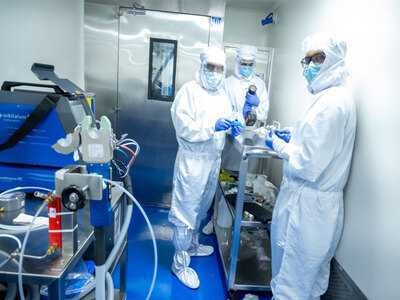
Gandhinagar (Gujarat) [India], May 18 (ANI): In a major step towards developing a skilled workforce to meet the needs of the state's growing semiconductor industry, the first batch of the UHP Welding for Semiconductors Program passed out from the Industrial Training Institute (ITI) at Dholera, the semiconductor hub of the state, on April 13.
The UHP (Ultra High Purity) Welding for Semiconductors Program is a structured, cohort-based training initiative at the ITI level, designed to build a cleanroom-ready workforce for semiconductor manufacturing. It is delivered by the Tata Indian Institute of Skills (Tata IIS) in collaboration with the Government of Gujarat and Tata Electronics.
The program is the first structured, cohort-based UHP welding training initiative at the ITI level in India. It also marks the first instance of a semiconductor-ready cleanroom training facility being established within an ITI, and a skilling initiative directly linked to a commercial semiconductor fab under development in the country.
The program trains students in Ultra High Purity (UHP) welding--a specialised skill required for contamination-free gas delivery and process piping systems inside semiconductor fabs. The program is open to ITI students pursuing courses or those who have passed out from any trade, with no specific trade prerequisite. Candidates are identified through structured selection sessions conducted by Tata IIS.
According to officials, a containerised ISO Class 1 Lac cleanroom facility has been set up at ITI Dholera.
"The lab is designed to replicate actual semiconductor manufacturing conditions, enabling hands-on training in a real cleanroom environment. The lab includes specialised equipment such as orbital welding machines, IR fusion welding systems, helium leak testing systems, pressure testing setups, and cleanroom infrastructure, including air lock and air shower systems," said an official.
The program is delivered over six weeks, including a two-week preparatory phase at IIS Ahmedabad and a four-week advanced training phase at the ITI Dholera cleanroom facility.
Students are trained in cleanroom protocols, precision tube preparation, orbital and IR fusion welding, leak testing, quality inspection, and documentation practices. Approximately 70 per cent of the training is hands-on, with continuous assessment and individual performance tracking. Training is delivered by Tata IIS in-house trainers, with the curriculum aligned to industry requirements defined by Tata Electronics.
The semiconductor industry in Gujarat is taking flight, as a skilled workforce is being prepared to join the sector through the government's efforts to provide specialised training to youth in collaboration with private players. A total of 16 students, drawn from Dholera and nearby areas, successfully completed the highly specialised skill programme.
Under the leadership of Chief Minister Shri Bhupendra Patel, the state has emerged as a semiconductor hub and is generating employment opportunities for the youth. To provide a skilled workforce for the industry, the state government is leaving no stone unturned by involving corporate players in skill development through various initiatives.
Graduates of the program are trained to be deployment-ready as UHP-certified precision welders with cleanroom experience. Their profiles are shared with the industry, creating a direct pathway for potential absorption into semiconductor facility construction and related roles. Opportunities are available across semiconductor companies, EPC contractors, and specialised high-purity piping and gas delivery systems used in advanced manufacturing environments.
Gujarat has emerged at the forefront of India's semiconductor revolution by combining facilitation-first governance with industrial-scale readiness.
It is the first state to introduce the Gujarat Semiconductor Policy (2022-27), which supports qualified projects with fiscal incentives, land allotment, faster approvals, and access to essential utilities such as power, water, and gas.
Additionally, Gujarat is strategically located, with a long coastline, major ports, and seamless connectivity through the Delhi-Mumbai Industrial Corridor, along with airports, highways, and railways ensuring smooth and reliable operations.
The state also provides fast-track facilitation, clear subsidy disbursement plans, and a strong ecosystem for investors and innovators. These measures have helped Gujarat secure nearly 40 per cent of India's approved semiconductor manufacturing capacity, with investments of around Rs 1.25 lakh crore, accounting for over 75 per cent of the national total. (ANI)
-
A Golden Opportunity for Women: The Delhi Government to Provide Collateral-Free Loans of Up to ₹10 Crore..

-
Between O Sanam and Ek Pal Ka Jeena, Lucky Ali gave Pune its most emotional moment

-
“I was afraid to die alone”: Why a Shanghai grandpa gave away his Rupees 1.4 Crore flat to a stranger who showed him kindness

-
Essential Tips for Safe Digital Parenting

-
Effective Parenting Strategies to Encourage Honesty in Children