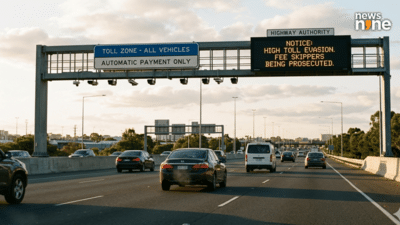
New Delhi: National Highways Authority of India has run into fresh enforcement challenges just weeks into launching Delhi’s first barrier-less toll plaza on the Urban Extension Road-II (UER-II) corridor at Mundka-Bakkarwala. The newly introduced Multi-Lane Free Flow (MLFF) tolling system was designed to reduce long queues and stop-and-go traffic by allowing vehicles to pass through toll points without slowing down.
Instead of physical barriers, the system relies on AI-powered cameras, automatic number plate recognition (ANPR) technology and RFID-based FASTag detection to deduct toll charges from a vehicle owner’s linked account automatically.
However, authorities are now grappling with a growing number of motorists attempting to bypass the system through various methods, the biggest being tampering of the number plates.
As per reports, some users are purposely obscuring or modifying their High Security Registration Plates (HSRPs), making it difficult for the ANPR cameras to correctly identify vehicles. Since the system heavily depends on accurate number plate detection, the smallest alterations in lettering, spacing or formatting can temporarily confuse the software and prevent successful toll deduction.
Officials have also highlighted cases where motorists are using reflective films or coatings on number plates to distort camera images. In some of the extreme instances, some vehicles are reportedly equipped with illegal mechanisms that can flip or conceal plates while driving through toll zones.
Another challenge comes from vehicles not having properly mounted FASTags on their windscreens. Even though these cases reportedly account for less than one per cent of overall traffic, they still create gaps in enforcement and revenue collection.
Advanced technology’s misuseThe barrier-less toll system marks a big shift in India’s highway infrastructure strategy, aiming to improve traffic flow and reduce congestion at toll booths. Similar systems are quite widely used in countries across Europe and North America, where camera-based tolling has largely replaced physical barriers on major expressways.
For India, however, the transition also exposes a familiar problem of enforcement. Without strict penalties and effective monitoring, even advanced tolling technologies remain vulnerable to being misused. NHAI is now expected to tighten surveillance and explore stronger legal action against offenders as it prepares for wider implementation of barrier-less tolling across the country.
-
Class 8 girl dies in tragic accident after saree tied to ladder tightens around neck while playing in Chikkamagaluru

-
India to monitor Boeing fuel switch tests after Air India scare

-
Truth behind UK Eurovision's abysmal one point disaster - the acts aren't to blame

-
I played 10 hours of LEGO Batman: Legacy of the Dark Knight on Steam Deck

-
Anne Hathaway to produce new series perfect for fans of My Life with the Walter Boys