
I think my Hogwarts letter got lost in the mail when I was 11. And, although a whole army of owls showed up with extra letters for Harry Potter when his Uncle Vernon destroyed his original copy, that never happened for me.
Magic may sound a bit sketchy to rational thinkers, but there’s something wonderful about believing the impossible could actually happen. About one-third of Americans believe that the power of magic is a real thing. Now, one of the most legendary universities in the country is offering an alternative to Hogwarts, so it’s time to pull out your wands.
A class called ‘Omens, Oracles, and Prophecies’ is available to take online through Harvard University.
Unfortunately, it probably won’t give you quite as well-rounded of a magical education as you would receive from Hogwarts. The course is entirely virtual and only lasts a week, so there’s no enchanted castle ambience included. However, you can sign up for the class anytime that you feel interested in doing so, and it’s completely free, unless you want to add on a $99 verified certificate.
Melanie Casabar | Pexels
“Omens, Oracles, and Prophecies” is described as an “immersive learning experience” that focuses on “‘pre-scientific’ prediction systems ranging from ancient Chinese bone burning to the Oracle of Delphi to modern astrology and tarot.” It’s part of Harvard’s PredictionX program, which explores all of the ways humans have attempted to predict the future.
So, if you’re thinking about it in Hogwarts terms, it’s probably closest to Divination class. It sounds like the Harvard option is centered much more on the history surrounding prediction practices than on actually teaching students how to predict what’s coming themselves, though.
: If You Think You’d Be In One Of These 2 Harry Potter Houses, Psychology Says A 9-To-5 Job Probably Isn’t For You
Predicting the future is basically as old as civilization, but that doesn’t mean it’s not controversial.
When you think about trying to predict the future in the modern era, it’s probably astrology that comes to mind. Of course, in centuries past, some people were thought to have a special gift and heralded as oracles or shamans.
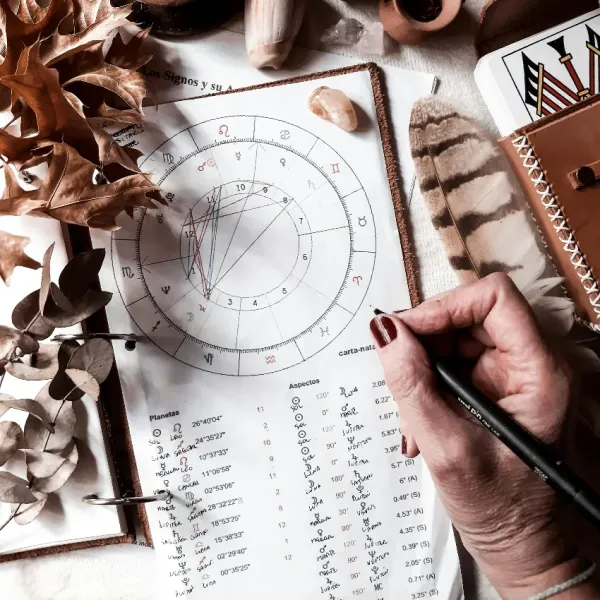 Gabriela Hughes | Pexels
You do have to take predictions for the future with a grain of salt, though, and not just because there isn’t a strong scientific basis for them. For most of history, the people who have been considered capable of making predictions have been straight white men who hold some kind of position of power, which calls their validity into question.
Some predictions have been eerily accurate, like Professor Peter Turchin’s assertion that 2020 would be complete chaos. Although he developed his theory in 2010, no one really paid much attention because, in his words, “they had no reason to believe that I wasn’t crazy.”
: How Your Childhood Hobbies Quietly Predicted Who You Are Today, According To Psychology
Even though forms of magic like this are considered to be ‘fantasy,’ we keep coming back to them.
As much as we might wish we could go to Hogwarts, the “Harry Potter” books will never make it to the nonfiction section of the library. The same goes for many other popular series like “The Lord of the Rings” and “The Chronicles of Narnia.” But, if we know they aren’t real, why do we care so much?
Part of the explanation may come from the way magic seems to make us happier, and maybe even smarter. Research shows that people who believe in magic not only have a higher likelihood of believing in other paranormal concepts, but also think luck is very real and have strong critical thinking skills.
 RDNE Stock project | Pexels
Furthermore, Dr. Gustav Kuhn, a psychology professor at the University of London, explained that magic, even in its most basic form, like a card trick, can make you feel like you’re watching an art form that also has a strong nostalgic pull.
Whether you think the future really can be predicted, or where you stand on the academic value of a course like “Omens, Oracles, and Prophecies,” magic is an inescapable part of our culture, and it can be a lot of fun, even if you never actually make it to Hogwarts.
: Actual Excuses College Students Used To Explain Why They Failed Classes & Genuinely Believe They’re In The Right
Mary-Faith Martinez is a writer with a bachelor’s degree in English and Journalism who covers news, psychology, lifestyle, and human interest topics.
-
Households told not to dry clothes on washing lines on Friday

-
Eagle-eyed fans spot the two people missing from Meghan Markle's wedding pictures

-
Kerala Secretariat's 'protest gate' opened after 10 years

-
Odisha Vigilance unearths crores worth of assets during raids on R&B Executive Engineer
-
Assam remediates 65 pc legacy waste in urban areas: CM Sarma