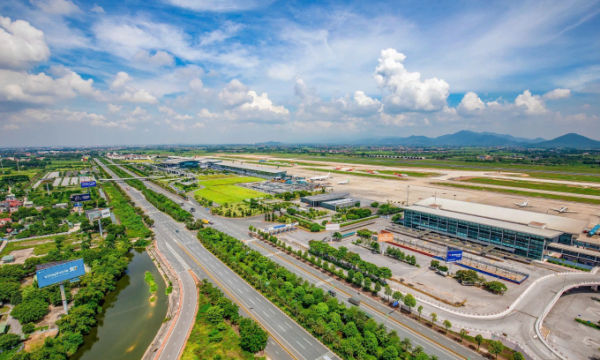
The plan, a blueprint for Hanoi’s development over the coming century, identifies the second airport as a multimodal transport hub and a strategic economic driver for the capital over the decades ahead. It places the airport in the Ung Hoa and Chuyen My area, about 40 km south of the city center, built to international standards with a designed capacity of 30 to 50 million passengers and around 1 million metric tons of cargo a year.
The ambition extends well beyond runways and terminals. Hanoi wants the surrounding area developed as an airport city that combines aviation services, a free trade zone, outlet malls, hotels, logistics, high-tech industry and other international services. Planners expect the airport to anchor an international cargo transshipment hub linking air, road and rail, with the surrounding corridor of warehousing, cold-chain logistics, an agricultural trade center and high-tech industrial parks built up as the logistics core of the entire capital region.
The plan also calls for a southern industry, logistics and high-tech growth pole in the Phu Xuyen and Ung Hoa area, tied to the second airport, high-speed rail and a river port.
|
Terminals T1 and T2 at Noi Bai International Airport. Photo by Giang Huy |
The southern zone is slated to double as a tourism gateway. The plan would link the airport to the Tam Chuc-Trang An tourism circuit and to a chain of spiritual heritage sites taking in the Perfume Pagoda, Tam Chuc, Bai Dinh and Trang An, the last a UNESCO World Heritage site. It designates the area as a logistics base and an international tourism transfer point between the airport and some of northern Vietnam’s most visited destinations, what the plan calls the capital’s “southern tourism gateway.” The airport zone would also be tied to high-quality healthcare complexes and a university town in southern Hanoi.
Rail is meant to be the main link between the airport and central Hanoi. The plan prioritizes urban railway line 1A, connecting Ngoc Hoi station with the second airport, for construction in the 2026-2030 window. Ngoc Hoi is designated as a major rail hub in the south, joining urban rail, the national network, the North-South high-speed railway and inter-regional rail ring lines, in order to reduce traffic cutting through the city center.
Road access in the south would rely on National Highway 1A, the North-South Expressway and a system of inter-regional ring roads, while the plan also envisions waterway transport to add logistics capacity.
Research and investment in the second airport and its accompanying free trade zone are grouped among the plan’s priority projects for the 2031-2045 period. Hanoi intends to draw on a mix of private and social resources and to apply special mechanisms to attract investment into what it frames as strategic infrastructure for the capital.
Hanoi currently has one airport, Noi Bai International Airport. Alongside the new southern project, the master plan calls for upgrading Noi Bai to a capacity of 50 million passengers a year and expanding it by about 1,500 hectares to the south. The city also plans to develop the Hoa Lac and Gia Lam airfields under a dual-use model serving both military and civilian aviation.
-
From the memoir: Mathematician and writer Manil Suri on his childhood in a crumbling Bombay flat

-
'Children of god': Madras HC infantilises transgender persons rather than speak of their rights
-
Sunscreen Tips: Should You Apply Sunscreen Before or After Makeup? 90% of People Make This Mistake..
-
Suvendu Adhikari aide murder case: CBI arrests fifth accused from Varanasi

-
Prepare South Indian Rasam Rice in just 20 minutes. The taste is such that you will keep licking your fingers..