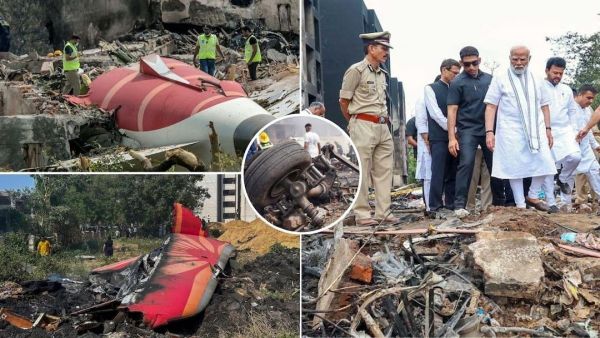
Ahmedabad: A man who lost three family members in the AI-171 crash in June last year has claimed that he saw the body of the flight's captain inside the mortuary in Ahmedabad in a seated position with his hands still gripping the plane's controls.
The claims of Romin Vohra, a resident of Kheda district in Gujarat, have surfaced amid continuing discussions over the circumstances leading to the crash and the actions taken in the cockpit during the final moments of the flight.
Latching on to his claims, an official of a US-based law firm, claiming to be representing families of more than 100 victims, said the crash must be examined by "truly independent experts" before blaming a "single person" for the tragedy.
"The families deserve the truth, not a quick conclusion that protects powerful companies or institutions," the official said.
The London-bound Air India flight AI-171 crashed into a hostel complex in Ahmedabad's Meghaninagar area moments after taking off from the Sardar Vallabhbhai Patel International Airport on June 12, killing 241 persons on board and 19 on the ground. One passenger survived.
It was operated by pilot-in-command Captain Sumeet Sabharwal and co-pilot Captain Clive Kunder.
The bodies of victims, many charred beyond recognition, were shifted to the mortuary at Ahmedabad Civil Hospital in the Asarwa area for identification and DNA matching.
Romin Vohra, who lost his brother, niece and aunt in the tragedy, claimed he entered the mortuary on June 13 to search for the remains of his family members and there saw the body of Captain Sabharwal.
Speaking to PTI over the phone on Tuesday, Vohra, a lab technician by profession, said he was allowed inside because he works in the medical field.
"My brother, my brother's daughter and my aunt died in the crash. I had gone to identify them a day after the crash. Since I am from the medical field and have some contacts, I got permission to go inside the mortuary," he said.
Vohra said Captain Sabharwal's body was kept separately from others on one side of a table.
"At that time, the body was stiff and in a sitting position, as if he was still on his seat," he claimed.
"His hands were holding the steering (control yoke or column). His legs were bent the way a seated person's legs remain bent, while his arms were stretched forward," Vohra added.
Asked if the controls were still in the pilot's hands, he replied, "Yes, the steering was in his hands." Vohra further claimed that the captain was still wearing his uniform, which helped him identify the body.
"The captain's uniform was there. There was only one captain's body there, which was that of Sumeet Sabharwal sir. I recognised him from the uniform," he said.
According to Vohra, the body had comparatively fewer burn injuries on the front side.
"He was burnt more on the backside. The front side and face were not burnt that much. I do not remember every detail exactly, but one could clearly tell it was the captain's body," he said.
Vohra said he could later confirm the identity after seeing publicly available photographs of the pilot.
"Being from the medical field, we can identify bodies from height, weight and physical structure. Later, when I saw photographs of Captain Sabharwal, I became sure that the body I saw was indeed his," he said.
He also described the emotional trauma faced by relatives waiting outside the hospital after the crash.
"At that time, our own tragedy was so huge that we were not in a condition to speak to anyone. For 10 days, I stayed put outside the hospital on the footpath in terrible condition while waiting for the bodies," he said, adding that his family was handed over the bodies after a successful DNA match.
Meanwhile, US-based legal firm Chionuma Law, which claimed to represent families of 115 victims of the crash, called for an independent investigation and cautioned against drawing premature conclusions.
"The reported account that Captain Sumeet Sabharwal was found in a seated position, still gripping the yoke, raises serious questions that cannot be ignored," Ayush Rajpal, case manager at the firm, said in a statement.
"A pilot who is holding the controls until the final moment should not be judged by speculation, especially when he is no longer alive to defend himself," he said.
"Every technical, mechanical, electrical and human factor" connected to the crash must be examined by "truly independent experts" before blaming a "single person" for the tragedy, Rajpal said.
"The families deserve the truth, not a quick conclusion that protects powerful companies or institutions," the statement added.
The Aircraft Accident Investigation Bureau (AAIB), in a preliminary report issued in July last year, said the plane's engine fuel control switches were cut off seconds after lift-off, with one of the pilots in the cockpit voice recording heard asking the other why did he cut off, and the latter responding he did not do so.
As per the report, the engine N1 and N2 began to decrease from their take-off values as the fuel supply to the engines was cut off.
The Supreme Court in November last year said no one blamed the plane's chief pilot for the crash, and asked Sabharwal's 91-year-old father not to carry any emotional burden.
(Disclaimer: This report has been published as part of the auto-generated syndicate wire feed. Apart from the headline, no editing has been done in the copy by ABP Live.)
-
From the memoir: Mathematician and writer Manil Suri on his childhood in a crumbling Bombay flat
-
'Children of god': Madras HC infantilises transgender persons rather than speak of their rights
-
Sunscreen Tips: Should You Apply Sunscreen Before or After Makeup? 90% of People Make This Mistake..
-
Suvendu Adhikari aide murder case: CBI arrests fifth accused from Varanasi
-
Prepare South Indian Rasam Rice in just 20 minutes. The taste is such that you will keep licking your fingers..