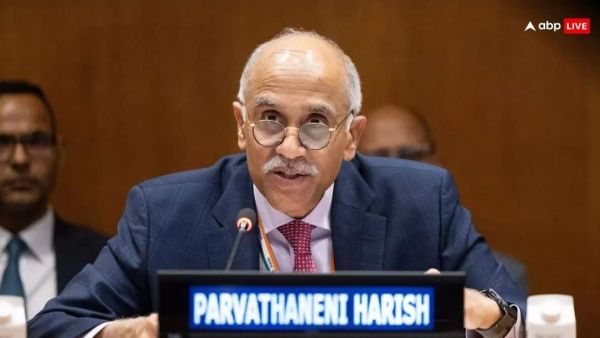
India launched a strong attack on Pakistan at the United Nations Security Council (UNSC), accusing Islamabad of sponsoring cross-border terrorism and repeatedly violating the principles of sovereignty, territorial integrity and peaceful coexistence. Speaking during the UNSC Open Debate, India’s Permanent Representative to the UN, Harish Parvathaneni, said New Delhi was compelled to respond to what he described as “baseless and unwarranted remarks” made by Pakistan during the session.
He asserted that India has “every right” to defend itself against terror attacks originating from across the border and warned that Pakistan must face the “consequences” of its actions.
India Accuses Pakistan Of Backing Terrorism
Parvathaneni accused Pakistan of pursuing a long-standing strategy of cross-border terrorism and following the doctrine of “bleeding India by a thousand cuts.” According to the Indian envoy, such actions expose the hollowness of Pakistan’s repeated claims about respecting the UN Charter and international norms.
He stated that independent India began its journey while confronting aggression from Pakistan, which, he said, sought control over territories that had “legally and irrevocably acceded to India”, as per reports.
The envoy also argued that Pakistan’s repeated wars, unprovoked aggression, and support for terrorist groups directly undermine the principles of peaceful coexistence and territorial sovereignty.
UNSC Debate Focuses On UN Charter And Reforms
The sharp exchange took place during the UNSC debate on “Upholding the purposes and principles of the UN Charter and strengthening the UN-centred international system.” The meeting was chaired by China as part of its presidency of the Security Council for May.
Parvathaneni also used the platform to push for long-pending reforms within the United Nations system. He noted that despite the UN Charter mandating a review conference in 1955, reforms to the Security Council have remained limited. He pointed out that the UNSC still reflects the geopolitical realities of the 1940s and argued that global institutions must adapt to changing international dynamics.
“The UN Security Council must be a living instrument, not a fossil,” he remarked, while calling for greater transparency and expansion of permanent membership in the Council.
Pakistan Raised Kashmir, Indus Waters Treaty
Earlier in the debate, Ishaq Dar raised the issue of Jammu and Kashmir and referred to the Indus Waters Treaty, which India suspended after the April 2025 Pahalgam terror attack that killed 26 civilians. India has blamed the attack on The Resistance Front (TRF), which it describes as a proxy of the Pakistan-based terrorist organisation Lashkar-e-Taiba.
Parvathaneni reiterated that Pakistan’s reliance on cross-border terrorism and its “thousand cuts” doctrine stands in contradiction to its public commitment to the UN Charter.
He also stressed that India, despite enduring the effects of colonial politics and global conflicts, has consistently remained committed to multilateralism and the United Nations framework.
Calling for cooperation instead of confrontation, the envoy said the future of multilateralism depends on compromise, inclusivity, and institutions that reflect present-day realities.
-
Haircare Tips: Does Sweat Make Hair Sticky? Learn easy tips to keep your scalp healthy

-
Mustard Oil Benefits: You will be shocked to know so many benefits of mustard oil, know the expert’s opinion

-
Cloudflare Layoff: Tech Firm Fires 1,100 Employees As It Shifts Towards AI And Automation

-
What is a Super Pressure Balloon? India launches first indigenous Super Pressure Balloon from Vijayawada
-
The explosion of the domestic company! New Lava Phone Launched Under 12k… Equipped with Powerful Battery and 120Hz Display