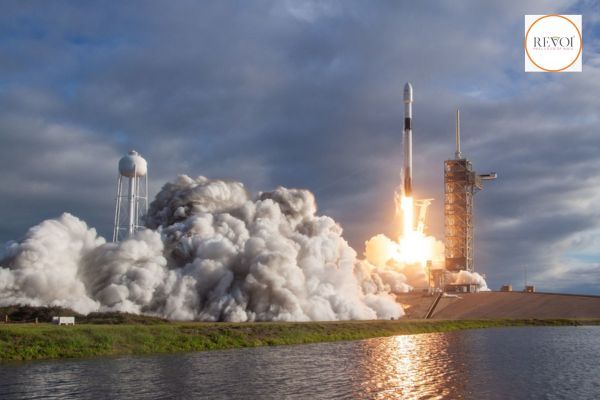
- many people launch time looks huge white to the cloud smoke up believe is, but of them big part this h of water varal are there is. Rocketny to heat due to water in moments ukli goes is and white Varal’s huge cloud make is
When a rocket takes off into the sky, a huge white smoke cloud suddenly appears around the launchpad. Many people think that this is just smoke coming out of fuel combustion, but in reality there is very interesting science behind this phenomenon. The white “smoke” seen during rocket launches is primarily a mixture of water vapor, condensation of supercooled gases, and in some cases, chemical particles. Especially in modern spacecraft, this phenomenon is caused by the combined effect of the Earth’s atmosphere, extreme heat and extreme cold.
use of cryogenic fuel
Cryogenic fuels like liquid hydrogen and liquid oxygen are used in many large rockets like the Space Launch System or Space Shuttle. When this fuel burns in the engine, its main product is water vapor. This extremely hot vapor coming out of the rocket’s engine quickly cools in the cold surrounding air and takes the form of a huge white cloud. That means the large portion visible at launch is not actually “smoke” but pure water vapor. A continuous white smoke is visible around the outer part of the rocket. The reason for this is the supercooled liquid filled inside the rocket. For example, the temperature of liquid oxygen is approximately minus 183 degrees Celsius. When such cold tanks come into hot and humid air, the moisture present in the air immediately condenses and takes the form of smoke or ice-like clouds. Therefore, the white smoke seen around the rocket before launch is often the result of moisture present in the Earth’s air.
“Solid rocket booster” is also used in some rockets. Aluminum based solid fuel is burnt in such boosters. Due to this, substances like microscopic particles of aluminum oxide, carbon dioxide, nitrogen and hydrochloric acid are produced. This type of smoke may appear slightly yellowish or dark white. Such smoke was more clearly visible in spacecraft like the old Ariane 5 and Space Shuttle.
sound suppression system
One of the biggest problems during a rocket launch is not only the heat shock, but also the extremely loud noise. When the rocket engine ignites, hot gases are thrown downwards with millions of newtons of power. In this process, such strong sound waves are produced that its sound can exceed 180 decibels. In comparison, the sound of a jet aircraft is around 140 decibels. Therefore, the sound of rocket launch can be dangerous not only for human ears but also for the rocket. These powerful sound waves are reflected back and forth along the launchpad and surrounding surfaces. If these waves collide directly with the bottom of the rocket or the satellites inside it, they can cause severe vibrations. As a result, electronic systems, fuel tanks or sensitive scientific equipment may be damaged. To reduce this risk “sound suppression system“are made.
The main function of this system is to reduce the power of sound waves. For this, a large amount of water is released on the launchpad before launch. This method is also called “water deluge system”. The water release process usually begins about 10 seconds before the rocket takes off. On some launchpads, millions of liters of water are released in just one minute. Water works in very interesting ways here. When the rocket’s hot exhaust gases mix with water, much of the water immediately turns into vapor. In this process water absorbs a large part of the energy of sound waves. In simple language, water acts as a “cushion” for sound. It breaks up sound waves and reduces their reflection.
water flow and quantity
Apart from this, water also helps in keeping the launchpad cool. The temperature of the flame coming out of rocket engines can reach thousands of degrees Celsius. If there is no water, the concrete and metals of the launchpad could break or melt. Therefore, apart from reducing noise, water also provides protection from heat. The word “deluge” means “sudden flow of large amounts of water.” In just a few seconds before the rocket launch, millions of liters of water is released on the launchpad. This water is thrown out very quickly through huge pipes, stitches and nozzles. At some launchpads, lakhs of liters of water is distributed in less than a minute. see this link.
When the flames coming out of the rocket’s engine interact with this water, the water immediately turns into vapor. In this process water absorbs a large amount of energy. As a result, the surface temperature of the launchpad decreases and the possibility of metal breakage of concrete is reduced. That means water acts as a kind of “cooling shield”. Many people consider the huge white cloud seen at launch to be smoke, but a large part of it is water vapor. Due to the heat of the rocket, the water boils within moments and forms a huge cloud of white vapor.
protective level of water against engine flames
In traditional launchpads, water was released from above through large towers and special nozzles called “rainbirds”. But SpaceX has developed a new method for its Starship. In this, a huge steel plate has been made below the launchpad which has thousands of small holes. Through these holes, water is thrown straight upwards under extreme pressure so that a protective layer of water is immediately formed against the flames of the engine. The water deluge system is extremely important in modern rocket science. Without it, it would be very difficult to safely fly the powerful rockets launched today. This system shows that even seemingly ordinary water can play a very important role in advanced space technology.
In older systems, water was released from large towers in a rain-like manner. But SpaceX has developed a new method for Starship. In this, water is released under high pressure through thousands of small holes beneath the huge steel plate directly in front of the flames of the engine. This system is also often called an “inverted shower”. Its purpose is to control both noise and heat more effectively. The large white cloud seen during a rocket launch is often water vapor. That is why the “smoke” we see on TV is mostly a miracle of water and science.
SpaceX developed a new method in this field
In modern space technology, SpaceX has developed a new method in this field. Instead of the traditional water filtering tower method, Starship has been made of huge steel plates. There are thousands of small holes in this plate through which high pressure water is released directly in front of the flames of the engine. This system is useful not only in reducing noise but also in protecting the launchpad from extreme heat. During the initial testing of Starship, concrete was blown away due to the power of the engine, after which this new system was developed.
Where does the water that evaporates during rocket launch go after that is also an interesting question. A portion of the water immediately turns into liquid. The second part spreads in the surrounding areas in the form of smoke and fog. The remaining water is collected around the launchpad. Because it may contain chemical residues and metal particles, it is purified by mixing it in special tanks. In modern space stations, filtration and recycling of this water is also done to reduce harm to the environment.
The spectacle of a rocket launch is not just a display of technology, but a wonderful coordination of physics, chemistry, acoustics and environmental science. In these huge clouds of white smoke, the vapor of water, the moisture of the earth, the heat of the flame and the amazing scientific understanding of human intelligence work together.
-
77 pc increase in improved menstrual hygiene among Indian women: Survey

-
Tobacco quitline receives nearly 1 cr calls in a decade, helps 2.32 lakh quit

-
Promised to return in ten minutes, man fatally stabbed on Eid; 3 minors held

-
Bengaluru cop carries differently-abled youth across flooded road, wins praise

-
CUET-UG delayed at some centres; NTA revises afternoon schedule