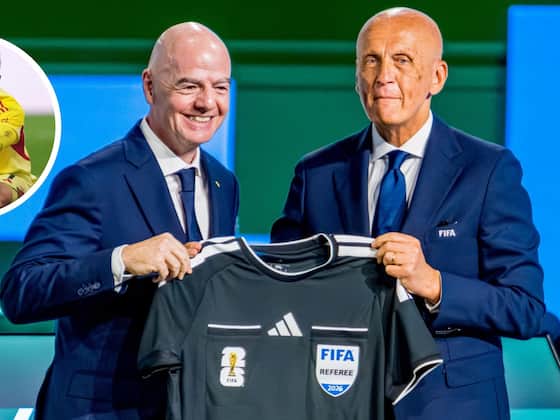
Among a series of major law updates for the upcoming World Cup, the International Football Association Board (IFAB) has introduced measures aimed at curbing tactical timeouts caused by goalkeepers going down injured, though many expect that teams may still find ways to exploit the rules.
The IFAB has announced that these revised laws will be implemented not only at the World Cup but will also come into effect globally from the 2026/27 season onwards.
“The IFAB approved a set of landmark changes to the Laws of the Game, and the FIFA World Cup 2026 will be the first major competition to apply them,” said FIFA’s chief refereeing officer Pierluigi Collina.
He added, “These amendments are designed to address discrimination, reduce time-wasting, improve the flow of the game, and enhance the experience for both players and fans.”
Here’s an overview of the key changes:
Players who cover their mouth with their hand, arm, or shirt in confrontational situations will now receive a red card. This rule follows an incident involving Benfica’s Gianluca Prestianni, who was accused of making discriminatory remarks to Vinicius Jr while covering his mouth. Prestianni received a six-match suspension from UEFA, later extended worldwide.
However, players chatting amicably with friends or former teammates on the pitch will not face punishment. “We understand that players may have friendly conversations before, during, or after the match,” said Collina. “But in a confrontational context, it’s completely different. Covering the mouth is a deliberate act and not something done instinctively.”
Players who leave the field to protest a referee’s decision will now receive a red card. The same rule applies to team officials who encourage players to walk off. Additionally, any team responsible for a match being abandoned will forfeit the fixture.
This rule was introduced after Senegal walked off the field during the 2026 Africa Cup of Nations final against Morocco in protest over a penalty decision. The team returned 16 minutes later and won 1-0 in extra time. However, CAF later overturned the result, ruling Senegal’s protest as a forfeiture. Senegal are appealing the decision, but the new laws now make such outcomes clearer.
Following the success of the eight-second rule for goalkeepers, IFAB is introducing five-second countdowns for throw-ins and goal-kicks. Referees will raise a hand to signal this countdown. If the throw-in or goal-kick is not taken in time, possession will switch — throw-ins go to the opposition, while delayed goal-kicks will lead to a corner for the opposing team. “We don’t expect many infractions; players will adapt to the new timing,” said Collina.
Substitutions will also be timed. Players will have ten seconds to leave the pitch after the substitution board is shown and must exit at the nearest boundary point. If they fail to do so, the substitute can only enter after one minute of play and at the referee’s signal. Exceptions apply for safety or injury concerns.
Under the new medical rule, any outfield player receiving treatment on the field must remain off the pitch for one minute after the restart. Exceptions include goalkeeper injuries, head collisions, fouls resulting in yellow or red cards, and situations where the injured player is due to take a penalty.
To discourage teams from exploiting goalkeeper injuries as tactical timeouts, players from both sides will no longer be allowed to approach the bench during treatment breaks. “We discussed this with all World Cup nations,” said Collina. “Referees will ensure that players do not use these moments as timeouts. The goalkeeper is entitled to treatment, but others are not entitled to a break.”
Since this rule is still under discussion, loopholes could persist, and teams may continue to use such stoppages to disrupt momentum.
VAR will now have expanded authority. It can intervene in the following situations: when a red card is wrongly issued instead of a yellow, in cases of mistaken identity, for incorrectly awarded corners if corrected immediately, and for fouls committed before the ball is in play during set-pieces.
This last change closes a previous gap that prevented VAR from reviewing fouls before restarts. Collina cited England’s Adam Wharton blocking a defender before Ben White’s goal against Uruguay as an example of what IFAB wants to eliminate. “We started using VAR in 2017 at the Confederations Cup before the 2018 World Cup. Now, with more experience, it’s time to update the protocol,” Collina explained. “Nobody wants a goal to stand just because VAR couldn’t intervene due to outdated rules.”
Hydration breaks have also been formalised: there will be a three-minute break around the midway point of each half at the World Cup. Referees can adjust the timing slightly, such as during an injury stoppage around the 20-minute mark. FIFA has approved limited commercial advertisements during these breaks — they can begin 20 seconds after the signal and must end 30 seconds before play resumes.
Across 104 matches, this will add roughly seven and a half hours of in-game advertising time throughout the tournament.
-
Train Safety Tips: Using Free Wi-Fi on the Train? One Mistake Could Empty Your Bank Account
-
Solar Panel Benefits: Say Goodbye to Electricity Bills—Here Are the Major Advantages of Installing Solar Panels

-
Suspect a Hidden Camera in the Trial Room? Don't Panic—Do This Immediately! Check Out This Complete Safety Guide

-
Ladki Bahin Scheme: 80 Lakh Women Removed from Beneficiary List—Know the Reasons and Check If You’re Affected
-
Money Management Tips: How to Build an Emergency Fund on a ₹25,000 Salary? Learn the Simple Math