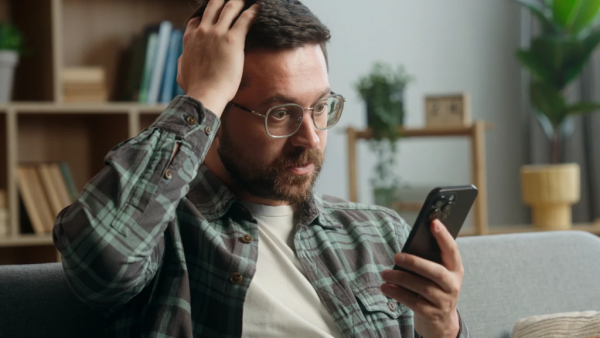
Social media can be a treasure trove of information. It showcases creativity and humor, while creating a space for people to share ideas.
Like with everything, that can be both good and bad. Many people have found it possible to use social media as a learning tool, but misinformation that can change the way people see reality still abounds. Certain age groups might find it harder than others to tell what’s real and what’s fake when scrolling through posts.
It seems like millennials could be the only generation able to differentiate between what’s real and fake on the internet.
TikTok content creator Aaron Locke, who is a millennial himself, believes that his generation rises above the rest when it comes to identifying real and fake information online. He argued that millennials grew up without the internet, but had to deal with it eventually, so they saw the world both with and without it.
He felt like this was most applicable in the case of writing research papers for school. “Any research paper we did, we had to have 10 different sources, and none of them were allowed to be Wikipedia or a website that ended with dot com,” he said.
These rigid requirements led many millennials to easily learn what’s the real deal since they had to verify sources extensively. This has caused them to be less likely to believe just anything that pops up on their feed. And, if they’re suspicious, they know they need to look into it further.
: Why So Many Millennials Are Clashing With Gen-Z Over What Work Ethic Actually Means
This seems to be a pretty commonly accepted idea, although there isn’t much evidence to back it up.
Another millennial named Zakiya offered an argument that aligned with Locke’s take in her own TikTok video. She said that, although her generation didn’t grow up with the internet, watching classic shows like “Rugrats” and “Boy Meets World” helped them understand media and how it connected to real life in a different way.
www.kaboompics.com | Pexels
“As a kid, we were taught how to analyze media and apply it to real life without even recognizing we were doing it,” she explained. She said this was even present in the way that media used to be a more communal experience, with families watching movies together and then talking about them afterward.
But millennials might not want to get too confident in their skills. A team of researchers from the University of Virginia and the University of Cambridge actually found that because Gen Z and millennials are so used to getting their news online, they’re also the most likely to fall for misinformation.
: You Can Usually Tell Someone’s Highly Intelligent By One Habit That Often Frustrates Average Minds
Regardless of which generation is the best, media literacy is a critical skill in today’s world.
In 2018, researchers from MIT found that fake news is 70% more likely to be shared on social media than real news is. And, despite commonly held beliefs that most misinformation comes from bots, they concluded it’s more likely to be spread by actual people.
Sinan Aral, one of the study’s co-authors and a professor at the MIT Sloan School of Management, explained how meaningful this is. “We found that falsehood diffuses significantly farther, faster, deeper, and more broadly than the truth, in all categories of information, and in many cases by an order of magnitude,” he said.
 pikselstock | Shutterstock
Technology is tricky because it can put everyone at a disadvantage no matter how old they are. Kids are the most familiar with the latest technology, but they also have a tendency to be more trusting of it. Meanwhile, boomers aren’t always skilled with using the internet, and those who are often don’t understand the dangers of AI and things meant to deceive.
Misinformation acts as a vicious cycle, though, because people are more likely to believe it if they see it for themselves. That makes it more likely for them to share it for others to see as well, which leads everyone down a rabbit hole.
All age groups need to develop media literacy to stay properly informed. And, perhaps it would be best for no single generation to get too boastful about their own abilities in the process.
: Not Everyone Wants To Be On Social Media: 4 Instances When It’s Definitely Time To Put The Phone Down
Sahlah Syeda is a writer who covers relationships, culture, and human interest topics.
-
'I just want to play for India': The simple dream driving RCB pacer Rasikh Salam Dar

-
How To Make Fresh Mango Frooti At Home That Tastes Like Store-Bought

-
2026 Honda City Vs Hyundai Verna: Detailed Comparison

-
7,500mAh battery and MediaTek processor… burn the new Honor smartphone in the market! You will also be happy with the price

-
Belgium beats Croatia 2-0, Lukaku scores 90th goal in return