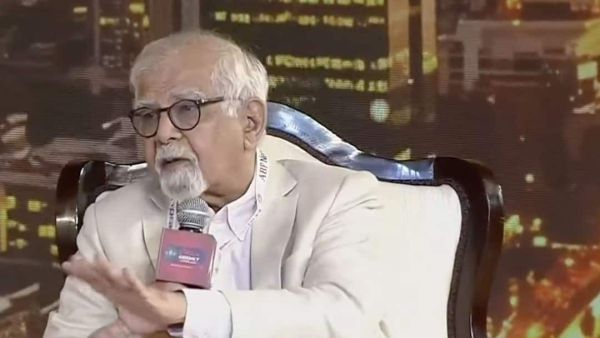
Is India facing an economic crisis? Economist Surjit Singh Bhalla believes the answer depends on how the question is framed.
Speaking at the ABP Network India@2047 Conclave on Tuesday, Bhalla argued that the economic challenges confronting India today cannot be viewed in isolation, as the ongoing conflict in West Asia has created uncertainty across the global economy.
"Every country in the world is in a crisis in 2026 because of the West Asia war," Bhalla said during the session titled 'The Economic Crisis: What Should the Government Do?'
He noted that it would be inaccurate to characterise the current situation as a uniquely Indian problem, given the widespread impact of higher energy prices, disrupted trade flows and geopolitical uncertainty.
"We don't know when the war will end," he said, adding that the consequences of the conflict are being felt across economies worldwide.
India's Challenge Is Not Crisis, But Growth
While acknowledging global headwinds, Bhalla suggested that the more important question for India is whether the economy is growing fast enough to achieve its long-term ambitions.
According to him, the country's challenge is not necessarily one of instability but of underperformance relative to its potential.
"The crisis is we are growing at 6 per cent," he said.
Bhalla pointed out that India's average growth rate has been around 6.34 per cent, a figure that compares favourably with many large economies but falls short of what is needed to transform India into a developed nation by 2047.
"Our infrastructure, human capital is way better than it was and still our growth rate is around 6 per cent," he observed.
Political Stability A Key Strength
Bhalla also highlighted India's political environment as one of the country's major strengths at a time when many nations are grappling with uncertainty.
"Our politics is at its peak, political certainty is at its peak," he said.
According to the economist, political stability is often associated with stronger investment activity, improved business confidence and more robust economic growth.
The combination of political certainty and improving economic fundamentals, he suggested, provides India with a stronger platform than many other countries currently dealing with the fallout of the West Asia conflict.
Why The 9% Growth Target Matters
Looking ahead, Bhalla argued that India needs to significantly accelerate its growth rate if it hopes to achieve the government's Viksit Bharat vision.
"The target of 9 per cent comes from the target of Viksit Bharat," he said.
According to Bhalla, sustaining growth closer to 9 per cent would be necessary to generate the scale of income expansion, employment creation and infrastructure development required to reach developed-country status over the next two decades.
"We should be growing much faster," he said.
For the economist, the defining challenge is not whether India is in crisis, but whether it can convert its improving infrastructure, stronger human capital base and political stability into the higher growth rates needed to realise its 2047 ambitions.
As discussions at the India@2047 Conclave continue, Bhalla's message was clear: the global environment may be difficult, but India's biggest challenge is ensuring that its economic growth matches the scale of its aspirations.
-
EPFO Passbook: No Password, No CAPTCHA Hassle—Check Your PF Balance Instantly with This App..

-
UPI Rules Changed in June: Enable These 5 Settings Immediately, or You Could Face Losses..

-
CDAC Recruitment 2026: Recruitment Announced for Multiple Posts, Including Project Engineer and Project Manager—View Full Details Here..

-
SBI Apprentice 2026: The deadline for registration for apprenticeship positions at SBI is approaching—apply soon..
-
RPSC Teacher Recruitment 2026: Recruitment Announced for School Lecturer Posts in Rajasthan—Check Eligibility and Other Details Here..