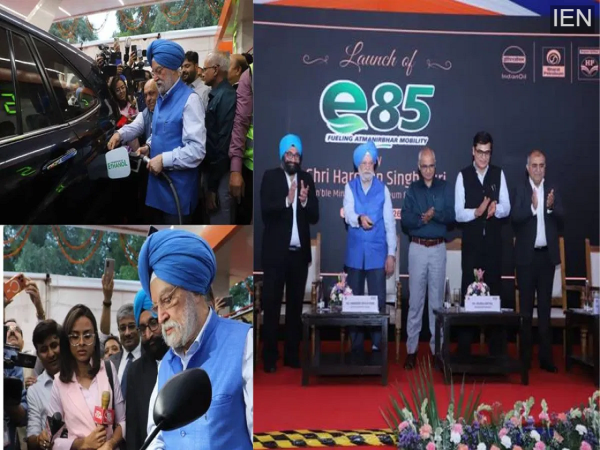
India has taken another significant step toward cleaner transportation with the launch of E85 fuel on World Environment Day 2026. The new fuel, introduced by Union Petroleum and Natural Gas Minister Hardeep Singh Puri in New Delhi, is expected to reduce fuel costs for consumers while supporting the country's goals of lowering emissions and reducing dependence on imported crude oil.
According to the government, E85 fuel could cost nearly ₹20 less per litre than conventional petrol. With petrol prices in Delhi currently above ₹102 per litre, E85 may be available at around ₹82 per litre, making it an attractive alternative for eligible vehicle owners.
What Is E85 Fuel?
E85 is a high-ethanol blended fuel made primarily from ethanol, with a smaller proportion of petrol. The blend generally contains 80-85% ethanol and 15-20% petrol. It has been specifically developed for use in Flex-Fuel Vehicles (FFVs), which are designed to operate on a wide range of ethanol-petrol mixtures.
Unlike regular vehicles, flex-fuel models can run on fuels containing significantly higher ethanol concentrations, ranging from E20 to E100. Because of this specialized design, E85 cannot be used in standard petrol-powered vehicles.
Initial Rollout Begins at Selected Fuel Stations
The government has started distributing E85 fuel through a limited network of fuel stations operated by public-sector oil marketing companies. In the first phase, the fuel is available at 48 retail outlets across the country.
Officials have outlined an ambitious expansion plan. The number of E85 dispensing stations is expected to increase to around 500 by the end of 2026. The government aims to further expand availability to approximately 5,000 petrol pumps nationwide by December 2027.
This phased rollout is intended to support the growing adoption of flex-fuel vehicles and create a stronger ethanol-based fuel ecosystem across India.
Why Is E85 Expected to Be Cheaper?
One of the biggest attractions of E85 fuel is its lower price compared to traditional petrol. Since ethanol is produced domestically from agricultural feedstocks such as sugarcane and other crops, it helps reduce reliance on imported crude oil.
The government believes that increasing ethanol usage can pass economic benefits directly to consumers while also strengthening India's energy security. Lower fuel costs could encourage more motorists to consider flex-fuel vehicles in the future.
Benefits for Farmers and Rural Economy
Officials say the ethanol blending programme has already generated significant economic advantages for the country. Ethanol blending levels, which were relatively low a decade ago, have expanded rapidly in recent years.
The increased demand for ethanol creates additional income opportunities for farmers by providing a market for agricultural produce used in ethanol production. Government representatives have emphasized that farmers are contributing not only to food security but also to India's clean energy transition.
The expansion of ethanol production is expected to channel thousands of crores of rupees into rural economies while creating new opportunities in agriculture and biofuel manufacturing.
Major Environmental Advantages
Environmental benefits are another key reason behind the launch of E85 fuel. Government estimates suggest that flex-fuel vehicles running on high-ethanol blends can significantly reduce greenhouse gas emissions compared to conventional petrol vehicles.
Studies indicate that lifetime emissions from such vehicles could be substantially lower, helping India move closer to its climate goals. Additionally, ethanol has a higher octane rating than petrol, which can contribute to improved engine performance and combustion efficiency in compatible vehicles.
The move aligns with India's broader strategy to promote cleaner fuels and reduce pollution from the transportation sector.
Ambitious Ethanol Targets for the Future
The government has set an ambitious roadmap for expanding ethanol usage over the coming years. Officials estimate that if half of all newly sold two-wheelers and four-wheelers adopt flex-fuel technology, ethanol demand could rise dramatically.
Such growth could lead to substantial savings in foreign exchange by reducing crude oil imports while also cutting carbon emissions on a large scale. Policymakers are targeting an overall ethanol blending level of around 26% by the financial year 2030-31.
Important Warning for Vehicle Owners
Authorities have clarified that E85 fuel is not suitable for regular petrol vehicles. Only certified flex-fuel vehicles are engineered to handle such high ethanol concentrations safely.
The government has also addressed concerns regarding ethanol-blended fuels, stating that no widespread issues related to engine damage have been reported with approved ethanol blends. Officials further noted that using ethanol-blended fuel does not affect vehicle insurance coverage when used as recommended by manufacturers.
As India accelerates its transition toward cleaner and more sustainable energy sources, E85 fuel could become an important part of the country's future mobility strategy. However, its success will largely depend on the availability of flex-fuel vehicles and the expansion of fuel infrastructure across the nation.
-
Weekend Getaways: 2 day budget trip plan, best places to visit near Delhi-NCR

-
Perfect for digestion in scorching summers, Nutritious Moong Dal Khichdi is quick to prepare in 15 minutes.

-
Tech Tips: Airplane Mode or DND? Who saves the most smartphone battery? Know in detail

-
32 year old Indian wicketkeeper retired, expressed gratitude to Rohit-Virat in an emotional post

-
IND vs AFG: From KL Rahul And Rishabh Pant to Sai Sudharsan; Check Shubman Gill’s Predicted India Playing XI For Mullanpur Test | In Pics