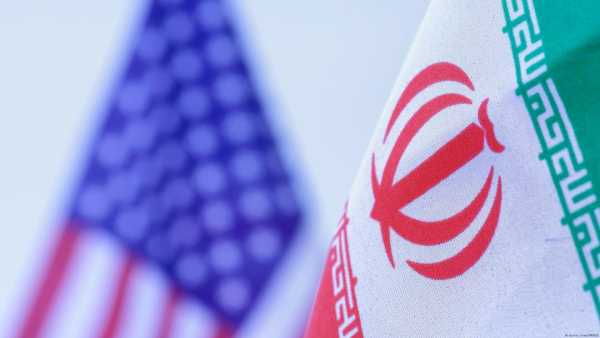
US President Donald Trump on Thursday announced that an agreement with Iran could be imminent. He spoke of a "memorandum of understanding" (MoU) that both sides aim to conclude in the coming days.
Iranian officials said that no draft MoU had yet been approved. However, if the United States were to accept the proposal put forward by Iran, it was likely that Iran would follow suit.
An agreement would mark the most significant diplomatic development since the Iran war began over three months ago — a conflict that has cost thousands of lives and pushed global energy prices higher.
Iran's Nuclear Program Remains Key Hurdle
At the center of the US-Iran negotiations is Tehran's nuclear program, in particular the handling of what is believed to be around 400 kilograms (970 pounds) of uranium enriched to around 60%.
If further enriched, this material could theoretically be sufficient to produce several nuclear weapons — something the United States is seeking to prevent.
Iran's state-run IRNA news agency said that "Iran's right to enrich uranium and the retention of enriched material... will be emphasised with a view to their inclusion in the final agreement."
While the US side has reportedly proposed a long-term moratorium of up to 20 years, Tehran has so far rejected this approach. Instead, talks have instead centered on a much shorter pause of around five years.
Dispute Over Highly Enriched Uranium
Iran views its enriched uranium as a bargaining chip in negotiations and is unwilling to give it up. The country has proposed downblending the material to lower enrichment levels itself, but only in exchange for lifting US sanctions.
The involvement of a third country is also under discussion as a possible compromise. Russia has repeatedly offered to take custody of Iran's highly enriched uranium for secure storage or further processing on its own territory.
China is also said to have signaled its willingness to be involved in a new deal as a mediator and logistical partner.
Alongside the nuclear issue, the economic dimension also plays a central role. A key point of contention is how to handle Iranian assets frozen abroad, which are estimated to amount to as much as $100 billion (€86 billion).
Much of these funds stem from oil exports that have been blocked by US sanctions in countries such as South Korea, China and Japan. Tehran is calling for the release of between $6 billion and $12 billion, as well as an easing of sanctions.
The US government, meanwhile, wants to release funds only gradually and strictly for humanitarian purposes.
At the same time, officials in Washington are reportedly discussing using parts of Iran's frozen assets to compensate for damages suffered by US allies in the Gulf region.
In response to US strikes, Iran targeted US bases and their logistical facilities in Arab countries along the Persian Gulf. US Treasury Secretary Scott Bessent is said to have tasked a team of experts with estimating the costs of the recent escalation and exploring possible funding options.
A Marshall Plan Or Iraq Deja Vu?
In a post on Truth Social on June 8, Trump said peace talks were proceeding "subject to ignorance or stupidity getting in its way."
When asked to clarify his post during an interview with US broadcaster ABC News, Trump said, "If people are stupid, we'll end up in something where we have to wipe out an entire infrastructure of a nation, and I don't think that's a good thing, because somebody's going to have to rebuild it."
Trump suggested that in such a scenario, the US would likely end up helping to fund the rebuilding of Iran.
"Somebody's going to have to build all that infrastructure ... You know, they're talking about a trillion dollars, probably more. And you know that's why we'll probably get involved in rebuilding, right, helping them rebuild," he said. Asked if that would be like a Marshall Plan for Iran, Trump replied, "Yeah." He added, "But we'll get half their oil."
Iran, however, rejects any foreign control over its oil resources as a violation of national sovereignty. Public opinion is also shaped by the experience of neighboring Iraq.
A significant share of Iraq's oil revenues — the country's main source of income — has effectively been handled from the Federal Reserve Bank of New York in an arrangement dating to the aftermath of the 2003 US invasion of Iraq.
The system was originally set up by the US-led transitional administration to safeguard funds for reconstruction. Infrastructure projects aimed at modernizing the economy are still incomplete.
What Will Happen With Strait Of Hormuz?
As an initial step following any agreement, shipping traversing the Strait of Hormuz is to be gradually normalized and the US blockade of Iranian ports lifted.
Disruptions to shipping in the key waterway are already having significant effects on global trade and energy prices. Around 20% of global oil and liquefied natural gas exports passed through this narrow chokepoint before the conflict.
Despite a ceasefire between Iran and the US in place since April 8, the past weeks have seen near-daily military clashes between the two sides in the Persian Gulf.
According to US statements, the operations have targeted Iranian positions along the coast, including surveillance facilities, communication systems and air defense sites, with the aim of weakening Tehran's military capabilities — and in particular its potential control over the strait.
Iran, for its part, responded with direct attacks on US targets in the region and most recently escalated further by shooting down a heavy combat helicopter.
On Friday, Iran's state media said that Tehran would not give up control over the strategic Strait of Hormuz.
"Iran makes no commitment … to cede the management of the strait or the restoration of conditions that existed prior to the American and Israeli military aggression," IRNA reported.
Disclaimer: This report first appeared on Deutsche Welle, and has been republished on ABP Live as part of a special arrangement. Apart from the headline, no changes have been made in the report by ABP Live.
-
BJP inspired by Kim Jong Un: Telangana CM on Meenakshi Natarajan
-
Gujarat Government Unveils Major Redevelopment Plan for Air Crash Site
-
India to Experiment with No. 3 Batting Position in ODI Series Against Afghanistan

-
Midland Police Pursue Suspect After Traffic Stop Incident and Deadly Shooting
-
Why the Empire State Building should top every traveller's New York itinerary in America's milestone year