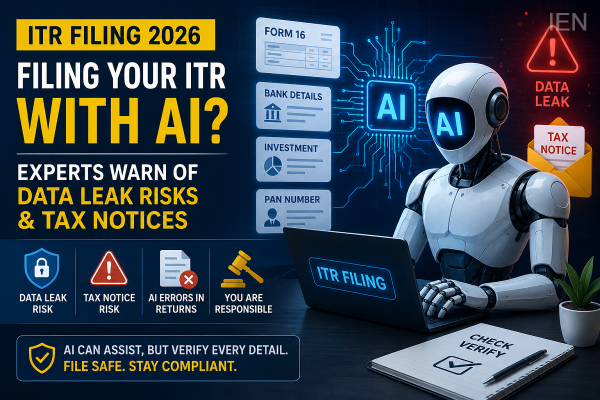
ITR Filing 2026: AI Can Simplify Tax Preparation, but Blindly Trusting Chatbots May Lead to Tax Notices and Data Leaks
ITR Filing 2026: Artificial Intelligence (AI) is rapidly becoming a part of everyday life, helping users with everything from writing emails to financial planning and investment research. Many taxpayers are now turning to AI-powered chatbots for assistance while preparing their Income Tax Returns (ITR).
However, tax professionals caution that relying entirely on general-purpose AI tools for filing tax returns can be risky. Experts warn that inaccurate tax calculations, incomplete disclosures, and privacy concerns could result in tax notices, delayed refunds, or even exposure of sensitive financial information.
Here is why experts recommend using AI only as a support tool—not as a substitute for professional tax advice or official filing platforms.
Why Experts Advise Against Relying Solely on AI
While AI can quickly answer tax-related questions and summarize complex rules, it does not always provide consistent or legally accurate tax calculations.
According to Archit Gupta, Founder and CEO of ClearTax, many taxpayers are uploading sensitive financial documents such as Form 16, salary slips, investment statements, and other income records directly to public AI platforms.
He cautions that general AI chatbots are not specifically designed to interpret India's tax laws with complete accuracy. As a result, the same Form 16 may produce different tax calculations when processed multiple times.
More importantly, if an incorrect return is filed based on AI-generated advice, the legal responsibility remains entirely with the taxpayer—not the AI platform.
Data Privacy Could Become a Major Concern
Experts also highlight serious concerns regarding the privacy of financial information.
Uploading confidential documents such as:
-
PAN details
-
Salary slips
-
Bank account information
-
Investment records
-
Tax documents
to publicly accessible AI tools may expose sensitive personal and financial data.
According to Gupta, sharing confidential company or employee financial information on public AI platforms may also violate the data security policies of several organizations. In some cases, such actions could even result in disciplinary action by employers.
For this reason, taxpayers should avoid uploading confidential financial documents to AI services unless they are specifically designed with enterprise-grade privacy protections.
Where AI Can Actually Be Useful
Despite the risks, experts agree that AI can still play a valuable role during the tax filing process when used appropriately.
Tarun Garg, Partner at Deloitte India, says AI should be treated as an assistant rather than a replacement for professional tax filing.
According to him, AI can help taxpayers:
-
Understand income tax rules in simple language.
-
Prepare a checklist of required documents.
-
Compare the old and new tax regimes.
-
Explain common tax concepts and deductions.
-
Organize information before filing returns.
However, any return prepared with AI assistance should always be treated as a draft until all information has been verified against official records.
Essential Checks Before Filing Your ITR
Experts recommend reviewing every detail carefully before submitting your Income Tax Return.
Match Your Income Records
Verify your income details with:
-
Annual Information Statement (AIS)
-
Taxpayer Information Summary (TIS)
-
Form 26AS
Any mismatch may lead to delayed processing or notices from the Income Tax Department.
Select the Correct ITR Form
Choosing the wrong ITR form can make your return defective and may require filing a revised return later.
Confirm Your Tax Regime
Ensure that you have selected the appropriate tax regime—either the old regime or the new regime—based on your eligibility and tax planning.
Verify TDS and TCS Credits
Check that all Tax Deducted at Source (TDS) and Tax Collected at Source (TCS) entries appearing in official records have been correctly claimed.
Review Special Income Disclosures
Pay particular attention to reporting:
-
Capital gains
-
Cryptocurrency transactions
-
Foreign assets
-
Foreign income
-
Other mandatory disclosures
These categories require accurate reporting and often involve additional compliance requirements.
Validate Your Bank Account
Ensure that your bank account has been pre-validated on the Income Tax e-filing portal so that refunds, if any, can be credited without delay.
Final Word
Artificial Intelligence is making tax preparation faster and more convenient, but it should not replace careful verification or professional advice. AI can simplify research, explain tax concepts, and help organize information, but it cannot assume legal responsibility for your tax return.
Before submitting your ITR, always cross-check every figure with official documents and the Income Tax Department's records. For taxpayers with complex financial situations involving capital gains, business income, foreign assets, or cryptocurrency transactions, consulting a qualified tax professional remains the safest approach.
Using AI wisely—as an assistant rather than the final decision-maker—can help you enjoy the benefits of technology while avoiding unnecessary tax disputes, privacy risks, and filing errors.
Disclaimer: This article is intended for informational purposes only and should not be considered tax, financial, or legal advice. Tax laws and filing requirements may change over time. Taxpayers should verify information through the official Income Tax Department portal or consult a qualified tax professional before filing their returns.
-
Shafali, Radha headline India's five-wicket win over Bangladesh in T20 World Cup, can qualify for semis?

-
Sweden Ring the Changes as Elanga Returns for Crucial Japan Clash

-
Libra Tarot Horoscope Today, June 26, 2026: Avoid flattery, favourable conditions will grow stronger

-
Love Horoscope Today for Friday, June 26, 2026: Aquarius Should Keep Ego Aside, See How Other Signs Fare

-
Sagittarius Tarot Horoscope Today, June 26, 2026: Trusted associates will be supportive; finish regular business tasks efficiently