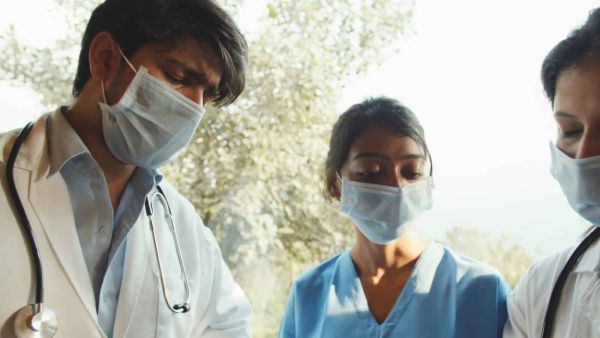
Hyderabad: As India marked the 35th National Doctors Day on Wednesday, July 1, medical practitioners in Hyderabad used the occasion not to celebrate but to sound an alarm over their safety, their pay and their mental health.
National Doctors Day has been observed since 1991, on the birth anniversary of Dr Bidhan Chandra Roy, the physician and former West Bengal chief minister, after whom the day is named.
Three-and-a-half-decades later, doctors in the city say the profession they once aspired to is increasingly defined by exhaustion, unmet basic needs and violence at the hands of the very people they are trying to help.

Attacks born of impatience, not intent
Dr M Rajeev, Director of RX Hospital, Hyderabad, said assaults on doctors are not confined to government facilities or private ones. They cut across both. “Most of these attacks happen because attenders grow impatient and there is a lack of implementation of doctor safety measures in Telangana,” he told Siasat.com.
He appealed to the public for a basic but often overlooked understanding: that treatment and medication can be provided, but survival can never be guaranteed. No doctor, however skilled, can promise an outcome.

The price of a medical degree
The conversation inevitably turned to money and on how doctors are trained and paid in the first place. Dr Rajeev pointed out that securing a seat in a government medical college purely on merit is exceedingly difficult, which pushes many aspiring doctors toward the management quota instead.
The financial burden that follows is staggering. From MBBS to MD, he said, a medical student spends a minimum of 15 years in training and close to Rs 6 crore on their education. In these gruesome years, they have no independent source of income.
Yet, once they enter government service, the reward is modest. An entry-level basic pay is Rs 42,000 to 50,000, which Dr Rajeev called inadequate given the scale of investment and sacrifice involved.
No place to rest, no water to drink
For those training on the wards, the conditions can be harsher still.
Dr Vyakarnam Nageshwar, Chief Allergist and Immunology Specialist at Aswini Allergy Centre, Hyderabad, described the toll taken on postgraduate students who work 36-hour hospital duties. Many, he told Siasat.com, develop allergies and conditions such as asthma over the course of their training, and in most cases, are not even provided a clean resting room, drinking water or functional washrooms.
Dr Nageshwar questioned why medical trainees are treated this way when entrants to other government services, such as the Indian Administrative Service (IAS) and Indian Police Service (IPS), are given proper accommodation and basic facilities as a matter of course.
He also linked the pattern of attacks on doctors to a different, equally structural problem such as delays in shifting patients to hospital in time, which cost precious minutes in what clinicians call the “golden hour,” and often provoke the anger of desperate families when outcomes go wrong.
Mental health crisis hiding in plain sight
The scale of the strain doctors are under was underlined by a survey from the Federation of All India Medical Association (FAIMA), which found that one in six doctors has experienced thoughts of self-harm linked to work-related stress.
A resident doctor at Apollo Hospital, Jubilee Hills, who spoke on condition of anonymity, described the toll in personal terms. “Mental health is very important,” the doctor told Siasat.com.
“Many times, I have thought that I made a mistake joining residency. Gaining the correct perspective is necessary, especially for the working hours.” Describing the relentless inflow of patients, the doctor added, “Can’t do much about it; put your head down and work. Almost no one is willing to help, even if there are a lot of patients.”
Another resident doctor recalled to Siasat.com working a 60-hour shift last year, and joined the wider call among practitioners for regulated working hours and designated days off. Doctors also urged the government to draft and strictly enforce comprehensive guidelines across all years of training, ensuring proper hands-on exposure alongside academic learning.
The everyday grind of practice
Beyond the headline concerns of safety and burnout, doctors also spoke of the quieter, daily pressures of clinical work. Dr Khizer Hussain Junaidi, founder of Caspian Healthcare, listed time pressure, burnout, delays in investigations and the sheer effort of giving every patient adequate attention while running a busy clinic as constant challenges.
In chronic disease care, diabetes and obesity among them, he told Siasat.com that the added difficulty lies in helping patients grasp that treatment is a long-term commitment and stay consistent with follow-up visits.
Dr Amreen, a paediatrician at Caspian Healthcare, pushed back on a common public perception that doctors routinely push unnecessary tests on patients. “I can’t speak for all doctors or all private care setups,” she told Siasat.com, “but at Caspian Healthcare, my husband Dr Khizer and I operate on the principle of trust and care.”
She explained that investigations are recommended in cases where they are genuinely necessary, and that a lot of diagnoses are made clinically. “There also happen to be daily instances where a patient might request a test,” she said, “but we reassure the patient and send them back with just a prescription.”
Occasion to introspect
Taken together, the accounts from Hyderabad’s doctors this Doctors’ Day paint a picture at odds with the celebratory tone the occasion is meant to carry, one of a profession stretched thin by long hours, inadequate infrastructure, financial strain and a public trust that frays easily under pressure.
The demand from practitioners was better safety enforcement, humane working conditions and a mental health support system as a baseline, not an afterthought.
-
Ronald Koeman Resigns as Netherlands Coach After World Cup Penalty Loss to Morocco

-
Crysencio Summerville becomes a prime transfer target for Manchester United, with Marcus Rashford’s future shaping any potential move for the West Ham star

-
Manchester United skipper Bruno Fernandes draws serious Champions League transfer interest: Report
-
Dream Sports Shuts Fintech Platform Dream Money Within A Year Of Launch

-
10 Major Changes From July 1, 2026: UPI PF Withdrawals, Credit Card Rules, Passport Fees & More