Edited by: Srinivas Mazumdaru
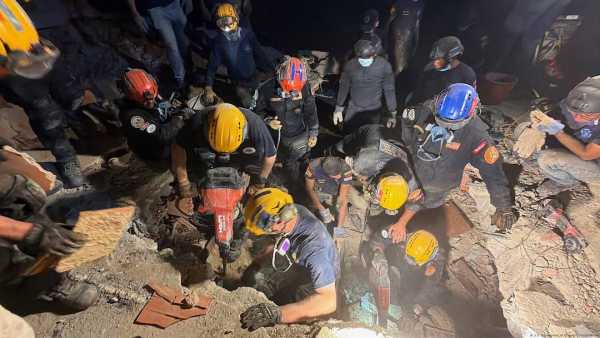
Rescuers in Venezuela raced to find survivors on Tuesday, nearly a week after twin earthquakes devastated parts of the country.
Following the magnitude 7.2 and 7.5 earthquakes striking just seconds apart last week, according to numbers collated by the Venezuelan government, opposition, UNICEF, and National Aeronautics and Space Administration (NASA):
- at least 1,943 people were killed
- more than 10,500 injured
- about 16,000 left homeless
- more than 6,400 people rescued
- around 43,000 remain missing
- about 680,000 children in need of humanitarian assistance, and
- 59,000 buildings were damaged
What is the situation of the rescue operations?
However, the pace of rescues has slowed sharply as the critical survival window of 72 hours has closed.
Rescuers are hoping to find survivors, but now are also looking for the dead.
On Tuesday, rescue teams from Ecuador and the US halted operations in Macuto, La Guaira, after they stopped receiving responses from a mother and her three children trapped beneath the rubble of a building after more than 40 hours of trying to get them out.
"In the end, we believe the days have already passed and that what we will find now is death," said Major Jorge Montanero, leader of the Ecuadorian team.
Hope still lingers in some cases as a Jordanian rescue team pulled a three-year-old boy alive from the rubble in Caracas on Tuesday, one of the few survivors found in recent days.
What are the aid agencies saying?
Meanwhile, aid agencies warned of worsening hunger, disease and an overwhelmed healthcare system.
The World Food Programme (WFP) has appealed for $50 million (€43.83 million) to provide emergency food assistance to up to 500,000 people over the next three months.
The World Health Organization (WHO) warned on Tuesday of the strain on Venezuela's healthcare system.
WHO said at least three health centers were critically damaged and six others only partially functional.
Christian Lindmeier, the WHO spokesperson, sounded the alarm bells over the spread of measles, malaria, yellow fever and dengue among the thousands of displaced due to lack of sanitary facilities and low inoculation rates.
(Disclaimer: This report first appeared on Deutsche Welle, and has been republished on ABP Live as part of a special arrangement. Apart from the headline, no changes have been made in the report by ABP Live. for DW)
-
Kylian Mbappé breaks World Cup knockout record with goal against Sweden

-
Getting sick frequently during rainy season? Protect yourself from ‘these’ serious infectious diseases, immunity will be weakened
-
Neha Dhupia Health Tips: How beneficial is Neha Dhupia’s favorite drink in low blood pressure? Learn from experts

-
OnePlus N6 Launches In India: Check Price, Features, Camera And Huge 8,000mAh Battery

-
AI-Powered 3D Creation for Businesses: How Tripo Studio Cuts Costs & Boosts Workflow Efficiency