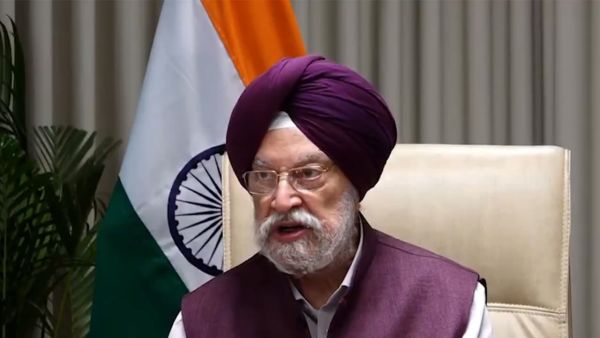
OMCs faced a Rs 74,781 crore loss in Q1FY27 and a total Rs 2.1 lakh crore under-recovery for selling fuel below cost, said Minister Hardeep Singh Puri, adding that the government shielded consumers from global crude price volatility.
OMCs Face Massive Losses to Shield Consumers
State-owned oil marketing companies' (OMCs) suffered a total loss of Rs 74,781 crore upto June 30 for selling petrol, diesel, and liquefied petroleum gas (LPG) below cost in the period April-June 2026, amid a spike in global crude oil prices that raised input costs, Union Minister Hardeep Singh Puri said on Thursday.

Addressing a press conference on the West Asia crisis, the Union Minister of Petroleum and Natural Gas, said OMCs' total under-recovery, which includes petrol, diesel, and LPG from the previous year (Q4FY26 & Q1FY27), stood at Rs 2.1 lakh crore. He highlighted that amid the ongoing West Asia crisis the country's fiscal framework successfully shielded consumers from the full impact of global crude oil volatility with fuel continued to be sold domestically at prices below cost.
Ensuring Domestic Fuel Stability
He said that although global crude prices have eased in recent weeks, the impact of the earlier surge is still being felt because refiners are processing crude purchased when prices were significantly higher. Despite these financial pressures, he said the country maintained steady domestic fuel supplies. "Why did we do well and come out of the crisis without any closures and dry outs? In the entire period of March, April, May and June, there were no dry-outs," Puri said. "By and large, there was no disruption, shortage or queues."
The minister contrasted this stability with the sharp fuel price hikes observed globally during the same four-month window. While India managed its domestic supply, petrol prices surged by 39.77 per cent in Pakistan, 36.66 per cent in Sri Lanka, 20 per cent in Nepal, and 42.69 per cent in Bangladesh. European nations also saw significant increases, with petrol prices rising by 17.74 per cent in France, 19.05 per cent in Germany, and 18.39 per cent in Italy.
Proactive Measures for Future Volatility
Addressing future crude price volatility, the minister noted that India is proactively expanding its storage capabilities and international partnerships. "Worried about that? No, my answer to that self-inflicted question is I'm not worried about it, but I have to prepare for it, stocking up as prices are low, increasing my storage space to intensifying our outreach to our bilateral partners, all that will go hand in hand," Puri stated.
India's Push for Refining Dominance
The government is pushing forward with massive domestic refining expansions to secure long-term energy independence. A review of capital expenditure across the ministry and public sector units confirmed that multiple advanced-stage projects will be implemented over the next 6 to 12 months. "This will bring our refining capacity to 300 million metric tonnes per annum. This is a noteworthy and remarkable figure," Puri said.
New Greenfield Refinery After a Decade
Part of this expansion includes a new 9 million metric tonnes per annum project featuring a 2.4 million metric tonnes per annum petrochemical capacity. "This is the first greenfield refinery we are establishing after a gap of 10 years. The last greenfield refinery was commissioned in 2016, which was the Paradip Refinery," the minister added. "In the global context, I would regard this as a state-of-the-art refinery with absolutely unique technology and highly efficient output."
Contrasting Global Refining Trends
This infrastructure growth comes at a time when traditional Western refining powers are scaling back their operations. "The United States has not had a greenfield refinery for the last 50 years. There has been no new greenfield refinery in the United States," Puri explained. "As far as Europe is concerned, my recollection is that it is losing refining capacity at the rate of 200,000 barrels per day."
According to the minister, this structural shift will redraw the map of global energy trade by the end of the decade. "If you look at the broader global picture, we can see that by 2030 there are likely to be three or four major refining hubs in the world. India is certainly emerging as, and is probably already, the third-largest refining hub in the world," Puri said. "So, I see smaller, less competitive refineries closing down. Global trade in hydrocarbons will be determined and very largely influenced by those countries that have significant refining capacity."
Puri concluded the briefing by acknowledging the heavy operational focus required by the ministry in recent months to stabilize the domestic market. (ANI)
(Except for the headline, this story has not been edited by Asianet Newsable English staff and is published from a syndicated feed.)-
Understanding RRB Group D Salary and Recruitment Process

-
Essential Preparation Tips for SSC CGL Tier-I Exam 2026

-
HPCL Recruitment 2026: Apply for 116 Officer Positions

-
RRB Group D Recruitment 2026 Results Announced: Check Your Merit List and Cut-Off Marks

-
BVFCL Apprentice Recruitment 2026: Apply for 38 Positions