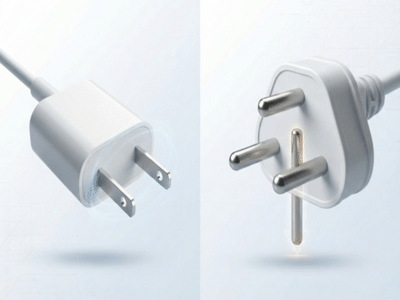
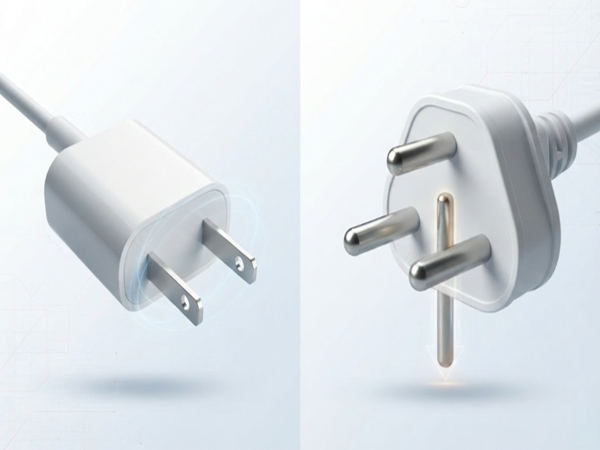
Two-Pin and Three-Pin Plug Chargers: We use various electronic appliances every day. You may have noticed that mobile chargers typically have two pins, whereas appliances like irons, refrigerators, and geysers use three-pin plugs. Most people might view this merely as a design choice, unaware that a significant safety reason lies behind it. In reality, the number of pins on a plug or charger in our country is determined by the appliance's power consumption and the safety regulations set by the Bureau of Indian Standards (BIS). Read the full article to understand this...
Plug Types: Why are 2-pin and 3-pin plugs different?
The number of pins on a plug depends on the device's power consumption and whether it requires additional safety measures.
Two pins are sufficient for devices that consume less power, such as mobile phone chargers, decorative string lights (like those used during Diwali), and electric lamps.
Conversely, 3-pin plugs are used for high-power appliances, such as washing machines and laptops.
Which appliances use 2-pin plugs?
In India, small electronic gadgets that operate on low power use 2-pin plugs.
These plugs feature two round pins, each with a diameter of exactly 4.0 millimeters. Globally, this specific design is also known as the "Europlug."
Since these appliances operate safely at low voltages, they do not require extensive safety features.
How did the use of 2-pin plugs begin in India?
Interestingly, India initially adopted the British electrical system, which utilized 3-pin plugs and sockets. After independence, when the task of extending electricity to remote villages and underdeveloped areas began in earnest, the two-pin system was adopted in many places because it was relatively easy to manufacture.
Which appliances use a 3-pin plug?
This type of plug is used for high-power appliances such as refrigerators, air conditioners (ACs), washing machines, and other heavy-duty equipment. Its third and longest pin is known as the 'earth' pin.
What is the function of the earth pin?
As the name suggests, the earth pin connects the appliance directly to the ground. In the event of a short circuit, electrical leakage, or a power surge, the excess current is diverted into the ground through this pin.
This reduces the risk of electric shock and the likelihood of fire, while also keeping expensive electronic appliances safe.
What do BIS regulations state?
According to the safety standards set by the Bureau of Indian Standards (BIS), the use of a three-pin plug is mandatory for all appliances that consume more than 5 amperes of electricity.
This is why heavy-duty appliances always come with an earth-pin plug, whereas a two-pin plug is considered sufficient for smaller, low-power appliances.
Is a 2-pin plug unsafe?
It is not that a two-pin plug is unsafe; rather, it is designed for appliances that pose a lower electrical risk and do not require additional earthing.
However, using a 2-pin plug for high-power appliances is not considered safe, as overloading can increase the risk of a short circuit. Therefore, it is always recommended to use appliances in a way that aligns with the plug's capacity.
Disclaimer: This content has been sourced and edited from Amar Ujala. While we have made modifications for clarity and presentation, the original content belongs to its respective authors and website. We do not claim ownership of the content.
-
Bruno Guimaraes Informs Newcastle United of Desire to Join Arsenal

-
Srihari says Surekha ‘misunderstood’ meeting with officials

-
BRS won’t revert to TRS, but won’t let Kavitha keep name either

-
Petrol tanker, milk lorry catch fire in accident in Bengaluru

-
Warangal couple suicide: Son claims neighbours forced conversion