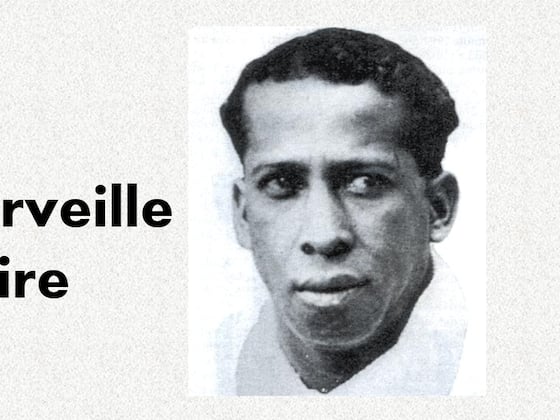
The term ‘star’ is often used loosely in modern football, especially during the spectacle of the World Cup, the grandest stage of them all.
Yet, very few truly embody that description. In the humble neighbourhoods of Salto, Uruguay, one man rose to define the term — a footballer whose brilliance shaped the sport forever. His name was José Leandro Andrade, and this is the story of his extraordinary rise.
Born on 22 November 1901 in the border town of Salto, Andrade’s lineage carried a unique mystery. His mother was Argentinian, while his father, Ignacio Andrade, was a former West African slave brought to Brazil, known locally for his deep knowledge of African spiritual traditions. Legends claim that Ignacio’s mastery of these mystical practices helped him escape bondage and live to the age of 98, long enough to witness his son’s birth — an astonishing feat in early 20th-century Uruguay, where average life expectancy was just 49 years.
Like many of his generation, Andrade grew up in poverty. Yet, Uruguay’s relatively progressive social environment, open to diversity during a period of widespread racial segregation in South America, gave him opportunities others did not receive. Andrade attended school and quickly emerged as one of its brightest pupils, though he eventually dropped out. His love for football, cultivated by daily matches with his brothers after lessons, kept him motivated and grounded.
As a teenager, Andrade left his small-town life behind and moved to Montevideo, Uruguay’s capital, determined to make something of himself. He joined the amateur club Bella Vista, balancing football with work as a carnival musician. His rhythm, flair, and energy — first seen in his tango performances — mirrored his style on the pitch. He led the drummers of the Libertadores de Africa troupe, combining art and sport long before it became fashionable.
In 1924, Uruguay, the reigning South American champions, qualified for the Olympic Games in Paris. The tournament, seen at the time as the de facto world championship before FIFA’s World Cup debut in 1930, featured only four non-European teams — Uruguay, the USA, Turkey, and Egypt. Uruguay’s squad consisted mainly of working-class amateurs: labourers, salesmen, and artisans. As writer Eduardo Galeano famously put it, “They were all twenty years old or a little older, though in pictures they look like old men. They cured their wounds with salt water, vinegar plasters and a few glasses of wine.”
Despite internal disputes between the Uruguayan Football Association (AUF) and the Uruguayan Football Federation (FUF) over amateurism and player selection, the team’s Olympic dream survived thanks to individuals like Francesco Ghigliani and Atilio Narancio. Narancio even mortgaged his home to fund their travel and lodging, while Casto Martínez Laguarda arranged friendly matches in Spain to raise additional funds.
Known affectionately as La Celeste, the Uruguayan team played nine friendlies across Spain, defeating clubs such as Celta Vigo, Athletic Club Bilbao, Deportivo La Coruña, Real Sociedad, Atlético Madrid, and Racing de Madrid. They remained unbeaten, scoring 25 goals and conceding just eight. Spanish newspapers, including El Mundo Deportivo, hailed them as “the best footballers we have ever seen here.”
Arriving in Paris, the Uruguayans travelled in second-class carriages and slept on wooden benches, but their spirit remained high. Their first Olympic match, against Yugoslavia, ended in a 7-0 rout. Andrade was sensational — his pace, strength, and creativity bewildered the Europeans, earning him four assists. French media, including L’Auto (the forerunner of L’Équipe), quickly labelled Uruguay the tournament favourites.
Andrade also made history as the first black footballer to play in the Olympics, a milestone that elevated him to global fame. His flair, humility, and composure won admiration in an era marked by racial barriers. Uruguay’s inclusive football policy had long embraced black players, a stance that angered rivals like Chile, who accused them of “cheating” — claims later retracted after diplomatic pressure.
After defeating Yugoslavia and then the USA 3-0 — a match The New York Herald called “near perfection” — Andrade’s legend grew. Galeano later wrote, “Andrade dazzled everyone with his exquisite moves... he crossed half the field with the ball sitting on his head.” The French press christened him La Merveille Noire — “The Black Marvel.”
In the quarter-final against France, Andrade faced jeers from the home crowd after a foul but responded by orchestrating a 5-1 demolition. Asked afterwards how they trained, he quipped, “We practised by trying to catch chickens.”
Uruguay’s semi-final against the Netherlands proved tougher. Trailing 1-0 at half-time, they rallied to win 2-1 through goals from Cea and Scarone, setting up a final against Switzerland. In front of a sell-out crowd of 30,000 at the Stade Olympique, Andrade assisted Pedro Petrone’s opener before Uruguay sealed a 3-0 victory to claim Olympic gold. The editor of L’Équipe described them as “like thoroughbreds next to farm horses.”
The triumph sparked nationwide celebrations in Uruguay, with the government declaring a public holiday and issuing commemorative stamps. Andrade, though goalless, was hailed as the tournament’s standout player. At just 22, he was lauded for his honesty, calmness, and grace — never celebrating goals, even in triumph.
Andrade joined Nacional after the Olympics, winning the Primera Division in his debut season. Over six years, he made 105 league appearances and scored 29 goals — impressive numbers for a defensive midfielder. During Nacional’s 1925 European tour, more than 800,000 fans turned out to watch him play across nine countries, confirming his global appeal.
However, during that tour, Andrade fell ill and was diagnosed with syphilis by a Belgian doctor, attributed to his flamboyant lifestyle. While the illness only mildly affected his performance initially, it marked the beginning of his decline. Returning home, he appeared withdrawn and physically diminished, increasingly turning to alcohol.
When Montevideo’s black community held a celebration in his honour, Andrade failed to attend, fuelling perceptions of arrogance. Friends said he had returned from Paris transformed — dressed in fine clothes, gloves, and a top hat — no longer the humble man they once knew. Yet, his fame and charm made him irresistible. In Paris, he mingled with celebrities like writer Sidonie-Gabrielle Colette and entertainer Josephine Baker, with whom he shared a passion for dance and nightlife.
Back home, Uruguay’s Olympic success was celebrated across South America, but envy brewed in Argentina. Convinced they could have won gold, Argentina challenged Uruguay to a two-legged contest to decide the true world champions. After a 1-1 draw in Montevideo, chaos erupted during the second leg in Buenos Aires. Fans invaded the pitch, forcing a postponement. In the replay, Cesáreo Onzari’s direct corner — the first-ever gol olímpico — gave Argentina the lead, but violence overshadowed the match. Stones were thrown, Andrade retaliated, and striker Héctor Scarone was arrested after kicking a police officer. Uruguay walked off with minutes remaining, handing Argentina victory by forfeit.
The tension between the two nations only deepened, and later, during the 1925 South American Championship, a supporter was tragically killed in post-match violence. Despite this dark aftermath, Andrade’s legacy as football’s first global superstar was already cemented — a man whose rhythm, grace, and defiance redefined the beautiful game forever.
-
Manchester United’s strategy to fend off interest in young prodigy JJ Gabriel
-
Spain vs Belgium preview: Will Lamine Yamal finally shine on the grand World Cup stage?
-
New Marine Species Named in Honour of Cape Verde’s World Cup Star Vozinha
-
Skin Care Tips: Want a Natural Glow? Forget creams worth thousands of rupees! Follow these simple tips

-
Monsoon Health Tips: Do you fall ill again and again during monsoon? Are there any shortage of these 5 things in your plate?