Why banyan trees can outlive entire civilizations
ETimes | July 12, 2026 7:39 PM CST
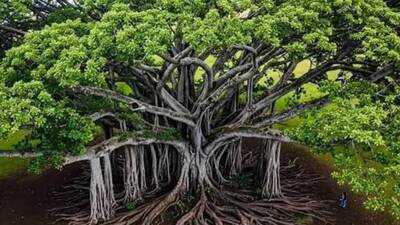
The banyan tree is one of nature’s greatest survivors. While kingdoms have risen and fallen, cities have disappeared, and civilizations have faded into history, some banyan trees have continued growing for centuries. Kingdoms have come and gone, whole cities have been destroyed, and some civilizations have died out while some banyan trees continue growing.
The longevity of such trees is a result of the special biological features and the unique ability of renewal which the trees possess. As opposed to other trees that are grown from one trunk, banyan trees grow with time by forming aerial roots on the branches which descend to the ground to become thick woody trunks with time. A banyan tree can produce hundreds of secondary trunks and become very large by covering several acres being only one organism at once.
It should be noted that in case the primary trunk is destroyed, becomes hollow or even dies out, the tree survives thanks to the secondary trunks. It becomes difficult to distinguish between the trunks and determine which of them was the primary one. Some scientists claim that it can be called the constant renewal that banyan trees undergo.
Designed for survival over many centuries
Banyan trees are very resistant to external factors because of their roots which allow them to stay firmly planted on the ground and endure storms and harsh winds. The ability of banyans to regenerate themselves with new roots helps them recover from the impact of aging, climate conditions, or even human intervention.
The beginning of the life cycle of many banyan trees is an epiphytic plant. In other words, it means that banyans germinate on other trees after seeds are spread by birds. Gradually, the growing banyan develops its roots which grow around the host tree and touch the ground eventually causing the death of the host tree and allowing the banyan to stand alone.
An ecosystem unto itself
Apart from being one tree, a fully grown banyan tree acts as a complete ecosystem. Its wide canopy shelters a variety of species ranging from birds, bats, squirrels, monkeys, reptiles, and bugs to others. Figs from the tree act as food for the flora and fauna for the entire year, especially those periods where fruits are scarce.
Its branches provide cooler microclimates due to reduction in temperatures because of shading and transpiration. Thus, the banyan trees become very significant for biodiversity, especially for the tropical and subtropical zones.
Witnesses to history
Many banyan trees that exist today were present even during significant historic moments in time. While some trees are said to be around 400 to 500 years old, a few others are older still, though accurately aging a banyan tree can be difficult since its trunk keeps regenerating.
One of the oldest trees includes the Great Banyan located at the Acharya Jagadish Chandra Bose Indian Botanic Garden, near Calcutta. Despite the removal of the main trunk due to its disease in the 20th century, the tree is still alive thanks to thousands of aerial roots covering over 4 acres of land. Another impressive specimen is the Thimmamma Marrimanu located in Andhra Pradesh; it occupies an area of almost 5 acres of land and is considered to be one of the world's biggest specimens in the world.
A symbol of sanctity in India
Apart from being biologically interesting, the banyan tree has significant cultural value for many Indians since it is viewed as a symbol of eternity, wisdom, and longevity in Hinduism and is related to Lord Shiva and Vishnu. Banyan trees have been used by the villages as a place to meet and conduct festivals and storytelling since the beginning of times.
Reasons why they survive beyond the civilizations
Trees, like any other organism, end up dying eventually as their age increases through the growth of the trunk. The banyan tree species, on the other hand, has developed another unique way of survival that makes it possible for them to renew themselves through the constant sprouting of new trunks and roots.
It is through this ability of renewing its structure that, along with its resilience, makes it possible for the banyan tree to stay standing even after the empires fall and civilizations come to an end.
The longevity of such trees is a result of the special biological features and the unique ability of renewal which the trees possess. As opposed to other trees that are grown from one trunk, banyan trees grow with time by forming aerial roots on the branches which descend to the ground to become thick woody trunks with time. A banyan tree can produce hundreds of secondary trunks and become very large by covering several acres being only one organism at once.
It should be noted that in case the primary trunk is destroyed, becomes hollow or even dies out, the tree survives thanks to the secondary trunks. It becomes difficult to distinguish between the trunks and determine which of them was the primary one. Some scientists claim that it can be called the constant renewal that banyan trees undergo.
Designed for survival over many centuries
Banyan trees are very resistant to external factors because of their roots which allow them to stay firmly planted on the ground and endure storms and harsh winds. The ability of banyans to regenerate themselves with new roots helps them recover from the impact of aging, climate conditions, or even human intervention.
The beginning of the life cycle of many banyan trees is an epiphytic plant. In other words, it means that banyans germinate on other trees after seeds are spread by birds. Gradually, the growing banyan develops its roots which grow around the host tree and touch the ground eventually causing the death of the host tree and allowing the banyan to stand alone.
An ecosystem unto itself
Apart from being one tree, a fully grown banyan tree acts as a complete ecosystem. Its wide canopy shelters a variety of species ranging from birds, bats, squirrels, monkeys, reptiles, and bugs to others. Figs from the tree act as food for the flora and fauna for the entire year, especially those periods where fruits are scarce.
Its branches provide cooler microclimates due to reduction in temperatures because of shading and transpiration. Thus, the banyan trees become very significant for biodiversity, especially for the tropical and subtropical zones.
Witnesses to history
Many banyan trees that exist today were present even during significant historic moments in time. While some trees are said to be around 400 to 500 years old, a few others are older still, though accurately aging a banyan tree can be difficult since its trunk keeps regenerating.
One of the oldest trees includes the Great Banyan located at the Acharya Jagadish Chandra Bose Indian Botanic Garden, near Calcutta. Despite the removal of the main trunk due to its disease in the 20th century, the tree is still alive thanks to thousands of aerial roots covering over 4 acres of land. Another impressive specimen is the Thimmamma Marrimanu located in Andhra Pradesh; it occupies an area of almost 5 acres of land and is considered to be one of the world's biggest specimens in the world.
A symbol of sanctity in India
Apart from being biologically interesting, the banyan tree has significant cultural value for many Indians since it is viewed as a symbol of eternity, wisdom, and longevity in Hinduism and is related to Lord Shiva and Vishnu. Banyan trees have been used by the villages as a place to meet and conduct festivals and storytelling since the beginning of times.
Reasons why they survive beyond the civilizations
Trees, like any other organism, end up dying eventually as their age increases through the growth of the trunk. The banyan tree species, on the other hand, has developed another unique way of survival that makes it possible for them to renew themselves through the constant sprouting of new trunks and roots.
It is through this ability of renewing its structure that, along with its resilience, makes it possible for the banyan tree to stay standing even after the empires fall and civilizations come to an end.
READ NEXT
-
[Watch] KL Rahul pulls off sensational one-handed catch to dismiss Will Jacks in 1st ODI vs England

-
Over 1,050 kids join RAK's summer etiquette camp teaching Emirati traditions

-
Dramatic Turn in Bankipur By-Election as Candidate's Nomination Rejected

-
Uttarakhand CM Pushkar Singh Dhami Inaugurates Shri Dhanvantari Dham Herbal World Himalaya, A New Global Hub For Ayurveda And Biodiversity

-
Australia Establishes Office of AI to Regulate Artificial Intelligence Development