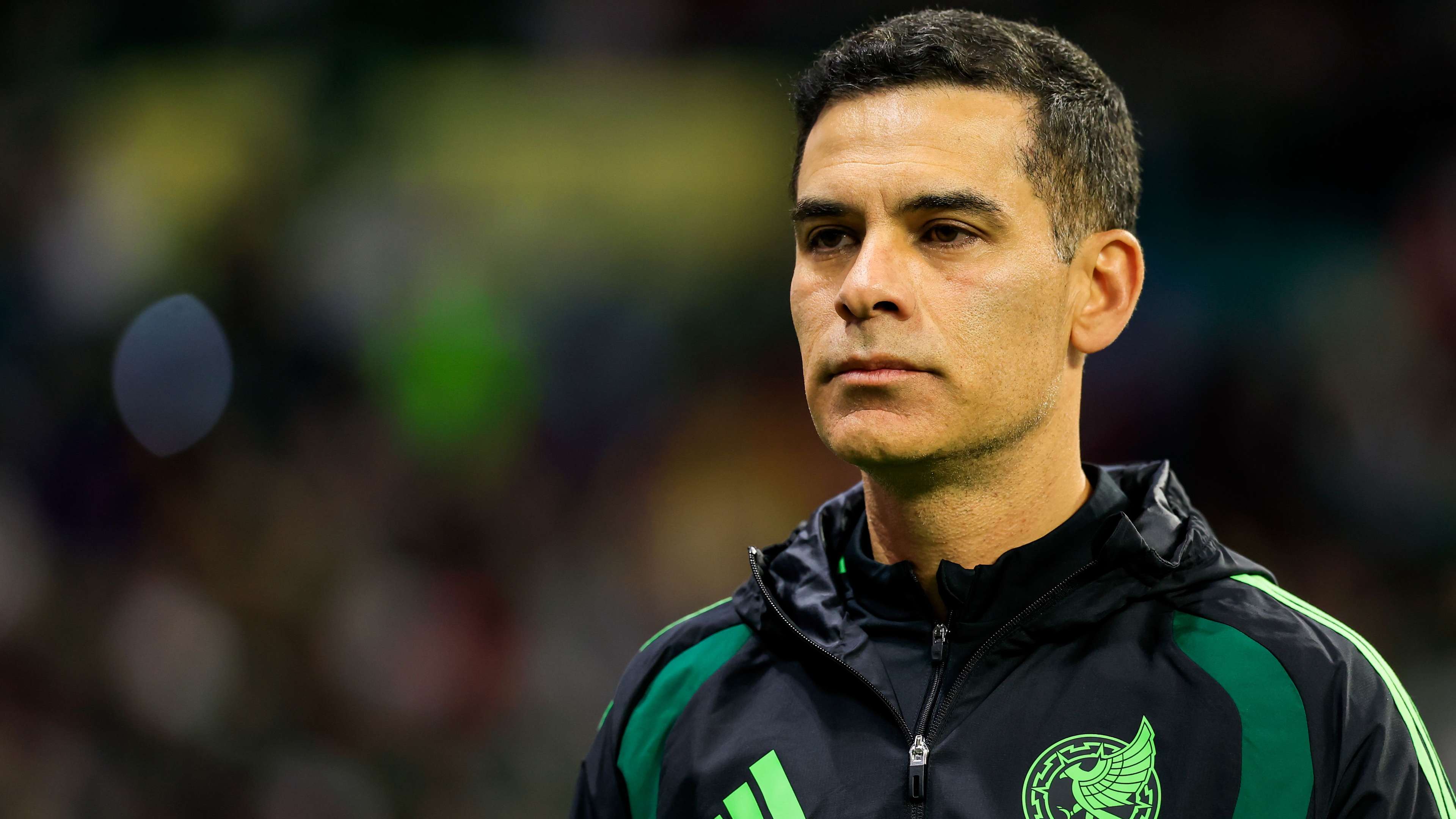
The legendary El Tri defender steps into the role of national manager with revived optimism, a rising generation of talent, and sky-high expectations. From defining Gilberto Mora’s position to clarifying Edson Álvarez’s status, here is what Márquez needs to do to move Mexico ahead.
When Rafael Márquez signed for AS Monaco in 1999, his first question was, “Is Monaco in Europe?”
That was all that mattered to the 20-year-old defender at the time. Márquez would go on to win Ligue 1 with Monaco in the 1999-2000 season and later become the first Mexican player to lift the UEFA Champions League trophy with Barcelona in 2006. He is widely regarded as the finest defender ever to wear the Mexico jersey.
El Tri have been in this situation before, appointing one of their national icons to lead the team. Hugo Sánchez, famously known as the Pentapichichi, was given his chance following the 2006 World Cup.
Sánchez’s peak as manager came at the 2007 Copa América, guiding a team led by Nery Castillo to third place after a 3-1 victory over Uruguay. However, less than a year later, Sánchez was dismissed after failing to take Mexico’s Under-23 side to the 2008 Beijing Olympics.
This time, there is far greater unity surrounding Márquez’s appointment. His apprenticeship as Javier “Vasco” Aguirre’s assistant could hardly have gone better. Working alongside Aguirre, Márquez observed the management of nearly 60 players and helped steer Mexico through a World Cup campaign that rekindled belief following the disappointment of 2022.
“I was pleasantly surprised by his personality within the group because, off the pitch, he is indeed a cautious, measured man,” Aguirre told journalist Denise Maerker on her podcast Hablemos. “He’s reserved by nature, and that works in his favour because, as the saying goes, flies don’t enter a closed mouth. Bora [Milutinović] used to tell me, ‘Don’t talk too much, because then they will use it against you.’ With Rafa, I can say we are in very good hands, very good hands.”
With Aguirre departs the humour, warmth, and lively press conferences. In steps Márquez, a manager shaped by Barcelona’s La Masía academy, carrying hopes that he can leave his own legacy while avoiding the pitfalls that prevented Sánchez from ever managing El Tri at a World Cup.
Here are the five critical areas Márquez must address as Mexico’s new manager...
Continuity, not a fresh start
Márquez inherits a Mexican side that rediscovered belief under Aguirre. His immediate task is to maintain that foundation while gradually imprinting his own identity.
That’s why his first public statement carried weight. Márquez spoke like a man who understood the importance of continuity.
“I believe there is a solid foundation. There are young players and experienced ones who I think will be crucial during this transition period,” Márquez said shortly after his appointment was confirmed. “As I have often mentioned on my social media, this is not the time to start from scratch but to accelerate.
“A foundation has been built, and a lot of work has been done to strengthen it. My responsibility is to make the most of this continuity, something that perhaps was lacking before. I will do everything I can to maintain and improve it. I am excited, I feel the responsibility, and I want to help Mexican players reach their full potential, which will, in turn, raise the level of Mexican football.”
Mexico’s matches in September and October will give Márquez a chance to build on the connection between team and fans that grew during the World Cup. They will also reveal which aspects of Aguirre’s project he intends to preserve and where he plans to innovate.
The message is clear: continuity. The challenge is ensuring it doesn’t turn into stagnation.
Push the Gilberto Mora generation forward
Mexico’s World Cup journey unveiled a group of youngsters who are no longer just future prospects.
Gilberto Mora, Brian Gutiérrez, Obed Vargas, Raúl “Tala” Rangel, Mateo Chávez, and Armando “Hormiga” González have all become central to Mexico’s next developmental cycle.
Márquez must convert their promise into consistent responsibility.
Mora’s rise was the defining story of Mexico’s campaign. At just 17, he never looked overwhelmed by the occasion and gave El Tri a glimpse of their emerging generation.
This gives Márquez a delicate balancing act: determining how fast to advance the young group without overburdening them with the expectations of an entire footballing nation.
The same applies to the other players who flourished under Aguirre’s open-minded approach. The World Cup gave them exposure; now Márquez must build their long-term path.
“It fills me with pride to be Mexican,” said Erik Lira after the 3-2 defeat to England in the Round of 16. “It fills me with pride to wear this jersey and be part of this family. We lost with honour. I’m not satisfied, but I am proud of what we achieved. Today we planted a seed that will grow tomorrow, and I’m sure great things are ahead.”
That seed now lies in Márquez’s hands.
Define Edson Álvarez’s role
After Mexico’s 2017 Under-20 World Cup campaign ended in the quarterfinals against England, Edson Álvarez immediately joined the senior squad at the Confederations Cup in Russia.
Then-coach Juan Carlos Osorio wanted to fast-track Álvarez’s progress. He saw a technically gifted, tactically flexible player capable of earning a World Cup spot the following year — whether as a centre-back, right-back, or midfielder.
When Álvarez arrived in Russia, he was awestruck to be training alongside his idol, Márquez.
The former Mexico captain took him under his wing, forming a bond that now adds intrigue to this new chapter.
Álvarez has played in three World Cups, yet his last two tournaments didn’t fully reflect the role many once envisioned for him. His minutes were limited in 2026, though he started against South Korea and Czechia, showing why he remains invaluable.
Márquez, more than most, understands Álvarez’s potential. However, he also knows that the midfielder must now prove himself anew. His club form will be crucial in determining his national team role.
Álvarez has been linked with a move to the Bundesliga, with 1. FC Köln reportedly interested. If he remains in Europe and earns regular playing time, Márquez will likely keep him in the national team fold.
The bigger question: will Álvarez begin this cycle as a starter, a leader, or a player fighting to reclaim both roles?
Build an identity that suits Mexico
One fascinating storyline tied to Márquez’s appointment is unfolding in Liga MX, where Gabriel Milito — his former Barcelona teammate — has Chivas playing some of the most attractive football in the country. The two shared three seasons together at Barça, and now both are shaping major Mexican football projects from different positions.
Milito’s Chivas have not only been winning; they’ve been doing so with a clear footballing philosophy. Last season, they finished second with 36 points, a testament to how quickly a strong tactical identity can take hold.
That makes Chivas an interesting case study for Márquez. Milito has instilled structure, intensity, and clarity. Márquez must strive for a similar coherence with El Tri while maintaining the competitive grit that Aguirre restored.
His two years with Barça Atlètic provide clues as to his possible approach.
Márquez guided Barcelona’s reserve side to fourth in the Primera RFEF in 2022-23, then to second the following season, reaching the promotion playoff final. His teams typically operated in a Barça-style 4-3-3, building from the back, controlling possession through midfield, and taking initiative in the attacking half.
But Márquez was flexible — he occasionally used a false nine, repositioned midfielders, and sometimes deployed two strikers when chasing a goal.
That balance will be key for Mexico.
Márquez cannot simply copy Barcelona’s system. He must adapt it to his squad’s strengths, the realities of international football, and the challenges of Concacaf competition — all under the intense scrutiny that comes with managing El Tri.
Can Rafa give Mexico the same clear identity that Milito has brought to Chivas?
Manage the pressure of being a legend
Márquez is not just another national team coach — he’s a national icon: a former captain, a five-time World Cup participant, and a Barcelona legend.
That status gives him immediate authority, but it also leaves him exposed to immense pressure.
Aguirre restored pride to Mexican football; Márquez must now transform that pride into tangible progress. The task demands more than symbolism, especially after a World Cup that reenergised fans but ended heartbreakingly against England.
His first critical decision will involve assembling his coaching team.
Márquez is expected to hold a press conference in August, where there should be more clarity about his staff. Names such as Alfredo Talavera and Andrés Guardado have surfaced as possible additions, though nothing is confirmed yet.
Reports also suggest Márquez may bring in an experienced mentor. Ignacio Ambriz and Luis Fernando “Flaco” Tena — who guided Mexico to Olympic gold at London 2012 — are among those linked.
Whomever he selects will reveal much about his managerial philosophy. Does he prefer a team representing his generation, an experienced voice beside him, or a continuation of Aguirre’s foundation?
Pressure will be immediate, given his stature. But so will the opportunity.
For years, Márquez was the Mexican player who made Europe feel attainable. Now, as manager, he must make Mexico’s next step feel possible too.
-
Gary Lineker hails Jude Bellingham as potential ‘England’s greatest ever footballer’ after 2026 World Cup heroics
-
Michael Olise seeks meeting with Bayern Munich as Real Madrid interest grows, with Mbappe, Tchouameni and Konate influencing talks
-
Marcus Rashford: What the Manchester United Star Plans After the World Cup

-
Why These World Cup Semi-Finals Could Be the Greatest Ever
-
Israel's Upcoming Elections: A Crucial Test for Netanyahu's Leadership