It’s no news that diesel cars are largely out of vogue. Granted, they were never particularly popular in the United States for several reasons, so you’ve probably only come across a few on your daily commute. Globally, though, they’re being phased out following the 2015 Dieselgate scandal — where Volkswagen admitted to manipulating emissions tests for over 11 million vehicles around the world. In Europe, where diesel engines saw significant commercial success, there are concrete plans for 90% of new car sales to be zero-emission by 2035, which effectively closes the door on diesel as a car engine.
However, just because diesel has come to be frowned upon in passenger vehicles, with many brands choosing never to produce a single diesel-powered unit, doesn’t mean that it’s no longer useful in other forms. Quite a few essential industries are still fueled primarily by diesel. Some other applicable areas for diesel are rather niche, but are generally “cool” in the sense of the word. This list highlights 10 such vehicles or machines that are still powered by diesel today, and only a handful are under any existential threat — whether via emissions reporting or performance degradation.
Aircraft
The chances you’re ever going to be on a plane that is solely fueled by diesel are very slim. For the most part, passenger planes run on refined fuel designed to power gas turbine engines. Smaller aircraft like private jets, cargo planes, and regional airliners can also use turboprop engines — they may be slower than their jet-fueled counterparts, but they consume less fuel, which makes sense for short-distance flights.
Given the context of the niches these two engine types serve in air travel, one might wonder where diesel comes into the picture, and why there are so few available. In fact, Piper Aircraft in the U.S. and Europe-based Diamond Aircraft are two manufacturers that make them today. Whether they’re good for flying is another question, but the main reason for the scarcity is how impractical diesel engines are for flight: They are heavy, and thus have a poor power-to-weight ratio. To get, say, 100 hp from a diesel powertrain, it would need to weigh around 220 lbs. For context, the Airbus A380 generates about 280,000 hp at takeoff, and the engine weighs between 13,400 and 13,770 lbs. Mathematically, a diesel equivalent would need to weigh around 616,000 lbs.
That constraint hasn’t stopped Piper and Diamond Aircraft, though. For instance, Diamond uses diesel for its single, twin, and high-performance engine lines. Despite the significant challenges, diesel does have certain advantages, such as fuel efficiency, over specific avgas-powered engines.
Dakar Rally Trucks
It’s unconventional to see diesel engines in racing. Maximizing speed in a competitive atmosphere requires reducing drag, which in turn needs engines that are as light as possible. Inherently, this disqualifies diesel — its higher compression ratios make it impractical to race with. However, there’s a niche of racing where you’re likely to see diesel engines across the lineup: the Dakar Rally.
Again, you might associate the rally event with the specially modified road-legal cars with spoilers moving across the desert. While that’s the more popular version, the Dakar Rally has more than one class of vehicle in its multi-day program: Motorcycles, quads, and even trucks participate in the grueling race. Making up the T5 category, the trucks racing at the Dakar Rally weigh at least 12,125 lbs. Diesel powertrains handle that kind of weight better than gasoline since they generate copious amounts of low-end torque — which is why you’re very likely to encounter them in heavy towing applications.
The Dakar Rally puts a fun and competitive twist on that outlook through teams like Kamaz-Master. From 2010 to 2022, they placed on the podium every year, with five clean sweeps to their name. The 2015 clean sweep gives a little more context on how powerful diesel engines can be. Those models used a Liebherr D9508 A7 powertrain that, despite a dry weight in excess of 3,000 lbs, completed the 0-60 mph dash in 10 seconds. The team hasn’t competed since 2022 for political reasons, but its plans for a 13-liter Cummins engine underscore diesel’s importance for racing large trucks.
Trains
Locomotives have come a long way since the days when their engines were powered by coal. High-speed (hence the name “bullet”) trains are essentially alternatives to air travel in places like Japan and China; they can reach speeds well over 200 mph. However, while electricity might be gradually capturing a significant chunk of the market share in Europe, a large portion of trains are still powered by diesel. The American landscape is particularly diesel-based: Only 1% of the 161,000+ miles of railroad was electrified as of 2023, compared to 60%, 72%, and 80% in Europe, China, and Japan, respectively.
So, bullet trains are faster; why haven’t U.S. trains gone electric? Well, logically speaking, one explanation is that it’s very expensive — both infrastructure-wise and financially — to embark on a large-scale electrification of American railroads. The second reason is that, in a way, American trains are already using electric power. Although diesel is the primary component, it’s actually electricity that moves the train’s wheels.
The diesel engine is connected to an electrical generator that converts its mechanical energy into electricity, which is then delivered to traction motors. These convert that electricity back into mechanical energy, which turns the train’s wheels. With this configuration, a diesel-powered train is essentially electric, with the diesel engine’s horsepower serving as the “charger,” if you will. That’s a neater design than opting for a purely electric approach; with current battery technology, you’d need one that’s so large it would reduce the amount of weight the train can carry.
Cargo vessels/cruise ships
It’s a bit difficult to contextualize the size of a cruise or container ship if you’ve never seen one. Cruise ships in particular are mammoth-sized vessels — some are even large enough to have distinct neighborhoods within them. The average cruise ship measures around 1,000 feet long, and mainstream container ships (also known as cargo vessels) are in the same ballpark. Given their grandiose, it’s only natural to wonder how vehicles that large generate enough power to move at all, let alone travel at the 12 to 24 knots (roughly 14 to 28 mph) at which the average cargo vessel ferries goods across the waters.
The answer is largely diesel, although modern cruise ships are adopting diesel-electric setup, similar in principle to diesel-electric trains. Vessel size plays a fundamental role in the design choice; ships require lots of torque to overcome the many forces acting on their propulsion systems, such as drag from water density and pressure drag. For ships of such size, that means lots and lots of power. To contextualize just how much they need, consider the Oasis of the Seas cruise liner, which is run by six Wärtsilä V46 diesel engines.
These are evenly divided into 12- and 16-cylinder engines, all of which, when combined, provide a total output exceeding 96 megawatts — that’s almost as much power as a small town uses. Diesel will remain dominant for large ships for now, though the industry is gradually moving toward LNG and hybrid systems.
Submarines
When you consider a submarine and its operational needs, it’s not likely you’d conclude that diesel plays a part in any of the engineering. You’d be forgiven for that line of thought — after all, while diesel powertrains may not need spark plugs, they are still combustion engines, which means they rely on the chemical reaction between their fuel and oxygen. Submarines, by their very definition, exist, operate, and travel at several hundred meters below sea level. How then could diesel power these lithe machines?
The answer is counterintuitive: The submarine’s diesel engines don’t run at all underwater. Instead, before submerging, they charge the batteries, which then power the propellers. Once the vessel is meters deep underwater, the charged battery-powered motors take over — these are almost entirely noiseless and allow the submarine to operate stealthily. That doesn’t mean diesel submarines can only charge on land, though. If the vessel is near the surface, it can use a snorkel mast to give its combustion engine the air it needs to recharge.
As you can imagine, this mode of operation is rather restrictive. Diesel submarines can’t stay submerged for very long, which means frequent trips to the surface. Hence, while diesel is still used in the industry, nuclear-powered submarines are preferred — vessels can stay underwater for weeks at a time since nuclear generators don’t need oxygen.
Farm tractors
You’ve probably noticed a pattern at this point: Heavy vehicles or those that lug a lot of weight tend to use diesel engines for their movement. The same logic applies to farm tractors, but there are a few other reasons behind their use that go beyond mere size considerations. With farm equipment, you’d want machinery that can log hundreds of hours of use while needing minimal maintenance. Diesel offers farmers that luxury — diesel engines in tractors typically last anywhere between 4,000 and 10,000 hours of use.
However, not every farm tractor has to be powered by diesel. Depending on an individual’s farm needs, it would be perfectly reasonable to opt for a gasoline compact or utility tractor. Those classes barely attain 100 hp, and on a small piece of land, you might not notice the difference in performance between the two powertrains. When a larger farmland is the work area, though, you’re going to need to carry out heavy-duty work regularly, and that’s where diesel becomes the engine of choice. In fact, according to the Engine Technology Forum, diesel engines power about 75% of farm equipment and address about 20% of all irrigation needs in the United States.
Construction equipment
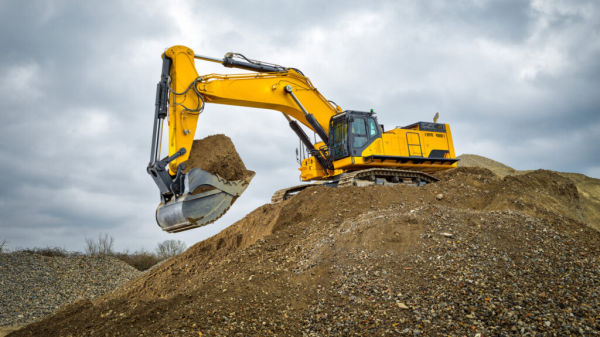
By definition, construction is a demanding business. From road repairs to erecting buildings, there’s a wide variety of equipment that you’ll find on construction sites, and if there’s a vehicle on the ground, there’s a high chance that it’s sporting a diesel engine. The reason is all about weight: Heavy objects like steel beams put an enormous strain on whatever machine is doing the arduous work of continuously lifting them — and in some cases holding them in place. Other tasks may have more of a drilling or digging focus, such as laying foundations, trenches, and wells; they are all extremely strenuous.
Diesel engines are preferred for heavy-duty tasks for a simple reason: They generate a lot of torque at relatively low rotational speeds, which means there’s less strain and better fuel efficiency when pulling heavy loads. Gasoline, on the other hand, produces its peak power and torque at higher RPMs, making it impractical for the strain that comes with construction. Moreover, since diesel is less flammable than gasoline, it’s safer to use on construction sites to lower fire risk.
Combine that with the fact that construction equipment is, by itself, massive machinery, and it’s easy to see why it will continue to use diesel engines for a long time. For instance, the Komatsu D575A-3 SD weighs 152.6 tonnes (just over 336,000 lbs) with a blade that is 3.25 meters tall to boot. To lug this kind of weight, its engine is rated at 1,150 hp. It’s not even the heaviest bulldozer on record either!
Generators
In first-world countries, electricity supply is barely a conscious thought of the average consumer. It’s an expected amenity. However, power generation isn’t constant, and any number of things can disrupt it at any time; while the chances for disruption are low, they are never zero. Now, there are several industries where even a few minutes of power outage can cause severe problems in their supply chains. Take hospitals, for instance: An unexpected blackout, whether due to climate conditions or operational failure, could be fatal for patients who rely on electric equipment.
That’s where generators come in; they are largely backup power sources to keep things running while the grid gets back on track. They come in different types: gasoline, natural gas, and diesel. For small power needs, like powering a house with a freezer and fans, for example, a gasoline generator rated between 2 and 5 kW can get the job done. However, for businesses and essential industries, that band is nowhere near sufficient, so diesel generators are still very much in business.
There’s a diesel generator for nearly every need profile. For instance, a DuroStar DS7000Q at 5.5 kW would be best suited for home backup, while you’d be likely to find a Caterpillar DE150E0 at an industrial site or a hospital with its 120 kW output. As one would expect, price varies significantly depending on power rating, with some running well into the tens of thousands of dollars.
Emergency vehicles
We’ve talked about how diesel powers specialized heavy-duty trucks at the Dakar Rally. From that disposition, it’s no surprise that emergency vehicles use diesel as well. A survey of EMS clinicians from 11 American states found that 67% of respondents’ service vehicles run on diesel. For ambulances, the reason is not as simplistic as size considerations — although the average five-ton weight is nothing to sniff at — but fuel economy and engine durability are the primary concerns.
As the number of trips an ambulance takes racks up, consumption is more than just a trivial component. Diesel engines are about 20 to 35% more efficient than their gasoline counterparts, so in the long run, health services would save more money that they can deploy to more essential equipment. In the case of fire trucks, although one would expect them to move around less than ambulances, weight considerations become the primary design decision. A typical fire truck can weigh anywhere between 20,000 and 40,000 lbs, and if an extendable ladder is required (you’ll usually find these in large aerial ladder trucks), that number can climb up to 70,000 lbs.
At that end of the weight scale, a diesel engine is far more practical than any other type of powertrain — at least with current technology. However, due to logistical hiccups stemming from natural disasters and emission concerns, alternatives like renewable diesel are being considered. With that in mind, the landscape could well change in some years, but diesel is still the leading powertrain here.
Snowcats
During the winter, snowstorms can get so bad that roads become very difficult to drive on, if not downright impassable. When that happens, you’ll see different types of winter service vehicles clearing away several inches of snow. Some types, like municipal salt trucks, are preventive — they spread road salt to slow down the formation of ice and melt any that have already formed. If you’ve ever wondered who makes salt trucks, we’ve got you covered too.
The same snow clearing principle applies to snowcats. These are vehicles roughly the size of a truck with large tracks that allow them to almost glide over snow. You’d likely spot them in the vicinity of a ski resort, so as you can imagine, they need that gliding-esque ability to traverse the rough terrain and weather conditions they are subjected to. However, snow clearing isn’t all they’re cut out to do.
They can serve as makeshift ski lifts, can assist in rescue missions after mishaps like avalanches, and can power through frozen lakes with blades attached. Some of the heavier snowcats can exceed 25,000 lbs, and at that size, diesel is the fuel of choice.