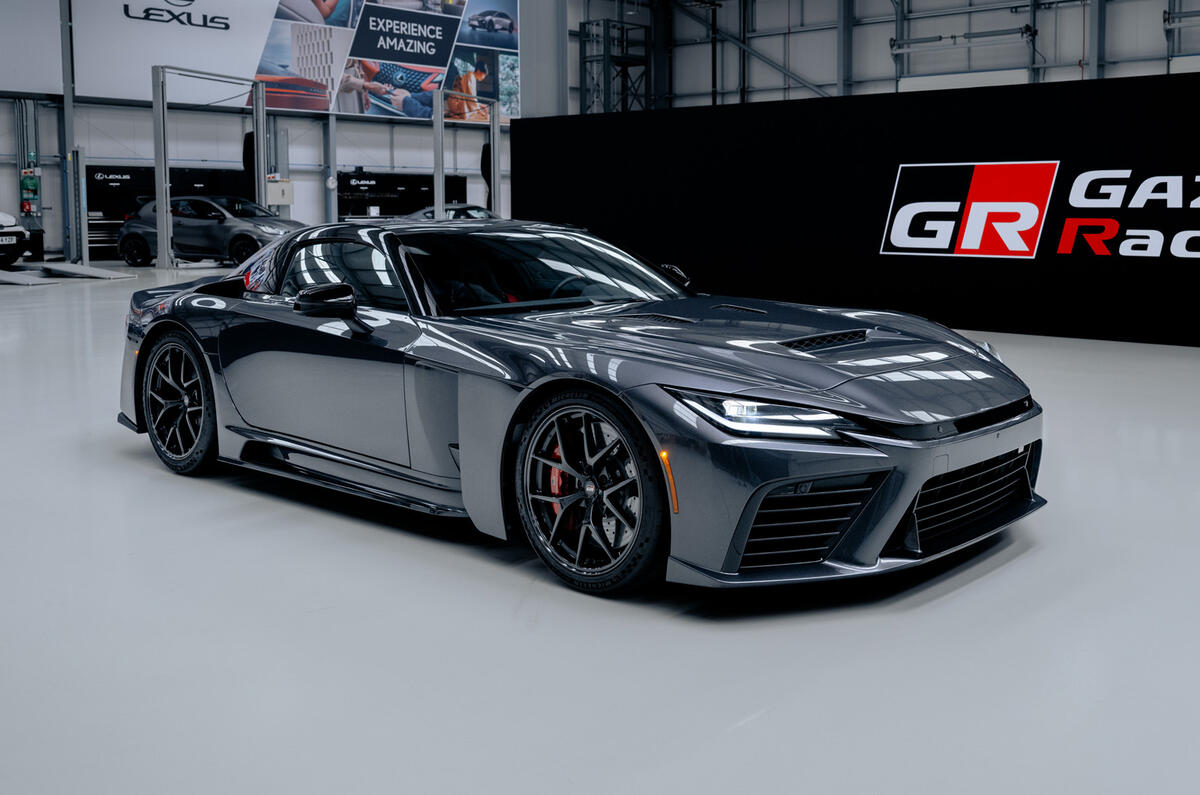
Toyota has brought its new flagship V8-powered supercar, the GR GT, to the United Kingdom ahead of its official market launch next year. This 641bhp performance machine is positioned to rival the Mercedes-AMG GT and the Aston Martin Vantage in the high-performance sports car segment.
The Toyota GR GT, developed under the Gazoo Racing performance division, has been designed as a “road-legal race car”. Both the road-going and GT3 racing versions were developed in parallel and unveiled together, illustrating Toyota’s close integration of motorsport technology with road car engineering.
The GR GT made its public dynamic debut at the Goodwood Festival of Speed last week. Prior to the event, Autocar had a chance to inspect the car up close and witness its powerful V8 engine roaring to life for the first time.
According to Toyota, the main development goal for the GR GT was to deliver “exceptional dynamic performance while creating a strong sense of unity between car and driver.” Company chairman and master driver Akio Toyoda personally guided the project alongside some of Japan’s most experienced racing drivers.
Together with the all-electric Lexus LFA, this new V8 supercar forms part of Toyota’s high-performance ‘Trinity’ range — a trio of flagship models designed to demonstrate the company’s engineering expertise and technological capability, honed through its extensive motorsport experience.
Another key objective during the GR GT’s development was to transfer “the secret art of car making” to a new generation of Toyota engineers. Many of the original LFA team members participated in this project to ensure that knowledge and craftsmanship were passed down effectively.
Japan’s answer to the Mercedes-AMG GT and Porsche 911 Turbo, the GR GT features a new 4.0-litre twin-turbocharged V8 engine combined with a hybrid system. Together, they produce a targeted 641bhp and 627lb ft of torque, sent exclusively to the rear wheels via a carbon-fibre-reinforced torque tube. Toyota notes that development is ongoing, and the final power output might exceed these early figures.
While official performance statistics remain undisclosed, Toyota is targeting a top speed of at least 198mph and an estimated 0–62mph acceleration time of around 3.5 seconds.
The engine is described as “exceptionally light and compact,” thanks to its hot-vee configuration — placing the twin turbochargers inside the cylinder banks — along with a dry-sump lubrication system and a slim oil pan. This design enhances both packaging efficiency and weight distribution.
Given the significant investment in this engine’s development, Toyota is expected to use it in additional applications, although no specific details have been shared yet. Importantly, the company has confirmed that the engine will comply with stricter future emission regulations, ensuring its viability for years to come.
The engine’s soundtrack was a major engineering focus. Toyota intended the V8 to deliver “high-level performance along with the distinctive race-bred sound of a twin-turbo V8.” The exhaust system has been “precisely tuned to harmonise with the vehicle’s dynamic state.”
Power is transmitted through an all-new eight-speed automatic transmission featuring a wet clutch — similar to the seven-speed system in the AMG GT — which ensures “world-class shift speeds.” A mechanical limited-slip differential further enhances traction and control.
An electric motor is mounted ahead of the gearbox to fill torque gaps between gear changes, ensuring smooth and uninterrupted power delivery.
The GR GT’s race-inspired design is apparent in its aerodynamically refined bodywork and driver-focused interior. Toyota claims the cockpit has been optimised for both professional racers and driving enthusiasts, balancing usability for track days and everyday road use.
Interestingly, neither the road nor the GT3 racing versions of the GR GT carry a Toyota badge on the exterior or interior. This aligns with Toyota’s broader strategy to establish Gazoo Racing as a distinct sub-brand, similar to Lexus or Century.
Inside, the cabin has been designed to maximise visibility, provide a strong sense of security, and ensure “the perfect driving position.” Every control switch is shaped and positioned for intuitive operation, reflecting Toyota’s focus on ergonomics and driver engagement.
Weight reduction and structural rigidity were other central priorities in the GR GT’s development. Toyota targeted “linear response and precise controllability” in all driving conditions — from racetracks to city streets.
The GR GT is the first Toyota model to feature an aluminium body-in-white construction. Many of its exterior panels and major suspension components are also made of aluminium, while the braking system uses carbon discs supplied by Brembo.
As a result, Toyota claims the GR GT’s kerb weight will be under 1750kg — around 300kg lighter than the four-wheel-drive Mercedes-AMG GT and nearly identical to the rear-driven Aston Martin Vantage.
The car’s 45:55 front-to-rear weight distribution, combined with a specially developed stability control system inspired by Toyota’s Le Mans race car, enables the GR GT to deliver an experience where “the driver and vehicle interact seamlessly,” whether on a racing circuit, winding road, or public highway.
-
UAE owners get early preview of OMODA & JAECOO's future intelligent parking technology

-
Groww Q1: Profit Surges 94% YoY To ₹735 Cr

-
Delhi Government Takes Major Steps for School Safety and Higher Education

-
'We are all Odysseus': Why Greek expats in UAE are eager for Christopher Nolan's 'The Odyssey'

-
S Y Quraishi Critiques Election Commission's SIR Process: A Threat to Democracy?