In modern society, home is rarely a single place. Especially in a city like Dubai, where almost everyone seems to be from somewhere else and on their way to somewhere else. For many Greeks living in the UAE, Homer's Odyssey, more than just being an ancient text, has become a lasting framework for understanding that feeling. Of nostos, the ancient Greek word used to describe a bittersweet, agonising yearning for home. Of what it means to build a life far from the soil that shaped you. You don't have to be sailing past sirens to recognise yourself in Odysseus. You simply have to know what it feels like to carry a version of home in your mind, even when that version may be more intact than the place itself you left behind.
For the Greek community here, Homer’s epic has become a language for articulating that ache of displacement, a way to express longing without self‑pity, and the strange, stubborn act of putting down new roots while refusing to let old ones die.
So, when Christopher Nolan turns his camera towards this Greek ancient epic with his adaptation of The Odyssey, arriving in UAE cinemas on July 16, anticipation within the Greek community runs particularly high.
Stay up to date with the latest news. Follow KT on WhatsApp Channels.
Led by Matt Damon as Odysseus, with Tom Holland as Telemachus, Anne Hathaway as Penelope and a star‑studded ensemble that includes Robert Pattinson and Lupita Nyong’o, Nolan’s version promises not just spectacle, but a fresh, global lens on a tale that began as a poem and now arrives in IMAX frames. For Greeks in the UAE, that meeting of ancient identity and modern scale, however, feels intensely personal. Because, in the dark of the cinema, the journey back to Ithaca won't only be Odysseus'. It will be theirs too.
Nostos: Carrying home in the mindFor the Greek community in the UAE, The Odyssey is woven directly into the fabric of growing up, though the ways it reaches them vary. For some, like Eleni, a flight attendant based in Abu Dhabi, it was introduced in school with a sense of reverence.
"Homer was introduced to me like something sacred," Eleni recalls. "Something that has a deep meaning, something that we must be proud of. My memories are of teachers trying to show and decode with us the meaning behind the text of Homer's epics."
For others, the epic seeped in more casually through the cultural atmosphere. Antonio Costalas, a Dubai-born and raised business development consultant who has lived in the city since 1997, admits his introduction came through popular culture.

Antonio Costalas, Greek expat
"And I think that's worth saying plainly, because I suspect it's true of a lot of Greeks my age and nobody wants to admit it! Growing up as a Greek abroad, myth reaches you sideways. Through the names of the islands, through what your parents say, through a passing reference in a film."
Yet, regardless of how the story was first received, its core theme remains a powerful mirror for the expat experience. Erifyli Sophia Veroni, co-founder of the Ellinomatheia Greek Language School in the UAE, left Greece years ago to pursue opportunities abroad.
"Like Odysseus, I encountered unexpected obstacles, unfamiliar cultures, setbacks and moments of doubt that tested my resilience," Erifyli adds. "But over time, I came to realise that life doesn't always lead you back to the place you left. Sometimes the journey itself transforms you and instead of returning home, you create one. I built a new life, embraced new beginnings and found a sense of belonging while carrying my Greek roots, with me every step of the way."
Erifyli Sophia Veroni, co-founder of the Ellinomatheia Greek Language School UAE
Gatekeeping vs. adaptation: Who owns a myth?When a filmmaker of Nolan’s scale tackles a narrative so deeply tied to national identity, the question of creative liberty inevitably arises. Some Greeks express worry over modern Hollywood casting choices, such as Lupita Nyong'o playing Helen of Troy, viewing it as a departure from historical roots.
Antonio, however, approaches the debate, focusing on the essence of the performance. "Personally, I don't hold that view," Antonio explains. "For me it's an artistic question, and it comes down to one thing, is the character served? Is she written and played with intelligence and weight, or rewritten into someone Homer wouldn't recognise? The race of the actor isn't what would damage this story. Manipulating the source material is," he adds.
"I understand why it stings. When you're a small country whose culture belongs to everyone, you feel every liberty taken with it. But I'd rather judge the film on the basis of the film," says Antonio.
Where he draws the distinction is between changing details and altering the soul of a narrative. "Interpret it, restage it, reimagine the look of it, but don't change its meaning to suit a point you wanted to make anyway. Fidelity to the source doesn't mean copying it. It means understanding it well enough that your changes come from respect rather than indifference."
Eleni shares this view, believing that myths must evolve to remain alive. "I don't feel a sense of ownership," Eleni says. "Just let the artists express themselves how they want. If it’s good, the people will approve it, if not, then that is it! That’s the ultimate test. Every piece of art is a child of its own time, trying to speak to us about our own age through an old epic."
The danger of the Hollywood spectacleThe true concern for many is not that the story will be changed, but that it will be flattened. The epic's monsters, sirens and gods are cinematic gold mines, but to a classicist, they are psychological milestones. Ioanna Papadopoulou, a Greek historian, cautions against reducing The Odyssey to mere popcorn entertainment.
"My concern is that the epic might be reduced to its most spectacular elements, such as monsters, battles, storms and supernatural encounters," Ioanna adds. "Yet the Cyclops, Circe, Calypso and the Sirens are not merely obstacles in an adventure story. Each represents a different temptation to forget oneself, surrender responsibility or abandon the journey home."
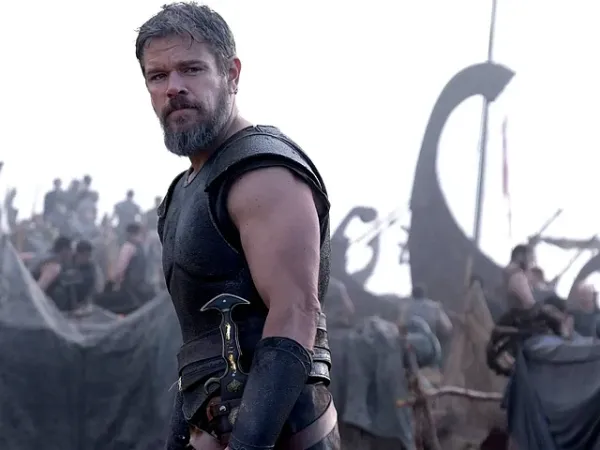
Matt Damon as Odysseus in Christoper Nolan's The Odyssey
For Ioanna, the story’s enduring genius lies in Odysseus’s decision to reject immortality in favour of a mortal life with Penelope on a rocky island. "And yet he chooses Ithaca. He does not choose it because it is more beautiful, richer or safer than the places he has encountered. He chooses it because it is the place to which his relationships, obligations and memories belong. Odyssey suggests that a good life is not simply a life without suffering. It is a life bound to particular people, particular promises and particular memories," she adds.
"In Odysseus’ fear of losing himself, we recognise a profoundly human struggle," says Ioanna. "The effort to remain faithful to who we are while the world continually changes us. Again and again, he must choose between oblivion and memory, immortality and mortal life, pleasure and responsibility, wandering and return, impulse and self-command. His journey reminds us that we may lose ourselves not only through suffering, but also through comfort. We are all Odysseus."
However, Nolan's reputation for complex, non-linear storytelling makes him uniquely suited to avoid this pitfall, says Antonio. "My expectations are high and they're high specifically because it's Nolan. He has a track record of taking difficult material and refusing to make it simplistic... My only concern is the one I'd have with any big-budget epic, which is that scale can swallow intimacy. Odyssey is a spectacle, but the heart of it is a man who lies, who falters, who loses every one of his men and who ends up crying on a beach. If Odysseus becomes a clean hero, that's a failure."
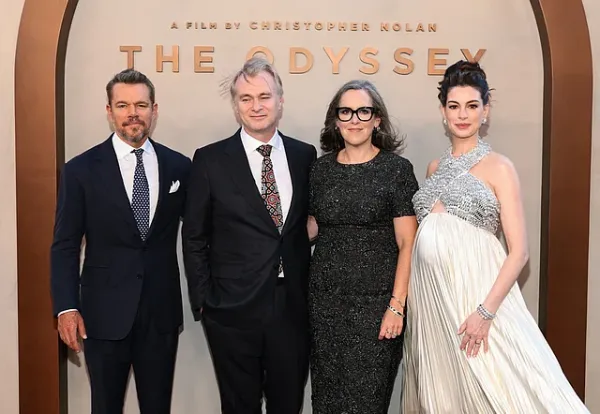
(from left) Matt Damon, Christopher Nolan, Emma Thomas and Anne Hathaway at the premiere of 'The Odyssey' in New York City
Why the epic enduresUltimately, whether through IMAX cameras or ancient oral recitation, Odyssey persists because it focuses on a timeless, unresolved human struggle. As Antonio points out, drawing on his studies of ancient Greek tragedy, "The Greeks didn't write answers, they wrote problems and that's the trick. An answer expires, a problem doesn't."
The tragedies ask how a life falls apart. Odyssey asks how you find your way back. "Strip away the monsters and it's a man twenty years late getting home, a wife holding a household together under pressure and a son growing up without a father. Displacement, loyalty, delay and whether the person who left is still the person who arrives. Empires disappear, but that lands the same way in 2026 as it did in 800 [or 700] BC," says Antonio.
For the Greek community in the UAE heading to theatres this weekend, the ultimate hope is that the blockbuster serves as a gateway rather than the final word. "I am looking forward for the people to see and embrace the story," says Eleni, "and why not purchase and read the original book."
Christopher Nolan defends modern dialogue, calls 'The Odyssey' backlash 'irrelevant' 'The Odyssey' would not have been possible without 'Oppenheimer', director says Christopher Nolan's 'The Odyssey' first reactions are in: Matt Damon tipped for Oscars-
Dombivli doctors' assault: Shinde Sena corporator gets bail

-
Kerala Tragedy: 3-Year-Old Boy Dies After Choking on Peanut in Malappuram

-
Revenue Inspector Caught Taking Rs 25K Bribe By Odisha Vigilance

-
Final Report on Ayodhya Temple Donation Investigation Expected Soon

-
Supreme Court Questions Implementation of NEP 2020's Three-Language Policy