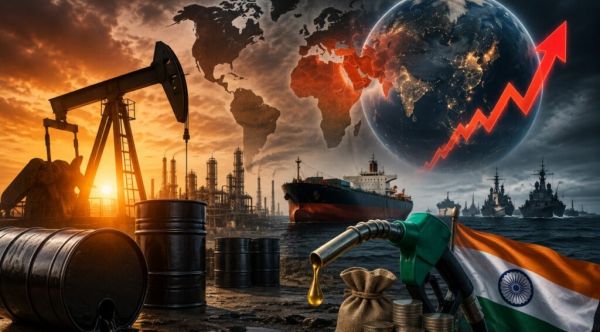
Is the world once again moving towards an Oil Shock that can slow down the pace of the global economy? In 1973, OPEC’s oil embargo pushed the world into recession and record inflation. The Gulf War of 1991 and the Russia-Ukraine war of 2022 also shook the energy market. Now in 2026, the threat is not only to oil production, but to the Strait of Hormuz, considered the energy lifeline of the world, through which about 20% of the global maritime oil trade and a large part of the LNG passes.
If this route is affected for a long time, the impact will not be limited to petrol-diesel only, but can affect inflation, shipping, food prices and the entire global economy. India also cannot remain untouched by this. Do you understand the whole matter?
Is the world heading towards a new energy crisis?
increasing tensions in the Middle East and Strait of Hormuz The increased uncertainty regarding has increased the concern of the global energy market. According to the US Energy Information Administration (EIA), about 20% of the world’s total seaborne oil trade (about 20 million barrels per day) passes through this strait. Additionally, about 20% of world LNG trade, especially Qatar’s exports, also depends on this route.
If the war continues in this sea route for a long time, not only the cost of crude oil but also the cost of gas, shipping and global supply chain may increase. This is why experts consider the situation in 2026 to be different and more complex than previous energy crises.
What are the differences and similarities between 1973, 1991, 2022 and 2026?
OPEC’s oil embargo after the Arab-Israeli war in 1973 increased crude oil prices almost four times and inflation reached above 10% in many developed countries. Oil prices rose sharply during the 1991 Gulf War, but the market returned to normal within a few months due to excess production and strategic reserves.
Brent crude reached almost $130 per barrel in 2022 after the Russia-Ukraine war, while natural gas prices in Europe hit record levels. The risk of 2026 is different because this time not only production but the world’s most important energy corridor is likely to be affected, due to which oil, LNG and container shipping may be affected simultaneously.
What is the biggest difference between 1973 and 2026?
The cause of the crisis in 1973 was OPEC’s oil embargo, whereas in 2026 the biggest risk is the supply route. The Strait of Hormuz is only 33 kilometers wide and its narrowest shipping lane is about 3 kilometers in each direction. Through this route, major energy producing countries like Saudi Arabia, Iraq, Kuwait, UAE, Qatar and Iran export oil and gas.
Almost one in five oil barrels in the world travels through this route. If this route is disrupted, it will not be easy to handle the crisis simply by increasing production because the problem will be to deliver the supply.
Why is the crisis of 2026 not being considered as limited as that of 1991?
In 1991, Saudi Arabia increased excess production and the United States used its Strategic Petroleum Reserve (SPR) to help stabilize the market. At that time the global supply chain was not as complex as it is today. Currently more than 80% of the world’s global trade is carried by sea routes and container logistics, e-commerce, automobile, electronics and manufacturing industries depend on ‘just-in-time’ supply models. Therefore, if the disruption in Hormuz lasts for a long time, the impact will not only be limited to the energy sector but global industry and trade will also be affected.
What are the similarities between 2022 and 2026?
Like 2022, the possible crisis of 2026 is also to geopolitical conflict. During the Russia-Ukraine war, Europe faced a huge cut in gas supplies from Russia and many countries had to compete with Asia for LNG. Similarly, if Hormuz is affected, the LNG supply from Qatar may be disrupted, which will increase pressure on both Asia and Europe. High energy prices have a direct impact on fertilizers, power generation, food transportation, aviation and sea freight, which could trigger a new round of global inflation.
Is the world at the brink of the fourth major energy crisis?
The situation is not like 1973. Today America is the world’s largest oil producer and produces more than 13 million barrels per day. Member countries of the International Energy Agency (IEA) have more than 1.2 billion barrels of strategic oil reserves.
India, China, Japan and Europe have also increased the diversity of their energy sources in the last years. Nevertheless, if the Strait of Hormuz remains blocked for a long time, the Middle East conflict escalates or OPEC+ cuts production, oil prices could again rise above $100 per barrel, which could have a broader impact on global inflation, shipping costs and economic growth.
How much will it affect India?
India imports about 85-88% of its total crude oil requirement. A large part of it comes from Gulf countries. About 35-40% of India’s imported oil comes from countries like Iraq, Saudi Arabia, UAE and Kuwait, whose supplies depend on the Strait of Hormuz. India is also the world’s third largest oil importer and consumer. If oil prices increase by $10 per barrel, India’s annual import bill could increase by billions of dollars, which is likely to increase the current account deficit and put pressure on the rupee. Expensive oil can have an impact on petrol-diesel, LPG, CNG, air fares, fertilizers, food items and transportation costs.
Although India has strategic petroleum reserves of about 5.3 million tonnes capacity and also has options to buy oil from many countries including Russia, but if the crisis continues for a long time, then pressure on both inflation and economic growth is almost certain to increase.
-
Tyler Fredricson Set to Miss Manchester United vs Wrexham Friendly Amid Imminent Transfer

-
Leeds United Eye Juventus Goalkeeper Michele Di Gregorio: The Right Fit for Daniel Farke?

-
Significant Changes Announced for 2027 ODI World Cup Qualifier Format

-
Trump Endorses Darline Graham Nordone for South Carolina Senate Seat

-
Revealed: The unique record of Slavko Vinčić, Argentina vs Spain World Cup final referee, with Messi and Yamal's sides