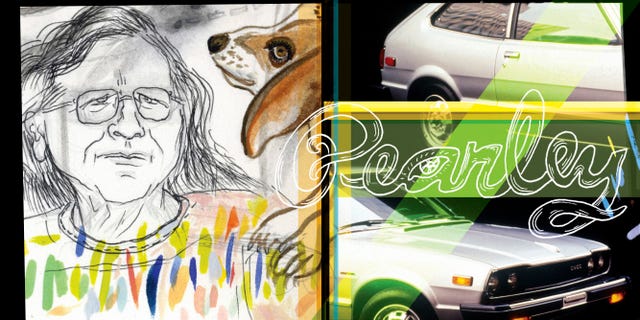
“All the good names like Cougar and Wildcat were already taken,” recalled Toshio Sasaki, who served as Honda’s foreign sales manager, in a February 1977 conversation with The New York Times. “We had to settle for Civic and Accord.” That decision turned out just fine.
The Civic celebrated its 50th anniversary in 2023, and in 2026, it will be the Accord’s turn. The challenge lies in determining how to honour a car that’s both deeply significant and wonderfully ordinary. The Accord is the modest Japanese sedan that redefined what people expected from a family car. My own family has owned six of them, with two passed down through generations.
We’re down to one Accord now. My mother bought it nearly new, and today, my daughter Nina drives it. There’s little doubt that more will find their way into our family in the future.
American Honda maintains a collection of historic vehicles at its American Honda Collection Hall, located on the ground floor of its Torrance, California headquarters. Many of these are race cars—from SCCA Showroom Stock to IndyCars—while others are production vehicles. Although I’ve yet to be allowed behind the wheel of an IndyCar, the production models are kept in immaculate, fully functional condition, and journalists like me are occasionally given the chance to drive them.
I’ve driven several of these preserved Accords, but something always feels missing. These cars are survivors—immaculate examples of their generation. Yet the Accord’s true greatness lies in the fact that so few have survived. It was designed to be driven hard, worn out, and replaced—not displayed in museums or private collections. Its legacy lives on in family stories, faded photographs, and old online posts, not in glass cases.
When the Accord debuted in June 1976, it became an instant hit. At the time, Honda had about 600 dealerships across the United States. Even though the Accord was available only as a three-door hatchback, demand quickly exceeded supply, resulting in a six-month waiting list and dealers charging $800 or more above the sticker price. That was a hefty markup when the car itself cost roughly $4000, including a radio and radial tyres.
“This new Honda may be the best automotive buy available in the U.S.,” wrote Road & Track in its August 1976 issue. It wasn’t a performance machine—it had 68 horsepower from a 1.6-litre single-overhead-cam, single-carburettor four-cylinder engine, needed 15.4 seconds to reach 60 mph, and topped out at 90 mph. But it offered a remarkably smooth five-speed manual gearbox and was built with extraordinary precision. Above all, it was practical and refined.
Remember, this was 1976. The Ford Pinto, Chevrolet Vega, and AMC Gremlin were still in showrooms, and the best-selling car in America was the massive “mid-size” Oldsmobile Cutlass. Toyota hadn’t yet introduced its first front-wheel-drive car, early VW Rabbits suffered from poor quality, and Datsun’s once-elegant designs had given way to awkward, psychedelic shapes.
Looking at a 1977 Accord today, its compactness stands out. Measuring 162.8 inches in length with a 93.7-inch wheelbase, it’s 22 inches shorter than the 2026 Civic and 14 inches tighter between the axles. Then I slipped into the driver’s seat.
The original Accord feels narrow across the hips and shoulders, but the seats are supportive, the gear lever sits exactly where it should, and the steering wheel—thin-rimmed and perfectly sized—feels just right. The overall layout is logical, intuitive, and easy to use. Driving through the streets of Torrance, it felt like a nostalgic throwback—somewhere between timeless Adidas Sambas and retro Members Only jackets.
Skipping over the CB200T motorcycle my younger brother Linus once rode, my personal connection with Honda truly began with the second-generation Accord. My cousin Guy Magrone, who shared a bedroom with me for a while (separate beds, thankfully), bought a brand-new 1984 Accord sedan on my recommendation when he started his long career at Marriott. If memory serves, we once managed to fit nine people into that car—maybe eight, maybe ten.
From a business standpoint, the second-generation Accord was significant because it was the first model assembled at Honda’s U.S. plant in Marysville, Ohio. For Guy, though, it was a steadfast companion through countless relocations and years of reliable service. By the time he sold it, the car was tired but spotless. “I drove it into the ground,” he told me recently. On my suggestion, he replaced it in 1994 with a Mazda MX-6.
I still have a soft spot for the third-generation Accord, especially the two-door coupe. Its hidden headlights, balanced proportions, and near-perfect interior design make it one of Honda’s finest efforts. It remains modern-feeling and effortlessly pleasant to drive.
If only Honda kept a few well-used Accords in its collection. My mother’s first, a 1995 EX sedan with a five-speed manual, was totalled in 1996 or 1997 after being hit at an intersection. Sadly, it was the last manual-transmission Accord in our family. Thankfully, my mom wasn’t injured—that mattered most.
My mother-in-law’s 2001 LX Coupe made the move from Memphis to Santa Barbara, later becoming my nephew Brannan’s car, then passing to my daughter. Two years ago, my son Jack and his friend Nate Campbell drove it from California to Minnesota—it served as his college beater.
“We got pulled over for speeding near Zion National Park in Utah,” Jack remembered. “The trooper told us to slow down and then gave us tips on the best places to visit.” While at Carleton College, he lent the car to teammates who needed a ride. “We crammed about eight big guys into it to get to Minneapolis,” he laughed. “One might’ve even been in the trunk.” After graduation, he left the exhausted car behind, and we donated it to charity.
The beauty of the Accord lies in the fact that few end up in museums. Honda never built them to be parked under trees at car shows while owners lounged in folding chairs nearby. As of now, there’s just one listed on Bring a Trailer—a pristine 1988 LXi coupe with 27,000 miles that sold for $8,000. I’d love to own it, but what would I do with it? It’s too pristine for daily use, and it’s an automatic—I’d want a five-speed.
Across 11 generations, the Accord has grown larger and evolved to meet each era’s needs, yet it remains a car for everyday life. Among ordinary cars, it’s still one of the best. My favourites? The third-generation coupe, the fourth-generation wagon, and the seventh-generation European Accord, sold here as the Acura TSX.
Since 1976, Honda has sold around 20 million Accords in the United States. Nearly every family has owned one—or two, or more.
Driving the new 2026 Accord Hybrid, it’s amazing how consistent its character and overall excellence remain. It’s still understated, superbly built, and endlessly practical. After a week with it, I’m seriously considering one as my next daily driver. It still doesn’t belong in a museum.
Honda could use a few well-worn Accords, Civics, Elements, and Odysseys in its collection—cars that show the true spirit of the brand. They can have my daughter’s 2016 Accord Sport once it’s clocked a few more hundred thousand kilometres.
-
Why Europe is falling behind in AI — and how to catch up

-
Physical AI Startup SwitchOn Raises $8 Mn To Scale Manufacturing Inspection

-
BSNL Awards ₹856.39 Crore 4G Expansion Order To ITI Ltd, Company To Deploy Network Across 7,613 Sites In Western India

-
AI Appreciation Day: UAE shifts from AI adoption to AI leadership

-
Anticipated Organizational Changes in BJP Following Key Meeting