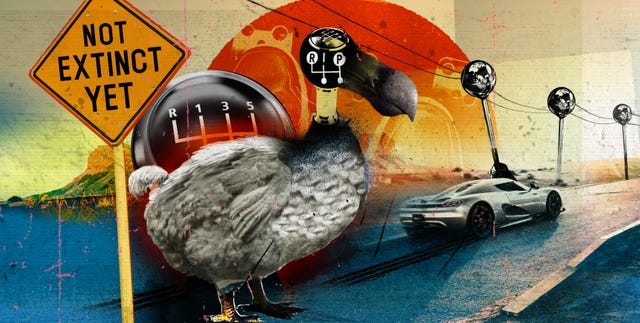
“Save the manuals.” You’ve probably spotted this phrase on T-shirts at Cars & Coffee meets, in social media hashtags, or on the rear quarter window of a late-model BMW parked in your neighbourhood. Hopefully, you share the same sentiment, because I certainly do. My fun cars always have, and always will have, proper shift levers instead of paddles—as long as my left leg continues to work.
In a sort of Biff Tannen “nobody drives this car but me” moment, I even went as far as permanently disabling the automatic rev-matching feature in my Porsche 718 Spyder.
Driving a manual gearbox is simple to learn but challenging to perfect. It’s a skill that requires patience, practice, and often public trial and error—where impatient commuters in two-pedal Toyota Camrys might honk if you hesitate too long. But once you master it, the reward is immense. A manual gearbox offers the purest connection to the mechanical soul of a car, letting you feel exactly what’s happening beneath you. If you’re reading this article, chances are that sort of connection matters to you.
But what does “Save the Manuals” really mean in today’s context? The boundaries aren’t as clear as they once were.
To begin with, the simplest way to support manual transmissions is to buy new models that still offer them. Manufacturers take a risk producing manual variants, so reward their effort. Don’t let a slightly rubbery shifter deter you—perfect is the enemy of good. You can always fine-tune the clutch or shifter feel later. Another way to preserve manuals is to keep driving and maintaining the three-pedal cars that already exist. Many enthusiasts already do this, often without even thinking about it.
You can also help by creating more manual drivers. Take a cue from my friend Jibran, who’s let dozens of people learn to drive stick on his own car (and yes, the clutch survived). Parents can encourage the next generation by saying, “I’ll buy you a car when you get your licence—but it’ll be a manual.” You can also teach your partner or spouse, sharing the joy of mastering the skill together.
Then comes the exciting part—creating more manual cars by converting automatics that deserved better.
High-value exotics led the way. Twelve years ago, I sent my Aston Martin Vanquish back to the factory to be converted to a manual gearbox, and it transformed the car completely. Aston Martin remains one of the few semi-mainstream manufacturers to offer such conversions in-house. The aftermarket scene soon followed, beginning with Ferraris—converting F1-equipped 360s, 430s, and 599s into gated six-speeds. Since these models were originally available with manuals, the swaps were relatively straightforward. Later, tuners began manual-swapping Lamborghini Gallardos, Murciélagos, and Audi R8s. Enthusiasts have even converted Maserati GranTurismos, Alfa Romeo 8Cs, and Ferrari 355s. One particularly daring individual even manual-swapped his Ferrari 458 Speciale. Thankfully, manual conversions are no longer exclusive to supercars—they’re increasingly common among enthusiast favourites.
BMW enthusiasts, in particular, have become leaders in the “affordable swap” movement, replacing thousands of SMG systems in M3s, M5s, and M6s with factory manual parts.
Given the growing value gap between manual and automatic variants—especially among exotics—a manual conversion can even be a financially smart move for those who can handle the tools.
But what about cars that never had a manual option to begin with?
I recently spent a day in Nashville, Tennessee, at Kwiek Classics, a workshop specialising in complete powertrain conversions for neo-vintage Mercedes-Benz models—most of which are also converted to manual. While my own project Mercedes will remain automatic (that’s a story for another time), I had the chance to drive a 190E fitted with a 4.3-litre V8 from a CLK430, paired with a six-speed manual. And let me tell you, this is absolutely the way to go. In stock form, the five-speed automatic dulled all the dynamic brilliance the engineers built into the chassis. Every manual-swapped Mercedes I’ve driven—now numbering five—has been dramatically improved and far more engaging.
We often forget that the way we shift gears today wasn’t always universal. Decades ago, configurations like “three on the tree” and “four on the floor” coexisted. Back in the 1930s, there were half a dozen different ways to change gears—most of which have since disappeared.
Even now, the definition of a manual transmission isn’t set in stone. Take Porsche’s GT models, for instance. They allow you to “clutch kick” the PDK automatic by pulling both paddles and releasing them, enabling burnouts and slides—activities usually reserved for manuals. You can even slot the car into neutral manually. But since the PDK still offers a full automatic mode, I wouldn’t call it a true manual. Still, it suggests that the future could include unconventional ways to regain manual control—and once again, perfect is the enemy of good.
Two years ago, Koenigsegg unveiled the CC850 concept—a retro-futuristic homage to the brand’s early designs, fitted with a synthetic manual gearbox. It featured a hydraulic clutch pedal and gated shifter connected to a nine-speed automatic. The driver could operate it as a fully automatic, paddle-shift, sequential nine-speed, or as a manual six-speed with a clutch, selecting six of the nine ratios per drive mode. It’s reportedly not yet production-ready, but yes—you can actually stall it in manual mode. I personally witnessed Christian von Koenigsegg demonstrate it.
Ferrari has also joined the experiment. The Italian marque recently introduced a limited-run version of its 12Cilindri V12 grand tourer, equipped with a clutch pedal and gated shifter connected to a dual-clutch transmission. It can still operate in full-auto mode or allow manual gear changes. Ferrari claims it allows controlled stalls and rev-heavy clutch drops, though you can’t “money-shift” it.
But here’s the surprise—you don’t need a Koenigsegg or Ferrari to experience something similar. The ZF 8HP gearbox, commonly known as the ZF 8-speed automatic, is everywhere—from performance sedans like the BMW M3, Alfa Romeo Giulia, and Audi RS6, to GTs like the Aston Martin DB12 and Maserati GranTurismo, and even American muscle such as the Dodge Charger Hellcat, Ram 1500, and Jeep Grand Cherokee. It’s robust, widely available, and surprisingly affordable.
Now, the 8HP is technically an automatic—it uses a torque converter instead of a clutch and flywheel, requiring only two pedals. But things get interesting inside. It houses electronically controlled clutch packs, which can be manually operated using aftermarket control units like the Turbo Lamic. Some setups even include a clutch-by-wire simulator pedal that mimics the function of a real clutch pedal, controlling the clutch packs electronically.
I haven’t yet experienced one first-hand, though I’d love to. But after watching several demonstrations, I can confidently say the system works. It can function as a drift-ready, clutch-kicking monster or as a standard automatic. In some cases, the 8HP’s clutch packs withstand abuse better than traditional clutches, according to early teardown reports. You could theoretically install this system in your daily car—no race-prep required.
Of course, purists may scoff, arguing that it’s not “real.” And they have a point—no one has perfectly replicated the tactile feel of a mechanical clutch pedal. Even top-tier simulators fall short. But since this is a virtual system anyway, why cling to the traditional third pedal? There’s vast potential for innovation—hand clutches, adaptive systems for differently abled drivers, or even a mouth-controlled clutch system. The possibilities are endless.
While a small group of passionate enthusiasts may not be able to stop the manual gearbox from fading out entirely, we should still buy and enjoy them while we can. But as history shows, necessity drives innovation. If manufacturers stop producing traditional clutches and flywheels, enthusiasts will find ways to replicate that experience through technology.
Because driving a manual isn’t just about moving your left foot and stirring a lever—it’s about maintaining control. It’s about managing power delivery, balancing weight transfer, and keeping your car precisely in its powerband. It’s about the ability to instantly disconnect and reconnect the powertrain whenever you choose.
Ultimately, keeping driver control alive—whether through three pedals, paddle shifters, or even synthetic systems—is what “saving the manuals” is truly about. The future of driving engagement depends on it.
-
Why Europe is falling behind in AI — and how to catch up

-
Physical AI Startup SwitchOn Raises $8 Mn To Scale Manufacturing Inspection

-
BSNL Awards ₹856.39 Crore 4G Expansion Order To ITI Ltd, Company To Deploy Network Across 7,613 Sites In Western India

-
AI Appreciation Day: UAE shifts from AI adoption to AI leadership

-
Anticipated Organizational Changes in BJP Following Key Meeting