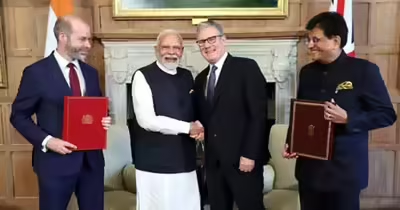

The India-UK Comprehensive Economic and Trade Agreement (CETA) officially came into force on July 15, 2026, marking a significant milestone in bilateral trade relations between the two countries. The agreement is expected to boost trade, increase market access for businesses and gradually reduce the prices of several British products in India, while giving Indian exports duty-free access to the United Kingdom.
The landmark trade pact was signed in London on July 24, 2025, by Union Commerce and Industry Minister Piyush Goyal and UK Secretary of State for Business and Trade Jonathan Reynolds, in the presence of Prime Minister Narendra Modi and UK Prime Minister Keir Starmer. After completing the required approval process, the agreement has now officially come into effect.
Under the agreement, 99% of India’s tariff lines will receive duty-free access to the UK market, providing a major boost to Indian exporters across sectors including textiles, engineering goods, pharmaceuticals, leather, chemicals, processed food and marine products. In return, India will gradually reduce import duties on several British goods over the next five to ten years instead of implementing immediate tariff cuts.
One of the biggest beneficiaries of the agreement will be premium British automobiles. Import duty on fully built luxury cars from the UK, which currently stands at as much as 110%, will gradually be reduced to 10% over a ten-year period through a quota-based system. Brands such as Rolls-Royce, Jaguar, Land Rover, Aston Martin and McLaren are expected to become more competitively priced in the Indian market. Petrol and diesel vehicles will receive concessional treatment from the beginning, while electric, hybrid and hydrogen-powered vehicles will benefit from lower duties starting from the sixth year, providing protection to India’s domestic electric vehicle industry during the initial years.
The agreement will also significantly reduce import duties on Scotch whisky and gin. The existing 150% import duty on Scotch whisky will immediately be reduced to 75%, before gradually declining to 40% over the next ten years. Similar phased reductions will apply to gin and several other premium alcoholic beverages, including bourbon, vodka, rum, tequila, brandy, cider and sake, making imported premium spirits more affordable for Indian consumers over time.
Apart from automobiles and beverages, tariffs will also be reduced on a range of British consumer products, including chocolates, biscuits, soft drinks, perfumes, cosmetics, shaving products, soaps and other lifestyle goods. Imported British food products such as salmon and lamb are also expected to become relatively cheaper as tariff reductions are implemented in phases.
The healthcare sector is another major beneficiary of the agreement. India will gradually reduce duties on selected British medical devices and healthcare equipment, including diagnostic machines, ECG equipment, X-ray systems and surgical instruments, which could help improve access to advanced medical technology.
The agreement also provides for a gradual reduction in import duty on silver, one of the UK’s largest exports to India by value. Tariffs on silver will be brought down to zero over a ten-year period, benefiting industries such as jewellery manufacturing and electronics that rely on the precious metal.
However, several sensitive sectors have been kept outside the scope of tariff concessions to protect domestic industries. These include dairy products, cereals, pulses, edible oils, apples, walnuts, gold, jewellery, smartphones, optical fibre, marine vessels, critical energy products and several agricultural commodities.
For India, the agreement offers significant export opportunities. Products that earlier faced tariffs of up to 70% in the UK—including processed food, textiles, garments, leather products, engineering goods, chemicals and pharmaceuticals—will now enjoy duty-free market access, making Indian products more competitive in the British market.
The agreement also extends the Double Contribution Convention, allowing Indian professionals working temporarily in the UK to remain exempt from dual social security contributions for up to five years, compared to the earlier limit of three years. The government estimates that this provision will benefit more than 75,000 Indian professionals and over 900 companies, resulting in savings of more than ₹4,000 crore.
Bilateral trade between India and the United Kingdom stood at around $56 billion when the agreement was signed, with both governments aiming to double trade volumes by 2030. While many tariff reductions on British products will be implemented gradually over several years, the agreement is expected to strengthen economic cooperation, expand business opportunities and provide long-term benefits for consumers, exporters and investors in both countries.
The post India-UK Free Trade Agreement Comes into Effect: Whisky, Luxury Cars, Chocolates and More to Get Cheaper | Cliq Latest appeared first on CliQ INDIA.
-
Strategic Shifts: The Managers Ushering in New Eras in the Roshn Saudi League

-
Liverpool nearing long-term contract renewal with Dominik Szoboszlai

-
Your Last Chance to Win £1,000 with Our Free World Cup Match Predictor

-
Investigation Unfolds Over Trump's Teleprompter Operator's Alleged Betting Scheme

-
Haldiram's opens in London: Here's how much chole bhature, pani puri, papdi chaat and pav bhaji cost in the UK; menu differs from India