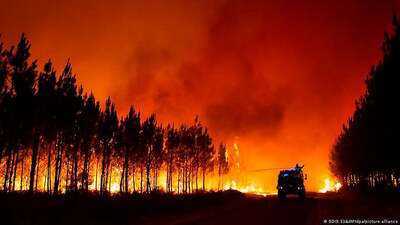
A powerful "heat dome" has pushed temperatures to record highs across large parts of the United States, while smoke from more than 100 Canadian wildfires has degraded air quality across North America, creating a dual public health emergency.
Billings in Montana recorded 43.9°C on 12 July, the hottest day in the city's history, while Salt Lake City in Utah reached a record 42.8°C. Boston has also experienced an unusually high number of days above 32°C this summer.
Scientists say the extreme conditions are being driven by a heat dome — a high-pressure system that traps hot air over a region for an extended period, suppressing cloud formation and rainfall while intensifying heat.
Night-time heat raises health risksResearchers warned that temperatures have remained unusually high overnight across parts of the Midwest and north-east, preventing people from cooling down and increasing the risk of heat-related illnesses, particularly among older adults and those with underlying health conditions.
The prolonged heat has coincided with an already severe wildfire season. Three firefighters were killed while battling a blaze near the Colorado-Utah border in late June, while a helicopter pilot responding to a Colorado wildfire died this week after crashing during firefighting operations.
According to the National Interagency Fire Center, dozens of active wildfires are burning across California, Oregon, Colorado, Utah, Minnesota and Idaho.
US heat wave kills dozens during 250th anniversary weekend Canadian wildfire smoke spreads across USSmoke from more than 100 active wildfires in Canada has pushed Toronto's air quality to the worst in the world, with prevailing winds carrying hazardous pollution into the United States.
Air quality warnings stretched from Minnesota to New York City on Wednesday, where residents also faced extreme temperatures.
"The best advice is to stay indoors to avoid both the smoke and the extreme heat," Tyler Hasenstein, a meteorologist with the National Weather Service in Chanhassen, Minnesota, said.
"Those two things coinciding with each other is not good from a health perspective."
Wildfires have already burned about 3.6 million acres of land this year in the United States.
Climate researchers said prolonged heat dries vegetation, making forests and grasslands more combustible and allowing fires to spread rapidly once ignited.
Dan Westervelt, an associate professor at Columbia University's Climate School, said severe drought and persistent heat had created "a perfect storm" for destructive wildfires across Canada and the western United States.
Researchers also pointed to growing scientific evidence that human-caused climate change — driven largely by the burning of coal, oil and gas — is increasing the frequency and intensity of wildfires by creating hotter and drier conditions.
Minnesota wilderness evacuatedAuthorities have closed Minnesota's Boundary Waters Canoe Area Wilderness after around 17 lightning-triggered wildfires broke out across the vast protected area.
Officials estimated between 6,000 and 10,000 people were still inside the 1.1 million-acre wilderness when the closure took effect, forcing lengthy evacuations by canoe and on foot.
The National Oceanic and Atmospheric Administration has forecast dangerous heat conditions to continue through next Monday, with California and several upper Midwest states expected to remain at high risk before the heat shifts into the southern United States later in the week.
Health authorities urged people to watch for symptoms of heat exhaustion, including heavy sweating, clammy skin and fatigue, as well as heatstroke — a medical emergency that can cause confusion, slurred speech, rapid pulse and body temperatures above 39.4°C.
Europe battles intensifying heatwave as record temperatures, deaths and health alerts mount-
US: Indian Muslim man stabbed in Utah over his religion

-
Aurum PropTech To Acquire Housing.com For ₹458 Cr

-
E20 Petrol Engine Damage Case: Raipur Consumer Court Orders Carmaker to Give New Car or Refund Rs.20 Lakh

-
E20 fuel row: FIR against content creators for 'defamatory posts' about Nitin Gadkari

-
Maiden FATs Of Indigenously Built Water Jets At M/S MJP Goa - 14 FPVs Project