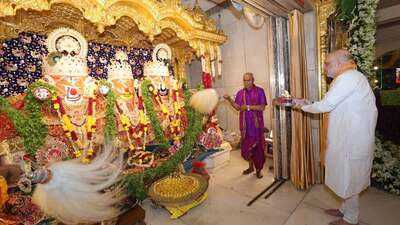
The festivities began at 4:00 AM with the sacred Mangala Aarti, attended by Union Home Minister Amit Shah along with his family. Following the aarti, the deities were offered the traditional Khichda Bhog.
After the idols were ceremoniously placed on their chariots, Gujarat Chief Minister Bhupendra Patel performed the age-old Pahind Vidhi—a symbolic sweeping ritual that marks the beginning of the Rath Yatra.
Lord Jagannath rode on the Nandighosh Rath, accompanied by Lord Balabhadra on the Taladhwaj Rath and Devi Subhadra on the Darpadalan Rath, as devotees thronged the streets for a glimpse of the divine procession.
This year's Rath Yatra featured over 100 themed tableaux highlighting India's rich spiritual and cultural heritage. The colorful displays became major attractions for devotees lining the procession route.
One of the most admired tableaux recreated the Dwarkadhish Temple, where artists dressed as Lord Krishna distributed prasadam while interacting with devotees, creating a deeply devotional atmosphere.
Ahmedabad Mayor Hitesh Barot said the Ahmedabad Municipal Corporation made elaborate arrangements to ensure the smooth conduct of the yatra. Multiple civic departments worked round the clock to manage sanitation, traffic, emergency services, and crowd control, allowing lakhs of devotees to participate without inconvenience.
Highlights of the 149th Ahmedabad Rath YatraThe Grand Procession Included
- 18 decorated elephants
- 101 theme-based trucks and tableaux
- 30 traditional akhadas
- 18 bhajan mandalis
- 3 marching bands
- 2,500 saints and seers from across India
- 1,000–1,200 devotees pulling the sacred chariots
- 45,000 kg moong (green gram)
- 500 kg jamun
- 500 kg mangoes
- 400 kg cucumber and pomegranate
- 2 lakh 'Uperna' (traditional sacred cloth offerings)
Authorities deployed extensive security arrangements for the procession, including:
- 30,000 police personnel
- 10 IGs and DIGs
- 42 Deputy Commissioners of Police (DCPs)
- 88 Assistant Commissioners of Police (ACPs)
- 800 Police Inspectors
- 26 police ranges
- 1,397 security points
- 100 surveillance drones
The Jagannath Rath Yatra is much more than a religious procession. It symbolizes faith, equality, devotion, history, and inclusivity. Every year, millions of devotees gather not only for the darshan of the deities but also for the opportunity to pull the sacred chariots—a privilege believed to bring immense spiritual merit. But several fascinating traditions make this festival unique.
Why Does Lord Jagannath Visit His Maternal Aunt's House Every Year?According to popular belief, Lord Jagannath, Lord Balabhadra, and Devi Subhadra travel every year to their maternal aunt's home in Saraspur for nine days.
Some religious traditions also associate Saraspur with the birthplace of Lord Jagannath. During the stay, the deities are believed to enjoy meals lovingly prepared by their aunt before returning to the main temple.
It is believed that during the Rath Yatra, the Lord Jagannath personally visits His devotees instead of waiting for them to come to Him.
What Are the Spiritual Benefits of Seeing the Chariot?According to Hindu scriptures, simply having the darshan of Lord Jagannath's chariot is believed to wash away sins.
The Vamadeva Samhita states that a devotee who worships Lord Jagannath continuously for seven days attains Vaikuntha, the divine abode of Lord Vishnu, along with their ancestors.
One of the most intriguing traditions of the Jagannath Temple begins after Snana Purnima.
On this auspicious day, the deities are ceremonially bathed with 108 pots of sacred water. According to tradition, the elaborate ritual causes the Lord to develop a symbolic fever.
As a result, Lord Jagannath, Lord Balabhadra, and Goddess Subhadra retire to the Anasara Ghar (rest chamber) for around 14 to 15 days, during which devotees are not allowed to have their darshan.
Once the deities are believed to have fully recovered, they reappear during the sacred Nava Jaubana Darshan (Nabajouban Darshan) before embarking on the annual Rath Yatra.
This centuries-old tradition beautifully symbolizes the Lord's human-like emotions and strengthens the spiritual bond between the deity and devotees.
-
US: Indian Muslim man stabbed in Utah over his religion

-
Aurum PropTech To Acquire Housing.com For ₹458 Cr

-
E20 Petrol Engine Damage Case: Raipur Consumer Court Orders Carmaker to Give New Car or Refund Rs.20 Lakh

-
E20 fuel row: FIR against content creators for 'defamatory posts' about Nitin Gadkari
-
Maiden FATs Of Indigenously Built Water Jets At M/S MJP Goa - 14 FPVs Project