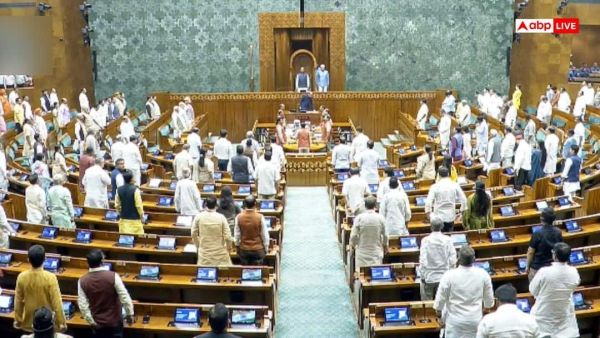
The Monsoon Session of Parliament is set to begin with significantly altered political arithmetic in both the Lok Sabha and Rajya Sabha, potentially reshaping the government's prospects on several key legislative proposals.
While the National Democratic Alliance (NDA) has strengthened its position compared to the Budget Session, it still remains short of the numbers required to comfortably pass constitutional amendment bills.
NDA's Position Improves In Lok Sabha
The NDA's strength in the Lok Sabha has increased from around 293 MPs during the Budget Session in April 2026 to 319 MPs ahead of the Monsoon Session.
With three seats, Basirhat, Shillong and Nagaon, currently vacant, the effective strength of the House stands at 540, making the two-thirds mark 360 votes.
During the Budget Session, the NDA secured 298 votes, leaving it 54 votes short of the required two-thirds majority. In the current scenario, the alliance could potentially secure 348 votes, reducing the gap to 12 votes.
Three Developments Boost NDA's Numbers
Twenty of the 28 Trinamool Congress (TMC) MPs have split from the party and joined the National Common People's Initiative (NCPI). They are currently supporting the NDA, while Speaker Om Birla is yet to decide on their merger.
Six MPs from Shiv Sena (UBT) have joined Eknath Shinde's faction, further strengthening the NDA's position.
Following the Congress' alliance with TVK in Tamil Nadu, the DMK has withdrawn from the INDIA bloc. Although the party has not joined the NDA, the BJP expects issue-based support from its 22 MPs on select legislation.
NDA's Position In Rajya Sabha
The Rajya Sabha currently has 242 members, against its sanctioned strength of 245.
The NDA has 141 MPs, along with the support of 10 nominated and independent members, taking its effective strength to 151.
While the simple majority mark is 121, a constitutional amendment requires 163 votes, leaving the NDA 11 votes short.
According to the figures, the alliance has also benefited after seven AAP MPs joined the BJP and the NDA secured 19 seats in the recent Rajya Sabha elections.
Major Bills On Government's Agenda
The government plans to move the Women's Reservation Bill (Nari Shakti Vandan Act), which was passed during the special session of Parliament in September 2023 but is yet to be implemented.
The legislation provides 33 per cent reservation for women in the Lok Sabha and state assemblies, with implementation linked to the completion of the delimitation exercise.
According to the data cited, women's voter turnout in the 2024 Lok Sabha elections stood at 65.78 per cent, slightly higher than men's 65.55 per cent.
The proposed Delimitation Bill is expected to be among the most contentious issues of the session.
The exercise aims to redraw Lok Sabha and Assembly constituencies based on population after the 2026 Census.
Southern states, including Tamil Nadu, Kerala, Karnataka, Andhra Pradesh and Telangana, have opposed the move, arguing that their success in population control could result in fewer parliamentary seats.
The government is also pursuing simultaneous elections through the 129th Constitutional Amendment Bill.
The proposal follows recommendations made by a committee headed by former President Ram Nath Kovind, which submitted its report in March 2024.
According to the report, simultaneous elections could reduce election expenditure and minimise disruptions to development work.
The proposal would require amendments to Articles 83, 85, 172, 174 and 356 of the Constitution.
The government is proposing amendments to the Foreign Contribution Regulation Act (FCRA) to tighten oversight of foreign funding received by NGOs and religious organisations.
The proposed changes could include reducing the registration period, stricter monitoring of fund utilisation and criminal action for violations.
The government says the amendments are aimed at preventing foreign interference, while critics argue they could increase scrutiny of social organisations and activists.
Another proposal before Parliament is the 130th Constitutional Amendment Bill.
The bill proposes that a Prime Minister, Chief Minister or Minister convicted in a criminal case and sentenced to imprisonment would automatically vacate office within 30 days of the commencement of the sentence.
The government is also expected to introduce the Developed India Education Foundation Bill, the Anti-Doping Bill, legislation to increase the number of Supreme Court judges, and reforms in corporate law.
Issues Opposition Plans To Raise
The opposition is expected to target the government on five major issues during the session.
Unemployment
Citing Centre for Monitoring Indian Economy (CMIE) data, the opposition is expected to raise concerns over unemployment, which stood at 8.1 per cent in May 2026, compared to 7.4 per cent a year earlier.
Inflation
The opposition is also expected to highlight rising prices.
According to the figures cited, Consumer Price Index (CPI) inflation stood at 5.1 per cent in June 2026, while food inflation was 7.4 per cent.
Petrol And Diesel Prices
The opposition is likely to question the government over rising fuel prices following the Iran-US conflict and the closure of the Strait of Hormuz.
According to the figures cited, crude oil prices have crossed $100 per barrel, resulting in an increase of ₹8-12 per litre in retail petrol and diesel prices.
NEET Paper Leak
The alleged NEET 2026 paper leak is also expected to feature prominently in Parliament, with the opposition likely to renew its demand for the resignation of the Union Education Minister while the matter remains before the Supreme Court.
Rajnath Singh Controversy
The Congress also plans to initiate breach of privilege proceedings against Defence Minister Rajnath Singh, alleging that he stated during the Lok Sabha discussion on Operation Sindoor that "no Indian soldier was martyred", despite the government later acknowledging military casualties.
Can The NDA Pass Constitutional Amendment Bills?
A constitutional amendment requires:
- A majority of the total House strength, or 272 MPs in the Lok Sabha.
- A two-thirds majority of members present and voting.
The NDA currently has 319 MPs in the Lok Sabha.
According to the present numbers, the alliance could potentially secure 346 votes with issue-based support from parties such as the DMK and backing from other regional parties. Even then, it would remain 14 votes short of the required two-thirds majority if all members participate in voting.
-
Aina Raises $5.5 Mn From Info Edge, Others To Build AI Hardware Interface

-
Avanse Financial Services Introduces Avanse EduSure & Avanse EduSure+
-
Inside Cosmos Diamonds' Bootstrapped Push Into India's Lab-Grown Jewellery Market

-
Kashmiri Dum Aloo Recipe: Make Kashmiri Pandit-style Dum Aloo without onion and tomato!

-
Silchar's Capital Point–Rangirkhari Road to Undergo Major Reconstruction