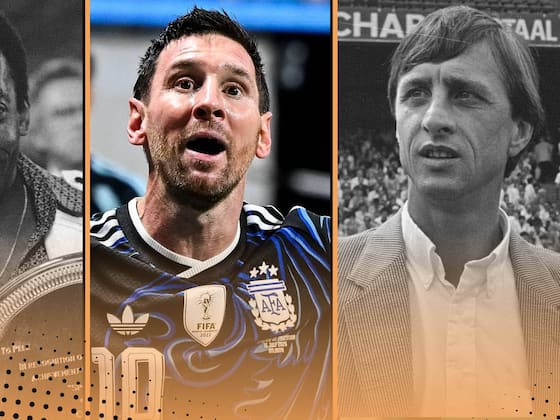
Lionel Messi continues to dazzle the football world at the age of 39, lighting up the World Cup once again. The Argentine star now has his eyes set on becoming the first back-to-back World Cup winner in decades and the oldest player ever to score in a final.
Messi’s longevity and brilliance remain unmatched. Having already netted eight goals in the current tournament, another World Cup triumph could further cement his claim as the greatest of all time – if there were ever any doubt left to settle.
To highlight just how extraordinary Messi’s achievements are at this age – even though his club football these days takes place in the MLS – here’s a look at what some of the game’s most iconic legends were doing when they reached 39.
The original ‘GOAT’, Pele, first captured the world’s imagination at just 17 during the 1958 World Cup. From there, the Brazilian forward, representing Santos and the Selecao, maintained his incredible scoring record, becoming a three-time World Cup champion.
Pele’s final professional match came in October 1977, an exhibition for the New York Cosmos, just before his 37th birthday. By the time he turned 39, he was filming the 1981 release ‘Escape to Victory’, portraying Corporal Luis Fernandez in the wartime football movie.
That same period also saw Pele lend his name to the video game ‘Pele’s Soccer’, which hit the market in 1981 when he was 40. He did, however, make a brief return to the pitch at 39 to participate – and score – in Franz Beckenbauer’s farewell match for the Cosmos, where he later served as a consultant.
Diego Maradona’s later years as a player were turbulent, but his brilliance in his prime made him one of football’s true mavericks. The Argentine legend was nearing 37 when he retired in 1997 after a final stint with Boca Juniors.
Unfortunately, Maradona’s post-retirement years were overshadowed by well-documented struggles with substance abuse. At 39, he was hospitalised following a drug overdose before undergoing rehabilitation in Cuba. In that same year, 2000, he released his first autobiography, ‘Yo Soy El Diego’ (‘I Am El Diego’).
Johan Cruyff, another all-time great, had already transitioned into management by the time he turned 39. After hanging up his boots in 1984 at 37, he returned to Ajax a year later to take over as manager. Cruyff turned 39 during his first season in charge, leading Ajax to a second-place finish behind PSV despite a remarkable +85 goal difference, averaging over 3.5 goals per match. He also guided the team to victory in both the KNVB Cup and the European Cup Winners’ Cup.
While many believe Messi’s World Cup heroics have ended the debate between him and Cristiano Ronaldo, some continue to champion the Portuguese’s case. However, Ronaldo’s own international campaign at 39 was less impactful, as he failed to score during Portugal’s run to the Euro 2024 quarter-finals.
At that time, Ronaldo was in his second season with Al-Nassr, which turned out to be his highest-scoring campaign in the Saudi Pro League to date.
Alfredo Di Stefano, meanwhile, was still playing competitively at 39. Following his birthday that summer, he embarked on his final season with Espanyol, scoring five goals in 33 appearances for a team that narrowly avoided relegation from La Liga. His international career – during which he represented three different nations but never appeared in a World Cup – had concluded four years earlier.
Ferenc Puskas had largely wound down by 39, playing only three matches after his April 1966 birthday, all in the Copa del Rey for Real Madrid, scoring once. The Hungarian legend retired at the end of that season but immediately moved into management, taking charge of Hercules. Although his first season ended in relegation, Puskas later built a respectable coaching career, most notably with Panathinaikos in the early 1970s.
The Brazilian Ronaldo, once hailed as the most naturally gifted striker ever, reached the pinnacle of his career at a young age, becoming the youngest Ballon d’Or winner in 1997. Despite his incredible early success, injuries took a heavy toll. He retired at 34 after a stint with Corinthians. Five years later, at 39, Ronaldo was focused on expanding the Ronaldo Academy, his youth football initiative, into China, the United States, and across Brazil.
Zinedine Zidane’s playing career ended memorably – or infamously – with his headbutt on Marco Materazzi in the 2006 World Cup final. Yet, his connection with Real Madrid endured. At 39, he was appointed as the club’s sporting director at the request of then-manager Jose Mourinho. The following season, Madrid captured the La Liga title in record-breaking fashion, and a year later, Zidane became assistant coach under Carlo Ancelotti.
-
Manchester United’s new recruit Cristian Orozco eager to prove himself as 18-year-old Colombian midfielder finalises long-awaited move to Old Trafford
-
Manchester United Begin Negotiations for Hugo Larsson, Seen as the Next Rodri

-
‘Diego is smiling from the heavens’ – Lionel Messi dedicates Argentina’s World Cup semi-final win to Maradona, calling it a ‘gift’ after sealing a spot in the final
-
'Nobody wants to play' – Thomas Tuchel backs England’s semi-final feat, criticises World Cup third-place match against France
-
CM Mohan Yadav To Inspect The Country's Longest Sleemanabad Water Tunnel Today In Katni District