More young Vietnamese women diagnosed with premature ovarian insufficiency
For more than a year, her menstrual cycles had become increasingly irregular before stopping altogether. At Hanoi Obstetrics and Gynecology Hospital, Dr. Dong Thu Trang ordered an ultrasound and an anti-Müllerian hormone (AMH) test, which measures the number of remaining ovarian follicles.
The results showed that both ovaries had shrunk significantly, with virtually no dominant follicles left. Her AMH level was just 0.005 ng/ml—comparable to that of a woman approaching menopause—while the normal range for women aged 20 to 30 is between 1.0 and 3.5 ng/ml. Loan also experienced frequent hot flashes, excessive sweating and unexplained irritability, all common symptoms of estrogen deficiency.
“The patient’s ovarian reserve is already critically low and will continue to decline over time,” Dr. Trang said. “Without timely intervention, her chances of conceiving with her own eggs will become increasingly limited.”
Loan said she had worked as an online livestream sales host for the past four years. She told doctors she typically slept through the day, ate only one meal daily and relied on strong coffee and tea to stay awake while working until two o’clock each morning before cleaning up and going to bed at around sunrise.
Dr. Trang said that in Loan’s case, prolonged sleep deprivation, poor nutrition and chronic stress may have accelerated hormonal decline. However, she stressed that severe diminished ovarian reserve rarely has a single cause. Genetics, underlying autoimmune diseases and other biological conditions also need to be ruled out through comprehensive medical evaluation.
“It is important to conduct a thorough assessment to identify the underlying cause rather than attributing everything solely to lifestyle,” she said.
|
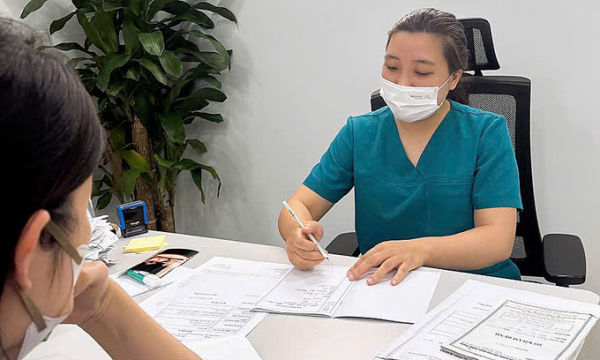
Dr. Trang examines a patient during a medical consultation. Photo courtesy of the doctor |
Another patient, Lien, 25, received a similarly devastating diagnosis just over a year after giving birth. Her reproductive health indicators had all been within normal parameters the previous year, but on noticing that her menstrual cycles had become unusually short, she went for further testing.
Doctors found almost no visible follicles on ultrasound, while her AMH level had dropped to 0.006 ng/ml, indicating that her chances of conceiving naturally had become extremely low without medical intervention.
Lien told doctors she had been raising her baby largely on her own while continuing to work, surviving on only a few hours of sleep each night. Poor nutrition and rapid weight loss followed. Within five months she lost nearly 15 kilograms and was frequently ill despite taking vitamin supplements.
Premature ovarian insufficiency (POI) has traditionally been considered a rare condition affecting women under 40, with an estimated prevalence of about 1% in the general population. In recent years, however, doctors at several major hospitals in Vietnam have reported seeing a growing number of patients in their 30s, and even their 20s, with significantly diminished ovarian reserve.
Dr. Phan Chi Thanh, deputy head of the Department of Andrology and Sexual Medicine at the National Hospital of Obstetrics and Gynecology, says the number of women seeking treatment for the condition has risen markedly compared to previous years.
However, he noted that Vietnam has yet to conduct official epidemiological studies on the condition. Part of the apparent increase may simply reflect greater public awareness of reproductive health, leading more women to undergo screening.
“We cannot yet conclude whether the actual prevalence is increasing or whether more women are simply seeking medical attention,” Dr. Thanh said. “Large-scale epidemiological studies are needed to answer that question.”
Research elsewhere also indicates a similar picture. One review study found that 9–24% of women undergoing fertility treatment, not women in the general population, had diminished ovarian reserve. The figure does not represent prevalence among all women.
Dr. Thanh said diminished ovarian reserve and premature ovarian insufficiency are caused by a complex combination of factors, including genetics, autoimmune disorders and chromosomal abnormalities. Ovarian reserve also declines naturally with age.
Unhealthy lifestyles, including excessive alcohol consumption, smoking, substance use, chronic sleep deprivation, prolonged stress and extreme weight loss, are additional risk factors.
Dr. Trang likened the ovaries to “a bank account that only allows withdrawals, never deposits.”
Unlike men, who continuously produce new sperm, women are born with a finite number of eggs that gradually diminish with each menstrual cycle.
“Once the ovaries have declined and the egg supply is depleted,” she said “there is currently no medical treatment capable of restoring them to normal function.”
She added that many young women assume their youth protects them from harm and neglect their health, unaware that the ovaries are particularly sensitive to damaging stimuli. Heavy workloads, academic pressure and the demands of urban life keep the nervous system in a constant state of stress.
Under chronic stress, the body releases hormones that can negatively affect overall health. In women, prolonged stress may disrupt hormone production, interfere with menstrual cycles, impair ovulation and reduce natural fertility.
Staying awake past 11 p.m. also significantly reduces melatonin, a powerful antioxidant that helps protect egg quality. The pursuit of an ultra-thin body shape has also driven some young women to engage in extreme dieting or take rapid weight-loss medications, both of which may harm ovarian function. Smoking, including secondhand smoke and e-cigarettes, as well as excessive alcohol and caffeine consumption are additional risk factors.
“If a patient no longer has any remaining follicles, the only option left is egg donation,” Dr. Trang said, adding that treatment plans depend on each patient’s condition and reproductive goals.
Women with premature ovarian insufficiency commonly experience absent or irregular menstruation, menstrual disorders, persistent fatigue, dizziness, nausea, insomnia, irritability, difficulty concentrating, painful intercourse and vaginal dryness. Many also experience reduced libido, avoid sexual intimacy, lose their fertility or develop urinary problems.
“Ovarian insufficiency can make the body age like that of a 60-year-old while the patient is only 30,” Dr. Thanh said. “It can also increase the risk of cardiovascular disease, bone and joint disorders, cancer and other health problems.”
In cases like Lien’s, doctors said she needs to quickly adjust her lifestyle and improve her nutrition to restore her overall health while working with fertility specialists to preserve any remaining follicles if she still hopes to have another child.
For Loan, the immediate priority is maintaining emotional stability and avoiding panic. She needs to closely follow her doctor’s hormone treatment plan to protect her overall health, reduce the risk of complications associated with early menopause and consider egg donation if she wishes to become a mother in the future.
Doctors advise young women experiencing symptoms such as irregular periods, a sudden reduction in menstrual flow or the absence of menstruation for three months or longer to seek medical evaluation promptly. Tests including AMH measurement and transvaginal ultrasound can help detect ovarian insufficiency before treatment opportunities are lost.
-
‘No talks about MLS’ – Jack Grealish’s next move revealed as Manchester City or Everton future takes shape, with England ambitions still alive

-
Marriage does not mean the end of loneliness, why is the emotional distance growing under the same roof?

-
Readers Choice: 12 Best Burger Joints Across India

-
Will Donald Trump attend FIFA World Cup Final on Sunday?

-
FIFA World Cup: When will the closing ceremony take place, who will perform? Read full details